Finding free job leads: every option compared
Updated 23 August 2026. Models and figures were checked at the source on that date.
Free job requests exist, but they cost time instead of money. There are three kinds of channels: platforms that charge you per request, platforms that charge nothing, and channels you own yourself such as your Google Business Profile and your existing customers. That last group pays off most over time and costs nothing. The fastest free start is a complete Google Business Profile, a listing on two or three free platforms, and taking part in the neighbourhood groups where you actually work.
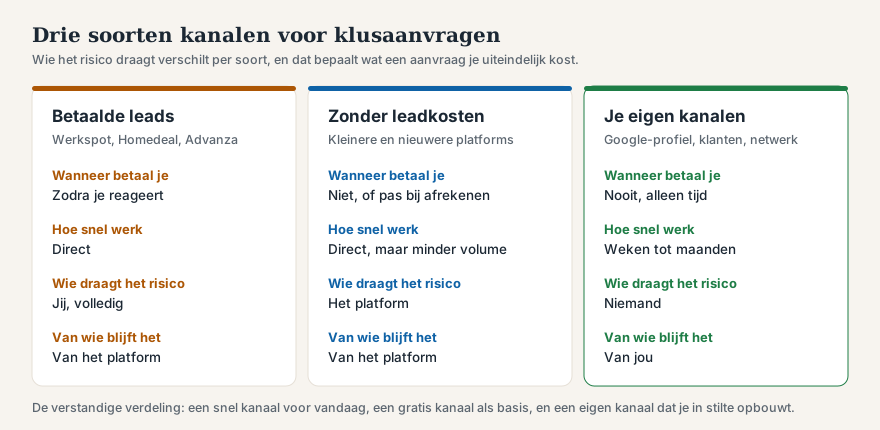
What free means on a job platform
Almost every job platform calls itself free somewhere, and usually that is true. The word simply refers to something other than you think. Free refers to creating your profile, not to getting work. The business model sits further along, at the moment a real request comes in.
There are four models in the Netherlands, and it pays to know which one you are in before you sign up.
- Lead fees. You pay per request you respond to, whether you win the job or not. Werkspot, Homedeal and Advanza work this way.
- Commission. You pay a percentage, but only once the job is finished. Zoofy works this way.
- Subscription. You pay a fixed monthly amount regardless of how much work comes out. Often combined with one of the two models above.
- No cost per request. No lead fees, no subscription. These platforms earn from something else, or not yet at all.
The four models side by side
The difference is not the size of the fee but who carries the risk. With lead fees you carry it entirely: you pay for the chance, not for the work. With commission the platform carries it with you, because without a finished job they earn nothing either.
| Model | When you pay | Who carries the risk | Examples |
|---|---|---|---|
| Lead fees | As soon as you respond to a request | You, entirely | Werkspot, Homedeal, Advanza |
| Commission | After the job is completed | Shared | Zoofy |
| Subscription | Every month, regardless | You, up front | Various, often as an add-on |
| No cost per request | Never, or only on payment | The platform | Smaller and newer platforms |
Classification based on the platform overview by trade publication Cobouw and the platforms' own information pages, checked in August 2026.
What a lead costs, and why you cannot find that anywhere
No Dutch lead platform publishes a fixed price list. That is not sloppiness but the model: the price depends on the type of job and its size, and you only see it at the request itself. Werkspot states that the exact amount depends on the precise size of the job, and that the price is fixed before you respond and does not change afterwards.
Trade publications and user accounts mention ranges of roughly four euros for a small job up to forty-five euros for a large renovation. Treat those as an order of magnitude rather than a tariff, because they do not come from the platform itself.
Something else matters more than the lead price, and that is where most businesses miscalculate.
The sum that actually matters: cost per job won
A lead is not a job. Several businesses usually respond to the same request, so you win only a share of them. The only meaningful sum is therefore not what a lead costs, but what a won job costs.
The formula is simple: lead price divided by your win rate. Win one in four and you pay for four leads for every job you land.
| Lead price | Win 1 in 2 | Win 1 in 4 | Win 1 in 6 |
|---|---|---|---|
| 10 euros | 20 euros per job | 40 euros per job | 60 euros per job |
| 25 euros | 50 euros per job | 100 euros per job | 150 euros per job |
| 45 euros | 90 euros per job | 180 euros per job | 270 euros per job |
Our own calculation: lead price divided by the win rate. Track your own win rate for a month and you know which column you are in.
Work it back to your margin, not your turnover
A hundred euros per job won sounds bearable on a six thousand euro bathroom. On a job of two hundred and fifty euros it is forty per cent of your turnover and probably all of your profit.
That is why lead platforms work well for large jobs and badly for small ones. If you mostly do small repairs, channels without a cost per request leave you the most. If you do renovations, paid leads can work out fine.
- Small jobs up to roughly five hundred euros: lead fees eat your margin. Choose free channels.
- Mid-sized jobs: work it out per job with the table above before you respond.
- Large jobs and renovations: a paid lead usually pays for itself here, provided your win rate is reasonable.
Option 1: your Google Business Profile
This is the strongest free channel there is, and most one-person businesses half-fill it or forget it. Someone searching for a trade plus their town first sees a map of businesses, and those businesses are there without paying anything.
Creating a profile is free, takes about an hour, and gives you a phone number that reaches you directly with no middleman. Anyone arriving this way has already decided they need someone.
- Complete the profile: opening hours, service area, every service you offer, and your phone number.
- Add real photos of your own work. Profiles with photos get clicked more often than profiles without.
- Ask for a review after every completed job. This is the one thing that structurally improves your position on the map.
- Reply to every review, including the mediocre ones. What people read there is how you handle problems.
- List your services separately in the profile rather than in one long sentence. That is what the map searches on.
Option 2: platforms without lead fees
There are Dutch platforms that charge nothing per request. They are smaller than the well-known names, so expect less volume, but what comes in costs you nothing. For completeness the list below also includes platforms that are not ours, because this is your decision and not ours.
The honest caveat for every small platform, ours included: fewer requests than the big names. If you need work today, combine this with the channels below.
- JouwPro. Responding is free, no lead fees and no subscription. We charge a percentage on jobs settled through us, so we only earn once you earn.
- Klussendirect. No lead fees; signing up and responding cost nothing.
- ZoekKlus. Completely free, no lead fees and no commission, but a small network.
- Klaar de Klus. Free responses to jobs in your region, with a paid premium account as an option.
Option 3: Marktplaats
Do not underestimate this. Private individuals post job requests there daily under services and trades, and responding costs nothing. It is messier than a platform and you have to search yourself, but it is real demand from real people with no middleman.
It pays to build in a fixed moment to look. Spend five minutes twice a day and you see requests before ten others have responded. Speed matters more here than the finest wording.
Option 4: Facebook neighbourhood groups
Almost every municipality has a group for local buying and selling or for the neighbourhood itself. People ask there daily whether anyone knows a good plasterer. That is a warm request: whoever asks trusts the neighbours' answer more than an advert.
There is an etiquette you have to respect, otherwise it backfires. Anyone who dumps their services in every group gets ignored or removed.
- Only respond to questions that genuinely concern your trade.
- Answer with concrete advice first and who you are second. The person who helps first gets the call.
- No price lists and no advertising in the group itself. Move it to a private message.
- Take part in the groups covering your actual working area, not thirty groups across the country.
Option 5: your existing customers
The cheapest work that exists is work from someone who already knows you. Yet this is the channel that most often lies idle, because nobody turns it into a system.
A list of your customers from the past two years and a short message each season brings in more for most businesses than a month of buying leads. It costs nothing.
- Put your customers from the past two years in a list with what you did for them and when.
- Send a short, personal message once a season that fits that season. Before the heating season, after the winter, before the holidays.
- Ask at every completed job whether they know someone who needs the same. This is the cheapest question in your entire business.
- Note down what else the customer wants done. That is your job list for next year.
Option 6: other trades next to yours
A plumber fitting a bathroom needs a tiler. A painter who finds rot needs a carpenter. Those jobs are given away or turned down daily because nobody knows who to call.
Three to five reliable names in neighbouring trades are worth more together than a monthly lead budget. It only costs time to get to know them, and it works both ways.
Option 7: suppliers, builders merchants and wholesalers
At a wholesaler's counter there are private customers all day who want something done and cannot do it themselves. Many branches have a noticeboard, or the counter keeps a list of businesses they pass on.
Just ask. It costs a conversation rather than money, and the requests that come out of it are local and concrete.
Option 8: a website that gets found locally
A website is not a business card but a channel, provided it is found on the right words. That does not mean a thousand pages, but one page per service and per place where you actually work that answers the question people type in.
This is the slowest channel on the list. Expect months before anything comes in. It is also the only channel that stays entirely yours and whose price nobody can raise.
Option 9: local visibility off the screen
Lettering on the van, a sign at a job you are working on, and sponsoring the local club still work. They are not free, but they are one-off rather than per request.
A sign in the front garden during a roof job is seen by exactly the people whose roof matches their neighbour's.
You found the request: now win it
Getting to a request is half the job. Three to five businesses usually respond to each one, and the customer rarely picks the cheapest. They pick whoever responds fastest and inspires the most confidence, because they cannot judge the quality of the work in advance anyway.
That is good news for anyone willing to put in effort: a response that takes twenty minutes beats four responses that took two.
- Respond within the hour. Speed weighs more heavily with private customers than price, and whoever answers first sets the tone.
- Mention something from the request itself. One sentence showing you actually read it sets you apart from the standard replies.
- Ask one concrete question back. That opens a conversation instead of a price comparison, and you need the information anyway.
- Be clear about what is and is not in your price. Call-out charges, materials, disposal of old materials and VAT are the four that cause arguments afterwards.
- Say when you can come. A date often matters more to the customer than fifty euros of difference.
- Add a photo of comparable work if you can. It is the only proof you can offer in advance.
- Follow up once after a few days. Not more often, and not only to ask whether they have chosen.
Where the demand sits, by type of work
Not every channel suits every trade. Emergency work and small maintenance come from different corners than renovations, and that determines where you spend your time.
- If you mostly do emergency work, being reachable is your main channel. A missed call is a missed job.
- If you mostly do large work, you can afford more time on a response, because the job is worth it.
- If you do both, separate them in your diary. Otherwise emergency work eats the time you need for quotes.
| Type of work | Where the demand comes from | What works best |
|---|---|---|
| Emergencies and breakdowns | People search Google immediately | Google Business Profile, being reachable |
| Small maintenance and repairs | The neighbourhood and word of mouth | Neighbourhood groups, existing customers |
| Gardens and outdoor work | Seasonal, local | Neighbourhood groups, a sign at the job |
| Finishing and interior work | Through other trades | Working with neighbouring trades |
| Renovations | People compare and research for a long time | Platforms, including paid leads |
Based on how these jobs arise: emergencies get searched for, large work gets compared.
Every channel side by side
No channel scores well on everything. The sensible spread is therefore one fast source for today, one free source as a base, and one channel of your own that you build up quietly.
| Channel | Cost | How fast | How much work per month |
|---|---|---|---|
| Google Business Profile | Free | Weeks | Lasting, grows |
| Platforms without lead fees | Free | Immediate | Limited volume |
| Paid lead platforms | Per request | Immediate | High volume |
| Marktplaats | Free | Immediate | Variable |
| Facebook neighbourhood groups | Free | Days | Variable, warm |
| Existing customers | Free | Days | Predictable |
| Other trades | Free | Months | Steady, grows |
| Wholesaler and counter | Free | Weeks | Small but local |
| Your own website | Hosting only | Months | Grows, stays |
| Visibility off the screen | One-off | Months | Local |
A weekly routine you can keep up
Starting everything at once is how you stop within two weeks. This routine costs about an hour a week and keeps every channel moving.
- Monday, ten minutes: check the free platforms and Marktplaats for anything new and respond to what fits.
- Wednesday, ten minutes: look in your neighbourhood groups and answer a question about your trade.
- Friday, ten minutes: ask every customer whose job you finished that week for a review on your Google profile.
- Once a month, twenty minutes: message last year's customers with something that fits the season.
- Once a quarter: call or message two people in a neighbouring trade.
What to watch out for with free channels
Free has downsides too, and you should know them in advance. Otherwise the disappointment outweighs the gain.
- Less volume. A small platform has fewer requests. That is not a fault of the platform but a consequence of its size.
- More to do yourself. On a free channel you search, respond and follow up yourself.
- Competing on speed. Whoever responds first often wins. That needs a fixed moment in your day.
- It can change. A platform charging nothing today can introduce lead fees next year. That is why a channel of your own alongside it is not a luxury.
Where JouwPro fits in
We are one of the small platforms from option 2, and we would rather write that down ourselves than have you find out later. Responding to a job costs nothing, there is no subscription and there are no lead fees. We only charge a percentage on jobs settled through us, so if you earn nothing, we earn nothing.
The honest downside: we are new and we still have few requests. So use us alongside the channels above rather than instead of them. Creating a profile takes five minutes, and after that you get a message as soon as something comes in for your trade and your region.
What are others charging in your trade?
A request is only worth something once you dare to put a price on it. We track what a job costs on average in the Netherlands per trade, built up from real quoted amounts and public sources. Use it as a benchmark: far below it and you are working yourself poor, far above it without explaining why and you lose the job to someone who does explain.
Requests in your trade, without lead fees
See what is open and respond with your own price. Responding is free, there is no subscription and there are no lead fees.
Frequently asked questions
Do job platforms without lead fees really exist?
Yes. JouwPro, Klussendirect and ZoekKlus charge nothing per request, and Klaar de Klus lets you respond for free with a paid account as an option. They are smaller than Werkspot or Homedeal, so fewer requests come in. For most businesses a combination works better than a single channel.
What does a lead cost on Werkspot?
Werkspot does not publish a fixed price list. The price depends on the type and size of the job, is shown at the request itself before you respond, and does not change afterwards. Trade publications mention amounts from roughly four euros for a small job to forty-five euros for a large renovation, but those are not official rates.
What is the difference between lead fees and commission?
With lead fees you pay as soon as you respond to a request, whether you win the job or not. With commission you pay a percentage and only after the job is completed. The difference is who carries the risk: with lead fees you do, with commission the platform carries it with you.
So what does a job I win actually cost me?
Divide the lead price by your win rate. Pay twenty-five euros per request and win one in four, and every job you win costs you a hundred euros. Track your win rate for a month, because without that figure any comparison between platforms is a guess.
What is the best free channel to start with?
Your Google Business Profile. It is free, it puts you on the map for people searching in your town, and the requests reach you directly with no middleman. It takes about an hour to complete, and after that only asking for reviews.
Are free requests worth less than paid leads?
No, where a request comes from says nothing about its quality. The temperature does differ: someone who finds you through a neighbourhood group or an existing customer has already given you some trust, whereas with a bought lead you are almost always bidding against three or four other businesses.
Can I use several platforms at once?
Yes, and almost every platform allows it. Just watch for subscriptions that keep running while you do nothing with them. On platforms without a subscription and without lead fees, an extra profile costs you nothing beyond the time to create it.
How quickly does this produce work?
Platforms without lead fees and Marktplaats can produce something the same day. Your Google Business Profile needs weeks before it really runs, and your own website months. So do not rely on a single channel, but run a fast one and a slow one at the same time.
Sources
- Cobouw: five online platforms in construction, and their biggest differences
- Werkspot helpdesk: how lead fees are calculated
- ZZP Nederland: marketplaces for freelance assignments
- Google: create and manage a Business Profile
Accessed 23 August 2026