How much does insulation cost in 2026?
Cavity wall insulation costs €15 to €30 per square metre including installation in 2026, making it the cheapest measure. Floor insulation is €25 to €55 per m² and roof insulation €30 to €115, depending on whether it is done on the inside or the outside. For an average terraced house, cavity wall insulation comes to around €1,600 to €3,200. ISDE subsidy comes off that. These are guide prices: the real price depends on the insulation value, the thickness and the state of the construction.
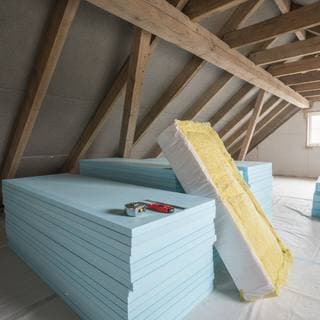
What does a insulation company cost per hour and per m2?
Guide prices per type of job. What you pay follows from the quote; the condition of the work decides most of it.
| Type of job | Guide price 2026 | What makes the difference |
|---|---|---|
| Cavity wall insulation | €15 - €30 per m² | including installation; the cheapest measure and usually done in one day |
| Floor insulation | €25 - €55 per m² | depending on whether the crawl space is accessible |
| Crawl space floor insulation | €20 - €40 per m² | |
| Attic floor insulation | €20 - €45 per m² | the cheapest way to seal off an unheated attic |
| Roof insulation on the inside | €30 - €70 per m² | |
| Roof insulation on the outside | €70 - €115 per m² | usually only worthwhile if the roof is being replaced anyway |
| Insulating a whole home | €8.000 - €15.000 total | several measures together, before subsidy |
Hourly rate
€40 - €70per hour
Call-out charge
€0 - €50
almost always included in the m² price; many companies do apply a minimum amount per order, because a small job does not cover the trip
What makes up the price?
Labour
roughly 40 to 50% of the quote, and this is the part on which 9% VAT applies
Materials
roughly 45 to 55%, stays at 21% VAT
Call-out charge
roughly 0 to 5%, usually included in the m² price
The labour for insulation work is charged at the reduced VAT rate of 9%, provided the home is more than 2 years old. The insulation material itself stays at 21%. An insulation company should list those two parts separately in the quote. The Dutch tax authority publishes the conditions that apply.
What determines the price?
- Which measure: cavity wall is the cheapest per m², roof insulation on the outside the most expensive
- The insulation value (Rd) and the thickness of the material; minimum values apply for ISDE subsidy
- Accessibility: a low or wet crawl space makes floor insulation considerably more expensive
- The state of the construction: penetrating damp or a blocked cavity must be fixed first
- Choice of material: glass wool and EPS beads are cheaper than PIR boards or natural insulation
- Whether you have several measures done at once; that is not only cheaper per m², it also doubles your ISDE amount
What will your job cost exactly?
These are indicative market prices, not a quote. Post your job for free and get replies from insulation companies near you, so you know exactly where you stand.
Post your job for freeFrequently asked questions
How much subsidy do I get on insulation?
Through the ISDE you receive a fixed amount per square metre in 2026, which differs per measure. If you have two or more measures carried out, that amount is doubled. Minimum and maximum surface areas apply. The subsidy check on this site calculates it for your own address, using the surface area from the national buildings register.
Why does one quote show 9% and 21% VAT?
Because the low rate only applies to the labour and not to the insulation material. With insulation, the material is often about half of the bill, so that difference is really noticeable. Ask for a quote in which labour and materials are listed separately; you need that split anyway for the subsidy application.
Which insulation pays for itself fastest?
Cavity wall insulation, usually within three to five years. It is the cheapest measure per square metre and immediately makes a difference in a home with an uninsulated cavity. Floor and attic floor insulation follow. Roof insulation on the outside pays for itself slowest and is usually only worthwhile if the roof needs replacing anyway.
Can cavity wall insulation cause damp problems?
Only if the cavity is not suitable for it. A good company inspects the cavity first with an endoscope and checks the width, for construction debris and for penetrating damp on the outer wall. If that is skipped, that is a reason to ask another company. Always ask for the inspection report before signing.
Should I insulate first or get a heat pump first?
Insulate first. A heat pump works most efficiently at a low flow temperature, and you only achieve that in a home that holds onto its heat. In the reverse order you buy a larger and more expensive device than necessary.
Does the reduced 9% VAT rate apply to insulation?
Yes, for the labour, and only if the home is more than 2 years old. The insulation material itself stays at 21%. With insulation that difference matters, because the material is often half the bill. Ask for a quote that separates labour from materials: you can then see whether the reduced rate was applied correctly, and you need that split for the ISDE subsidy anyway.
Where these amounts come from
The amounts on this page come from the Dutch price guides below and from the Belastingdienst, accessed on 11 August 2026. Prices go up, so check at the source before you decide anything. Spotted something that is out of date? Email info@jouwpro.nl and we will fix it.
Do you work as a insulation company yourself?
Anyone can look at the open job requests on JouwPro. Replying costs nothing and you only pay once you win a job and finish it.
See the open jobs for insulation companiesGuides that go with this one
Work that tends to come up in the same project.
All price guides for 2026