Solar panels on a rented home: is it allowed and who pays?
Sources checked on 3 October 2026
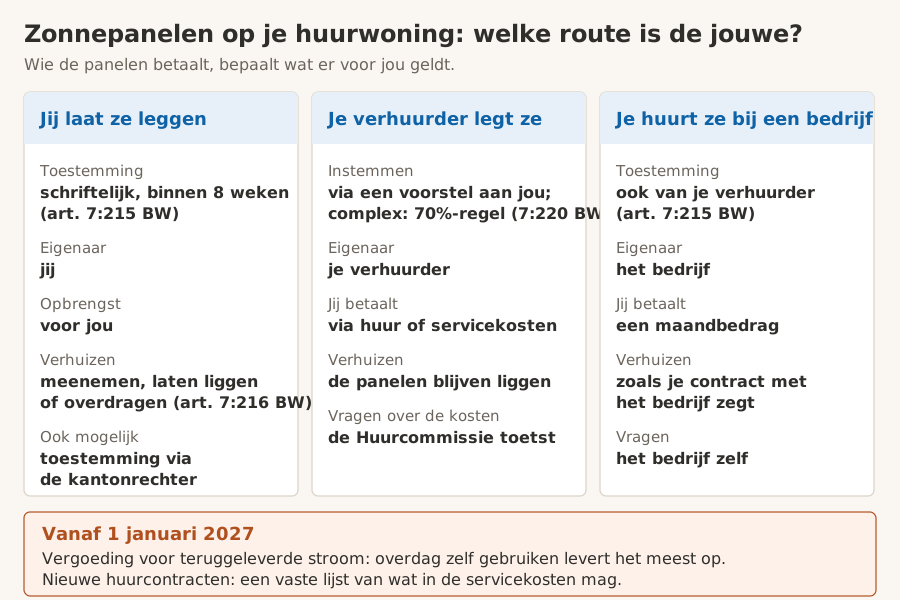
Yes, as a tenant you may have solar panels installed, with your landlord's written consent. The landlord gives it within eight weeks if the home stays just as easy to let and does not lose value (article 7:215 Dutch Civil Code). For the outside of the home your tenancy agreement may have its own terms, so check it first. The district court can also give consent. If your landlord installs the panels, you get a proposal and usually pay through the rent or service charges. From 2027 you get a payment for power fed back instead of net metering.
Rather have it done?
Post your job for free. Electricians near you respond with their own price and you choose. Your money stays safe until you approve the work.
Which situation is yours?
Almost everything depends on two things: who pays for the panels, and whether you have your own roof or one you share with other tenants. Find your situation in the table. The rest of this guide gives what the law says per question.
| Who pays for the panels? | Own roof (house) | Shared roof (flat or apartment) |
|---|---|---|
| You have them installed | Written consent from your landlord, who answers within eight weeks (art. 7:215 Civil Code). Your tenancy agreement may have its own terms for the outside. The panels are yours. | The roof belongs to the whole complex. You arrange it through your landlord, a project for the whole complex or an energy cooperative. |
| Your landlord installs them | Your landlord makes you a proposal for a rent increase or service charges. The Rent Tribunal (Huurcommissie) can review the amount (art. 7:255 and 7:260). | With ten or more homes the plan counts as reasonable if 70% agrees. If you want the plan reviewed, you ask the court within eight weeks (art. 7:220). |
| You rent them from a company | Your landlord's written consent is still needed. The company owns them; your contract with the company covers the rest. | You arrange this together with your landlord, because the roof belongs to the whole complex. |
Articles from Book 7 of the Dutch Civil Code, read on 3 October 2026. If you sign a tenancy on or after 1 January 2027, also read the section on 2027 below.
Installing solar panels on your rented home yourself: how to arrange it
A tenant may change the home with the landlord's written consent. For a rented home, the landlord gives that consent within eight weeks if the home stays just as easy to let and does not lose value (article 7:215 paragraphs 1 and 2). For the outside of the home your tenancy agreement may have its own terms (paragraph 6). Panels on a roof often fit the rule. This is how to go about it:
- Read your tenancy agreement and general terms. They state what applies to the outside, and many landlords have a standard request form.
- Check whether panels on your address need no building permit. On an ordinary roof that is usually the case, within the dimensions of the Buildings Decree. A listed building or a protected townscape has its own rules, and our permit check looks them up for your address.
- Ask for consent in writing. State how many panels, where they go, who installs them, how they are fixed and what happens when you move. The more concrete, the easier it is for your landlord to say yes.
- Your landlord answers within eight weeks. A clear plan with a certified installer already answers most questions.
- Put the agreements on paper: who maintains the panels, who insures them and what happens when you leave.
- Have the panels installed by a certified installer and keep the work order. It shows later how and by whom they were installed.
- Tell your contents insurer about the panels. Many policies cover what a tenant added under 'tenant's interest'.
Consent through the district court
The district court can also give you consent to install the panels (article 7:215 paragraph 3). It does so in any case if your plan meets what is described above: the home stays easy to let and does not lose value. It can also say yes because the panels improve your living comfort, as long as there are no serious objections for your landlord (paragraph 4). It can add arrangements, for example about removal when you leave (paragraph 5). For this consent the district court is the place; the Rent Tribunal deals with rents and service charges.
Live in a flat and want panels on the shared roof? That roof belongs to the whole complex, the District Court of The Hague ruled in 2014. In a flat you get furthest with a proposal to your landlord or the tenants' committee for the whole complex.
How to make your request strong: show that a certified installer fits the panels, how they are fixed to the roof, what happens to them when you leave and that you insure them.
Solar panels on a flat or apartment
With a shared roof you have three routes. Your landlord puts panels on the whole complex and shares the power or the yield. You join an energy cooperative that puts panels on another roof nearby. Or you choose a balcony panel.
A balcony panel hangs on your balcony railing and plugs into a socket. A panel you can remove at no significant cost when you leave may by law be placed without consent (article 7:215 paragraph 1). For the outside your tenancy agreement may have its own terms, so check it or let your landlord know you are putting it up. Fix the panel firmly to the railing.
Your landlord's panels: how agreeing works
For your own home your landlord makes you a written proposal, and usually you arrange it together. If you say no, the landlord can ask the court whether the proposal is reasonable (article 7:220). If the landlord asks rent for the panels, the increase is in reasonable proportion to what they cost. The Rent Tribunal can decide on the amount; you or your landlord ask within three months (article 7:255). In the free rental sector this article does not apply and you agree the increase together.
For a complex of ten or more homes a renovation proposal counts as reasonable if 70% or more of the tenants agree. Anyone who did not agree and wants the proposal reviewed asks the court within eight weeks of the landlord's letter (article 7:220 paragraph 3). If no request is made in those eight weeks, the plan applies to everyone in the complex. The district court in Central Netherlands ruled so in 2024 on a maintenance and insulation plan that more than 70% agreed to.
Received such a proposal? Look at how the panels are paid for and whether your contribution moves with what they yield. Talk it over with the tenants' committee.
Service charges or rent: how your panels are paid for
If your landlord installs panels, you pay in one of three ways: as higher rent, as service charges or as an energy performance fee. Service charges are settled separately each year, can be reviewed by the Rent Tribunal if there is a difference and are easier to lower. A rent increase becomes part of your rent and rises each year with the yearly adjustment. The tenants' union Woonbond therefore recommends service charges.
Courts look at how the panels are attached. The Amsterdam Court of Appeal ruled in 2018 that panels built into the design of a zero-energy home belong to the home and so are in the rent, without a separate monthly fee. Separate panels on an ordinary home may be in the service charges, at a reasonable price, the District Court of Northern Netherlands ruled in 2025.
An energy performance fee is only possible for a very efficient home that meets strict requirements. Ordinary panels on an ordinary home do not qualify.
| Higher rent | Service charges | Energy performance fee | |
|---|---|---|---|
| When | The landlord improves the home and you agree an increase | The panels are a separate facility you agree on this way | Only for a very efficient home (Energy Performance Fee Decree) |
| Can it go down? | Becomes part of your rent and rises with the yearly adjustment | Yes, by agreement; preferably record when the contribution goes down | Yes, if the promised output is not reached |
| Who reviews? | Rent Tribunal, within three months of installation (art. 7:255), not for free-sector rent | Rent Tribunal (art. 7:260) | Rent Tribunal (art. 7:261a), not for free-sector rent |
| When you move | Stays with the home | Ends with your tenancy | Ends with your tenancy |
Based on Book 7 of the Civil Code and the Energy Performance Fee Decree, read on 3 October 2026.
What changes on 1 January 2027?
From 1 January 2027 feeding back works differently. Instead of net metering you get a payment from your energy supplier for the power you feed back. The more power you use yourself while the sun shines, the more your panels yield: running the washing machine and dishwasher during the day already helps.
On the same day the Service Charges Modernisation Act takes effect. For tenancies signed on or after 1 January 2027, a fixed list applies of costs allowed in the service charges. Panels are not named separately on that list; separate panels can fall under 'movable items in, on or attached to the home'. Signing a new tenancy from 2027 for a home with panels? Ask how they are paid for: in the rent or in the service charges. If you already have a tenancy, your agreements simply continue.
Paying a contribution for your landlord's panels now? These are good questions to ask:
- Is the contribution in the rent or in the service charges?
- Does the contribution move with what the panels yield after 2027?
- Are the panels on your meter and your energy contract?
- How much power do you use during the day? That determines your benefit.
Who gets the yield from the panels?
Whoever pays, shares. If you bought the panels yourself, the yield is all yours: your power bill drops and the payment for power fed back goes to your own energy contract.
If your landlord installed them and they are on your meter, you see the benefit directly in your bill, because you buy less power. Against that stands the contribution you pay your landlord. If the panels are on the shared meter of the complex and the landlord pays for them entirely, the payment for power fed back goes to the landlord. The district court in Haarlem ruled so in February 2026.
The District Court of Rotterdam decided in 2022 that a landlord who bought panels did not have to deduct the feed-in payment from the service charges. The tenant got her power through the landlord and paid for what she used. So what your agreement says determines who gets what.
Moving out: take them, leave them or hand them over?
Panels you had installed yourself may go with you when you leave, if you return the roof neatly to its original state. You do not have to remove them if your landlord gave consent, unless you agreed otherwise when consent was given or the court ordered it. And if you leave them, you can claim compensation for the value left behind (article 7:216).
You can also hand the panels over to the next tenant. Agree that together with the landlord, so it is clear who maintains them afterwards.
Your landlord's panels simply stay. You do not need to do anything with them at the handover. Read more in our guide on handing over a rented home.
Insurance and roof leaks: who arranges what?
The roof and the home are usually covered by your landlord's buildings insurance. Panels you had installed, you insure yourself through your contents insurance, often under 'tenant's interest'. Call your insurer to have it recorded.
If the roof leaks from age or wear, that is a defect your landlord repairs (articles 7:204 and 7:206). If a leak starts at the fixing of panels you had installed, you arrange it with your installer. With a work order and a report to your insurer it is immediately clear who does what.
| What happens | Who arranges it | Why |
|---|---|---|
| The roof leaks from age or wear | Your landlord | The landlord repairs defects in the home (art. 7:206) |
| Leak at the fixing of your own panels | You, with your installer | You are responsible for work you had done (art. 7:218 and 7:219); the work order shows who installed them |
| Storm or hail damages your own panels | You, through your contents insurance | The panels are yours, often insured as tenant's interest |
| Your landlord's panels break | Your landlord | The landlord owns them and repairs defects (art. 7:206) |
General rule from Book 7 of the Civil Code. What you put on paper with your landlord takes precedence.
Having solar panels installed or removed
Got consent? Then find an installer who fits the panels, connects them to your fuse box and gives you a work order. Moving and taking the panels with you? Then you need someone who removes them neatly and seals the roof again.
On JouwPro you post the job for free. Professionals near you send their own price, and you choose who to continue with.
Done reading?
Describe the job in two minutes. Electricians respond with their price, you compare and choose. Free, with no strings attached.
Post your job for freeFrequently asked questions
May I install solar panels on my rented home myself?
Yes, with your landlord's written consent. The landlord gives it within eight weeks if the home stays just as easy to let and does not lose value (article 7:215 Dutch Civil Code). For the outside your tenancy agreement may have its own terms, so read it first. The district court can also give you consent.
Can I refuse solar panels on my rented home?
Your landlord installs panels in consultation with you, based on a written proposal. If you say no, the landlord can ask the court whether the proposal is reasonable. In a complex of ten or more homes the proposal counts as reasonable if 70% or more agree; if you want it reviewed, you ask the court within eight weeks (article 7:220).
Can a housing association make solar panels compulsory?
For a whole complex it can through a renovation plan, if 70% or more of the tenants agree. Anyone who did not agree can have the plan reviewed by the court within eight weeks of the association's letter. For a single home the association makes you a proposal, and if you disagree the court decides whether it is reasonable.
Who gets the yield from solar panels on a rented home?
Whoever pays, shares. If the panels are yours, the yield is yours. If your landlord installed them and they are on your meter, your power bill drops and you usually pay a contribution to your landlord. If they are on the shared meter and the landlord pays for them, the feed-in payment is the landlord's (district court Haarlem, 2026).
May a landlord pass the cost of solar panels on to the tenant?
Yes, if you agree: through a rent increase in proportion to the costs (article 7:255) or through the service charges (article 7:259). The Rent Tribunal can review the amount, for free-sector rent only the service charges. If the panels are part of the design of the home, according to the Amsterdam Court of Appeal it belongs in the rent.
What are the consequences for tenants with solar panels in 2027?
From 1 January 2027 you get a payment for power fed back instead of net metering, and the panels yield most if you use the power yourself during the day. Tenancies signed from that date also get a fixed list of service charges. Ask your landlord whether your contribution can move with it.
Do I pay feed-in costs with solar panels on my social rented home?
Feed-in costs belong to your energy contract; your landlord does not charge them. If the panels are on your meter, choose a supplier with low feed-in costs and use as much power as possible yourself during the day.
What should you look at with rented solar panels?
Check whether the contribution is in the rent or the service charges, whether it moves with what the panels yield, and whether the panels are on your meter. Service charges are easier to lower; a rent increase becomes part of your rent. With those three answers you know what you get.
What happens to my solar panels when I move?
If they are yours, you take them and return the roof to its original state, or you leave them. If your landlord gave consent, you may leave them unless you agreed otherwise at the time, and you can claim compensation (article 7:216). Your landlord's panels stay.
Do I need a permit for solar panels on my rented house?
Usually not. Panels on a roof need no permit within the dimensions of the Buildings Decree. A listed building or a protected townscape has its own rules; our permit check looks it up for your address. You also ask your landlord for consent.
Sources
Every claim on this page comes from one of these sources. They were checked on 3 October 2026. Legislation changes, so check the source itself if anything matters to you.
- Dutch Civil Code Book 7, articles 204, 206, 215, 216, 218, 219, 220, 247, 255, 259, 260 and 261a
- Service Charges Modernisation Act, Bulletin of Acts 2025, 156 (with transitional law, art. 208ga)
- Decree of 11 March 2026 amending the Service Charges Decree, Bulletin of Acts 2026, 70
- Volkshuisvesting Nederland, Service Charges Modernisation Act
- Energy Performance Fee (Rent) Decree
- Government of the Netherlands, net metering ends on 1 January 2027
- IPLO, solar panels on a roof (permit-free building)
- Milieu Centraal, solar panels on a rented home
- Woonbond, solar panels on a rented home
- Dutch Tax Administration, letting homes with solar panels
- District Court of The Hague 24 December 2014, panels on the roof of a gallery flat (ECLI:NL:RBDHA:2014:16078)
- Amsterdam Court of Appeal 26 June 2018, panels as part of a zero-energy home (ECLI:NL:GHAMS:2018:2113)
- District Court of Northern Netherlands 4 March 2025, panels in the service charges (ECLI:NL:RBNNE:2025:1618)
- District Court of Rotterdam 22 April 2022, feed-in payment and service charges (ECLI:NL:RBROT:2022:12088)
- District Court of North Holland (Haarlem) 11 February 2026, panels on the shared meter (ECLI:NL:RBNHO:2026:435)
- District Court of Central Netherlands 23 October 2024, maintenance and insulation plan and the 70% rule (ECLI:NL:RBMNE:2024:5951)
Tools for your own address
Three things you can check here for free that you will not find like this anywhere else. They run on open data from the Dutch Land Registry, the buildings register and the national energy agency, so the answer applies to your house and not to an average.
This is not legal advice
We set out what the rules say and where they are. Your situation may differ, and in a dispute your own contract, your deed of division or your local council's bylaw takes precedence. If you cannot work it out, Het Juridisch Loket, the Huurcommissie or a lawyer can help.