Felling a tree without a permit: how to know if you may
Sources checked on 1 October 2026
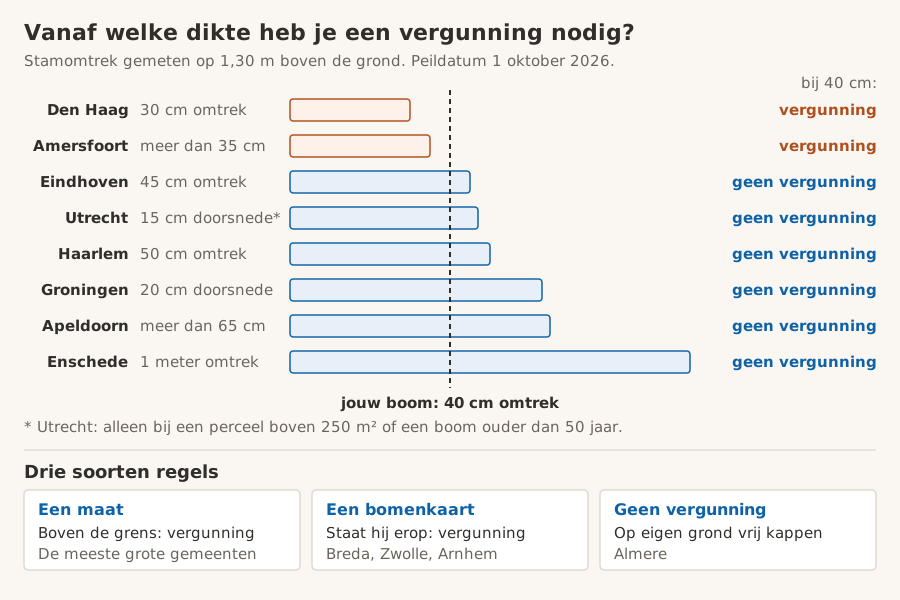
For a tree in your garden there is no national rule: your municipality decides in its environmental plan. Usually you need a permit once the trunk at 1.30 metres is thicker than a set size. In The Hague that is 30 cm circumference, in Enschede 1 metre. Other municipalities use a tree map, and in Almere you may fell on your own land without a permit. Check your address in the permit check of the Omgevingsloket, and wait if there is a nest in use.
Rather have it done?
Post your job for free. Gardeners near you respond with their own price and you choose. Your money stays safe until you approve the work.
May I fell my tree? Four questions in order
Go through these four questions before you pick up the saw. At the first question where the answer is yes, you know what to do.
- Is the tree in a wood or a row outside the built-up area? If it is more than 10 ares (1,000 m²) or a row of more than twenty trees, national rules apply: you notify the province in advance and replant within three years. A tree in a garden or yard does not fall under this.
- What does your municipality's environmental plan say? Enter your address in the permit check of the Omgevingsloket, or search the municipality's website for 'boom kappen'. That shows the limit, or the tree map your municipality uses.
- Is the trunk thicker than that limit, or is the tree on the map? Then you apply for a permit. How to measure is below.
- Is there a nest in use? Then you wait, even if you need no permit or already have one. Disturbing a nest is always prohibited.
How to measure the thickness of your tree
Almost every municipality measures at the same spot: 1.30 metres above the ground. There the trunk is usually above the root flare and below the first branches.
Check what your municipality asks for. Most use the circumference, the length of a tape around the trunk. Utrecht and Groningen use the diameter, straight through the trunk. Converting is simple: circumference is diameter times 3.14. A diameter of 15 cm is just over 47 cm circumference.
- Mark the trunk at 1.30 metres above the ground.
- Wrap a tape measure or a piece of string tightly around the trunk at that height.
- If the tree has several trunks, measure the thickest. That is how Eindhoven, Groningen and Apeldoorn count, among others.
- Take a photo with the tape in it. You need it when you apply for a permit, and it is your proof if you did not need one.
The rule in twelve municipalities side by side
We read every rule below on the municipality's own page. The difference is large: a tree of 40 cm circumference may be felled without a permit in Eindhoven but not in The Hague.
Is your municipality not listed, or are you unsure? Then the permit check of the Omgevingsloket decides for your address. Municipalities change their rules regularly.
| Municipality | Permit needed if | Note | Fees 2026 |
|---|---|---|---|
| The Hague | Circumference 30 cm or more | Small back garden (under 50 m²) and not visible from the street: only from 90 cm. Between 15 March and 15 July a permit may not be used | See municipality |
| Amersfoort | Circumference more than 35 cm | Applies to all species | Free |
| Eindhoven | Circumference 45 cm or more | Also for pruning more than 30% of the crown and for transplanting | 127 euros (green and orange reason) |
| Utrecht | Diameter 15 cm or more, and plot over 250 m² or tree older than 50 years | Pruning up to 40% of the crown needs no permit | 735 euros for 1 to 5 trees |
| Haarlem | Circumference 50 cm or more | Plot under 100 m² and not visible from the street: no permit. Pruning more than 20% does need one | 150 euros per tree |
| Groningen | Diameter 20 cm or more | With several trunks the thickest counts | 96.62 euros, then 72.97 per tree |
| Apeldoorn | Circumference more than 65 cm | Also for a dead tree, and always for a replacement or special tree | 43.07 to 77.27 euros |
| Enschede | Circumference 1 metre or more, or the tree is on the tree map | On important avenues and in three neighbourhoods with few trees from 50 cm | 181.35 euros for one tree |
| Breda | The tree is on the tree map | Not on the map: no permit | See municipality |
| Zwolle | The tree is in the green structure (Groene Kaart) or is special | Plot smaller than 400 m²: no permit | See municipality |
| Arnhem | Valuable tree in a protected area (map) | Also for heavy pruning | 174.05 euros per tree |
| Almere | No permit on your own land | Do talk to your neighbours | None |
Circumference and diameter measured at 1.30 metres above the ground. Read on the municipal pages on 1 October 2026, sources below.
Three kinds of rules, and why thickness does not always count
Most large municipalities use a size. If the trunk is thicker than the limit, you need a permit. Thinner, you may fell it yourself.
Some municipalities use a map. In Breda the tree map shows whether you need a permit; if your tree is not on it, you are free. Zwolle and Arnhem only protect trees in a designated area. There the question of how thick your tree is, is the wrong one: you look up your address on the map.
And a few municipalities ask for no permit at all on your own land, such as Almere. Neighbour law and the rule about nests still apply.
Why your municipality decides this and not the state
Since the Environment and Planning Act took effect on 1 January 2024, your municipality's felling rules are in its environmental plan, sometimes still in a separate tree bylaw. What used to be called the felling permit is now an environmental permit for felling a stand of trees. Everyone still calls it a kapvergunning.
The state only regulates woods and rows of trees outside the built-up area. The Environmental Activities Decree expressly excludes trees in yards and gardens, as well as trees grown for fruit or nuts (article 11.111). For your garden tree you only look at the municipality.
The municipality also sets the felling boundary in its environmental plan: the line within which its own rules apply. If you live in a village or the countryside, which side of that line your garden is on can matter.
Special trees: dead, fruit, monumental
Felling a dead tree is still felling. Apeldoorn says so in as many words: above the limit you also need a permit for a dead tree. If a tree is acutely dangerous, call the municipality. Many have a fast route for that.
A fruit tree in your garden simply falls under your municipality's rule. Only trees grown commercially for fruit or nuts fall outside the national rules, and some municipalities exempt them too. Check the table or the permit check.
A monumental or valuable tree almost always needs a permit, even if it is thinner than the usual limit. The same goes for a tree you were previously required to replant.
Shade, falling leaves or a tree blocking your solar panels are usually not a reason in themselves to get a permit. Poor tree health is, and Utrecht for example then asks for a report from a certified arborist.
Breeding season: when you have to wait
It is prohibited to intentionally destroy, damage or remove birds' nests (Environmental Activities Decree, article 11.37). That applies to everyone, with or without a permit.
The law sets no fixed period. According to Vogelbescherming most birds breed from mid March to mid July, which is why many municipalities use 15 March to 15 July. The Hague even prohibits using a granted permit in those weeks.
Some nests are protected all year, such as those of the house sparrow, the swift, the little owl and birds of prey. So always look carefully into the crown first. Felling in autumn or winter avoids most of this.
Felled without a permit: what happens and how to put it right?
It usually starts with putting it right. The municipality imposes a duty to replant: you plant a new tree, often with a deadline. If you do not, an order subject to a penalty follows. Laren's enforcement policy names 1,500 euros per felled tree per week, for up to six weeks. Eindhoven can also ask for a contribution to a tree fund and recover the cost of a valuation.
In addition, felling without a permit where the environmental plan requires one is an economic offence. The law sets a maximum fine of the fourth category, 27,500 euros as of 1 January 2026, or detention of up to six months. If done intentionally it is a crime, with up to two years in prison (Economic Offences Act, article 6). These are maximums for the court, not a fixed fine.
A fixed fine of, say, 750 euros, as many sites state, we could not find in any law or municipal rule. What the municipality asks first in practice is a new tree in the same spot.
Already felled and not sure it was allowed? Check the permit check of the Omgevingsloket anyway. If you needed no permit, there is nothing to arrange; the photo with the tape shows your tree was under the limit. If you did need one, contact the municipality yourself and offer to plant a new tree. A gardener or arborist can help you pick a good tree for the spot.
What does a felling permit cost, and what does felling cost?
Fees differ between municipalities even more than the limit itself. Amersfoort charges nothing, Groningen 96.62 euros for the first tree, Haarlem 150 euros per tree and Utrecht 735 euros for one to five trees. See the table above for the rest.
Felling itself costs, according to price overviews from hovenier.nl and Homedeal, roughly 375 to 500 euros for a small tree of 4 to 6 metres, 550 to 700 euros for a medium one and 750 to 1,000 euros or more for a large tree. Grinding out the stump is 100 to 350 euros extra. A tree against a house, over a shed or near cables costs more, because it has to come down in pieces.
How long does a felling permit take?
Usually the municipality decides within eight weeks, and may extend that once by six weeks. Then there is an objection period of six weeks in which neighbours or others can object. In Utrecht, Amersfoort and Groningen you wait out that period before felling.
Want to fell in autumn or winter, outside the breeding season? Then apply in summer.
Felling trees outside the built-up area
If you have a piece of woodland or a long row of trees outside the felling boundary, national rules apply. For more than 10 ares or a row of more than twenty trees, you notify the province at least four weeks in advance, and no earlier than a year in advance. Within three years you replant on the same land (Environmental Activities Decree, articles 11.126 and 11.129).
If the municipality also has an environmental plan rule for that spot, you may need a permit in addition to the notification.
Fell it yourself or hire an arborist?
A birch or conifer of a few metres standing in the open you can take down yourself with a good saw. Make sure there is falling space of at least the tree's height, and work with two people.
Is the tree close to your house, a shed, the neighbours' fence or a power cable, or taller than you can safely oversee? Then have it done by an arborist who works with ropes and lowers the tree in pieces. They also take away the wood and the stump, and know how to apply for a permit if needed.
Done reading?
Describe the job in two minutes. Gardeners respond with their price, you compare and choose. Free, with no strings attached.
Post your job for freeFrequently asked questions
May I fell a tree in my own garden without a permit?
That depends on your municipality. If the trunk is thinner than the limit in the environmental plan and the tree is not on a tree map, you may. In Almere you never need a permit on your own land, in The Hague from 30 cm circumference. The permit check of the Omgevingsloket gives the answer for your address.
How thick may a tree be without a felling permit?
There is no national size. In the municipalities we checked it runs from 30 cm circumference (The Hague) to 1 metre (Enschede), measured at 1.30 metres above the ground. Utrecht and Groningen measure the diameter: 15 and 20 cm. Circumference is diameter times 3.14.
What is the fine for felling a tree without a permit?
Usually you first get a duty to replant, with a penalty payment if you do not. On top of that it is an economic offence: the law sets a maximum fine of 27,500 euros (fourth category, 2026) or detention of up to six months. That is a maximum for the court, not a fixed amount.
May I fell a tree during the breeding season?
Only if there is no nest in use. Disturbing nests is always prohibited, even with a permit. Many municipalities use 15 March to 15 July, and The Hague does not allow felling with a granted permit in that period. Felling in autumn or winter is safest.
Do I need a permit to fell a fruit tree?
A fruit tree in your garden falls under the same rule as any other tree in your municipality. Only trees grown commercially for fruit or nuts fall outside the national rules. Check the table or the permit check for what your municipality says.
May I fell a dead tree without a permit?
Not always. In Apeldoorn you also need a permit for a dead tree above the limit. If the tree is dangerous, call the municipality: there is often a fast route for acute danger. Take photos of the tree's condition before it is gone.
What does a felling permit cost?
It varies a lot. Amersfoort charges nothing, Groningen 96.62 euros for the first tree, Haarlem 150 euros per tree, Arnhem 174.05 euros per tree and Utrecht 735 euros for one to five trees (2026 fees).
What if the tree belongs to the neighbours or stands on the boundary?
You may not fell the neighbours' tree. You may ask the neighbours to remove overhanging branches. If they do not do so within a reasonable time, you may remove them yourself. If the tree is on the boundary, it belongs to both of you and you decide together. By law a tree must stand at least 2 metres from the boundary, unless your municipality rules otherwise.
Sources
Every claim on this page comes from one of these sources. They were checked on 1 October 2026. Legislation changes, so check the source itself if anything matters to you.
- Environmental Activities Decree (Bal), article 11.111 (gardens and yards outside national rules), 11.126 and 11.129 (notification and replanting) and 11.37 (nests), current text
- Economic Offences Act (Wed), articles 1a and 6 (penalties)
- Dutch Criminal Code, article 23 (fine categories as of 1 January 2026)
- Dutch Civil Code Book 5, article 5:42 (trees 2 metres from the boundary)
- IPLO, national rules on felling and replanting
- Vogelbescherming Nederland, birds and the law: the breeding season
- Municipality of Laren, tree felling enforcement policy
- Municipality of Eindhoven, Tree Bylaw 2026
- Municipality of The Hague, felling a tree
- Municipality of Amersfoort, felling a tree
- Municipality of Utrecht, felling a tree
- Municipality of Haarlem, felling a tree
- Municipality of Groningen, felling a tree
- Municipality of Apeldoorn, felling a tree
- Municipality of Enschede, felling a tree
- Municipality of Breda, felling a tree
- Municipality of Zwolle, felling a tree
- Municipality of Arnhem, felling a tree
- Municipality of Almere, felling a tree
- Hovenier.nl, cost of felling a tree
- Homedeal, tree felling prices
Tools for your own address
Three things you can check here for free that you will not find like this anywhere else. They run on open data from the Dutch Land Registry, the buildings register and the national energy agency, so the answer applies to your house and not to an average.
This is not legal advice
We set out what the rules say and where they are. Your situation may differ, and in a dispute your own contract, your deed of division or your local council's bylaw takes precedence. If you cannot work it out, Het Juridisch Loket, the Huurcommissie or a lawyer can help.