Handing back a rental home: what is yours and what is the landlord's?
Sources checked on 27 September 2026
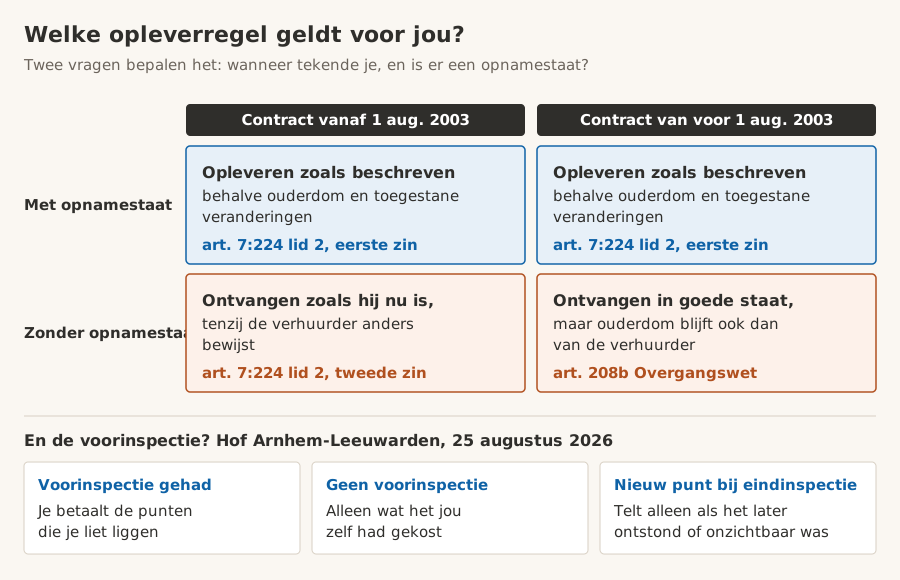
You hand the home back as you received it, but what wore out through age and what you were allowed to change does not need repairing (article 7:224 Dutch Civil Code). If no condition report was made at the start, the home counts as received as it is now. For contracts from before 1 August 2003 the reverse applies: received in good condition. After a pre-inspection you only pay for the items listed there that you left undone.
Rather have it done?
Post your job for free. Painters near you respond with their own price and you choose. Your money stays safe until you approve the work.
Which rule applies to you? Three questions
Almost every dispute at handover comes down to three questions. Answer them for your own situation and you know which rule applies, before the landlord even arrives.
- When did you sign the lease? From 1 August 2003 the current article 7:224 applies in full. Before that, the old rule applies when there is no condition report (article 208b of the Transitional Act for the new Civil Code).
- Was a condition report or description made at the start? Then you hand back according to that description. If not, question 1 decides what the law assumes about how you received the home.
- Was there a pre-inspection? Then you know exactly which items the landlord expects, and you only pay for what you left undone. No pre-inspection? Then the landlord can only claim what it would have cost you to fix it yourself.
What belongs to whom at handover
This is the lookup table. Find your item, check whether it is wear or damage, and you see who fixes it and which article that rests on.
Mind the difference between the columns. Wear through age is the landlord's, even if the home looks less fresh than at the start. Damage that occurred during the tenancy is the tenant's, and the law presumes damage inside was caused by the tenant, except fire damage.
| Item | Wear or damage | Who fixes it | Basis |
|---|---|---|---|
| Carpet that became thin or faded over the years | Wear through age | Landlord | Art. 7:224(2) DCC |
| Burn mark or tear in the floor | Damage | Tenant | Art. 7:218 DCC |
| Kitchen or bathroom worn out after decades | Age | Landlord | Art. 7:224(2) DCC |
| Holes from plugs and screws | Minor repair | Tenant | Minor Repairs Decree |
| Whitewashing walls, painting indoor woodwork | Minor repair | Tenant | Minor Repairs Decree |
| Tap washers, door handles, keys | Minor repair | Tenant | Minor Repairs Decree |
| Garden: lawn, weeds, hedge, dead plants | Minor repair | Tenant | Minor Repairs Decree |
| Laminate or cupboard you fitted without permission | Change | Tenant removes it | Art. 7:215 and 7:216 DCC |
| Renovation you had permission for | Permitted change | May stay | Art. 7:216(2) DCC |
| Damp patch from a leaking roof | Defect in the building | Landlord | Art. 7:206 DCC |
| Damage to the outside of the building | No presumption against the tenant | Landlord, unless he proves fault | Art. 7:218(2) DCC |
| Belongings and dirt left behind | Not handed back | Tenant | Art. 7:224(1) DCC |
Wear or damage: where is the line?
The law does not use the word wear. Article 7:224(2) says you hand back the home in the state in which you received it according to the description, except permitted changes and what perished or was damaged through age. Courts translate that as normal wear: what happens by itself through ordinary living.
Damage is something else. Article 7:218 makes the tenant liable for damage caused by failing to meet his obligations, and presumes all damage arose that way. Two exceptions: fire damage and damage to the outside of the building. There the landlord has to show it was your fault.
In practice the question is always: would this also have happened with a careful tenant? A worn path in the carpet yes, a burn hole no. A yellowed wall yes, a hole from a ripped-out shelf no.
A lease may not deviate from this rule to your disadvantage (article 7:242(2)). If it says you must always hand back as new, wear through age still stays outside your bill.
Handing back a rental after 30, 40 or 50 years
Anyone who has lived in a home for thirty years or more almost always signed before 1 August 2003. For those contracts a transitional rule applies: without a condition report you are not presumed to have received the home as it is now, but in good condition (article 208b of the Transitional Act, with the old article 7A:1599). That sounds unfavourable, and that is where most sites stop.
The important part comes next. Under the old rule too, what wore out through age is not for the tenant. A kitchen, bathroom, floor or door that is thirty years old is worn out through age, so you do not have to replace it. You hand back as it should be after all those years of ordinary living: clean, empty, without damage you caused, and with the minor repairs done.
If something does need replacing because you damaged it, its age counts. The Arnhem-Leeuwarden court of appeal applied depreciation in August 2026: for built-in appliances eight years old, with a lifespan of about fifteen years, the compensation was roughly halved. So you never pay for a new kitchen in place of an old one.
Many housing associations also have their own, more generous rules for long-term tenants. Always ask about them at the pre-inspection; what the association promises applies alongside the law.
Changes you made: do they have to go?
That depends on two things: did you have permission, and is it easy to remove? Changes you could make without permission because they are easy to remove, or that you got permission for, are permitted changes (article 7:215).
You do not have to undo permitted changes when you leave (article 7:216(2)), unless that was made a condition of the permission. If they stay behind, you can sometimes claim compensation for the value the landlord gains (article 7:216(3)).
Changes made without permission that cannot easily be removed have to go. You may always remove them, as long as you bring the home back to a state that reasonably matches the original (article 7:216(1)). Many housing associations call this ZAV, self-installed facilities, and sometimes let the next tenant take them over. Ask before you tear anything out.
Minor repairs were already yours
Everything that counted as a minor repair during the tenancy should simply be done at handover. Think of whitewashing, filling holes, tap washers, hinges, bulbs and ordinary garden upkeep. The full list per part of the home is in our guide to the Minor Repairs Decree.
Bigger work that is not on that list, such as exterior painting, the boiler or a leaking roof, is and remains the landlord's, at handover too.
The pre-inspection: what it should contain
The pre-inspection exists to give you clarity. The Arnhem-Leeuwarden court of appeal put it this way in August 2026: the tenant must know what is expected and get the chance to fix it himself, because that is cheaper than the landlord hiring a company.
A good pre-inspection report lists per item what needs doing. Ask for it if it is missing, and take your own dated photos of every room.
- Per room which items you have to repair or remove.
- Which changes may stay and which must go.
- Whether the next tenant takes anything over, such as a floor or curtains.
- The date and time of the final inspection.
- If you disagree with an item, say so straight away and in writing, before the final inspection. The court gave a signature under the report real weight.
No pre-inspection?
Then the landlord cannot simply pass on every cost he makes after you leave. According to the court you are then only liable for defects you should have understood you had to fix, and as a rule only for what it would have cost you to fix them. Not for the bill of a company the landlord hires later.
That has been settled law since the Supreme Court ruled on it in 1998. One practical note: if the landlord did offer a pre-inspection and you let it pass, that counts against you. The 's-Hertogenbosch court of appeal in 2021 awarded the repair costs against a tenant who skipped the pre-inspection and missed the final inspection. So always attend, even when it is inconvenient.
Final inspection: new items and not agreeing
At the final inspection the landlord walks through the home once more, usually on the day you hand in the keys. He checks whether the items from the pre-inspection were dealt with.
Do new items turn up? They only count if the landlord makes it plausible that they arose after the pre-inspection, or could hardly be seen at the time. What was plainly visible at the pre-inspection and not mentioned, you could treat as fine.
If you disagree with the report, do not just sign. Write down what you disagree with, or sign for receipt only. Take photos of every room the same day, so you have the day itself on record.
- Go through the pre-inspection list item by item and photograph every item you fixed.
- Empty the home and sweep it clean, including the attic, storage room and garden.
- Bring your own copy of the pre-inspection report and your photos to the final inspection.
- If an item appears that was not mentioned at the pre-inspection, ask why it could not be seen then, and have your answer added to the report.
- Hand in all keys and have the number written on the report.
Rulings that decide this
We read the rulings on handover ourselves, because in practice the rules were filled in by the courts. These are the rulings this guide rests on.
| Ruling | Situation | Outcome |
|---|---|---|
| Court of appeal Arnhem-Leeuwarden, 25 August 2026, ECLI:NL:GHARL:2026:5462 | Pre-inspection, final inspection and replaced appliances | Three situations: pre-inspection items in full, without pre-inspection only your own cost, new items only if they arose later or could not be seen. Depreciation on old appliances. |
| Court of appeal 's-Hertogenbosch, 26 January 2021, ECLI:NL:GHSHE:2021:189 | Tenant skipped the offered pre-inspection and missed the final inspection | Repair costs awarded: the tenant passed up the chance to establish the items together. |
| District court Groningen, 22 March 2011, ECLI:NL:RBGRO:2011:BQ2358 | No pre-inspection, tenant got no chance to repair himself | Citing the Supreme Court (1998): only the cost the tenant would have had to make himself. |
| District court Rotterdam, 2021, ECLI:NL:RBROT:2021:8101 | Contract from before 2003, no description | Old rule applies: presumed good condition at the start. |
| District court Limburg, 2021, ECLI:NL:RBLIM:2021:2923 | Tenant died, heir accepted the estate beneficially | The claim against the heir personally was rejected. |
Handing back a rental after a death
If a tenant dies and there is a co-tenant, the co-tenant simply continues the lease and can end it within six months (article 7:268(1)). Someone who shared a lasting joint household with the tenant continues the lease for at least six months.
If nobody continues the lease, it ends automatically at the end of the second month after the death. The heirs can also end it at the end of the first month (article 7:268(6)). No notice period has to run first.
The handover is then a matter for the heirs, under the same rules as above. If they accept the estate beneficially or reject it, the handover costs fall on the estate and not on them personally. Ask the landlord for a pre-inspection so you know which items are real.
Handing back the garden
Ordinary garden upkeep is a minor repair and so the tenant's, at handover too. That means: lawn mown, weeds gone, hedge trimmed, dead plants replaced and broken fence boards repaired.
What you built in the garden yourself, such as a shed, pond or canopy, is a change. Same rule as inside: with permission it may stay, without permission and not easy to remove it has to go. Felling trees, sunken paving and a fence owned by the landlord are not minor repairs.
Clean, broom-clean and ready for wallpaper
Broom-clean means empty and swept: no belongings, no dirt, floors swept. That is not a deep clean. Many landlords do ask for a clean handover, which includes the sanitary ware, the kitchen and the inside of the windows.
Ready for wallpaper means the walls are smooth and free of old wallpaper, so the next tenant can start straight away. It is not in the law, but follows from your lease or the pre-inspection. Wallpaper and indoor painting fall under minor repairs. If you painted a bold colour, the landlord can ask for neutral walls at handover.
Your own handover list per room
There is no official form for the final inspection; every landlord uses his own. With this list you walk through every room yourself before the landlord comes. Take a photo of each item.
- Living room and bedrooms: holes filled, walls and ceilings intact, floor empty and clean, nothing left behind.
- Kitchen: cupboards empty and clean, appliances that belong to the home clean and working, drain clear.
- Bathroom and toilet: limescale and mould spots gone, sealant intact, drain clear, your own mirror and hooks removed.
- Hall, stairs and attic: empty, swept, bulbs and fuses working.
- Meter cupboard: meter readings photographed with the date.
- Storage room and garden: empty, mown, weeds gone, your own structures removed or an agreement on paper.
- Keys: all keys counted, including storage room and letterbox.
The deposit after handover
After the tenancy ends the landlord repays the deposit within fourteen days. If he deducts costs for damage or rent arrears, he has thirty days, and must give you a full written specification of the costs (article 7:261b).
Deductions are only allowed for demonstrably incurred costs for real damage. Ordinary wear through age is not damage and does not belong on that specification.
Getting the repair items done before the final inspection
There are usually a few weeks between the pre-inspection and the final inspection. Everything on the report, such as filling holes, whitewashing, removing a floor, tidying the garden or cleaning the home, you can do yourself or have done in that time. That is almost always cheaper than the landlord having it done afterwards.
Post the whole list as one job on JouwPro, and professionals nearby will bid on the work and you choose who does it.
Done reading?
Describe the job in two minutes. Painters respond with their price, you compare and choose. Free, with no strings attached.
Post your job for freeFrequently asked questions
How clean do you have to hand back a rental home?
Empty and at least broom-clean: no belongings, no dirt, floors swept. If your lease or the pre-inspection says clean, that also includes the kitchen, sanitary ware and the inside of the windows. Photograph every room on the day you hand in the keys.
How do I hand back the garden of my rental home?
As ordinary upkeep requires: lawn mown, weeds gone, hedge trimmed, dead plants replaced. Those are minor repairs and belong to the tenant. What you built yourself, such as a shed or pond, may stay with permission. Felling trees and sunken paving are the landlord's.
How old may a kitchen be in a rental home?
The law sets no age. But what wore out through age is not for the tenant at handover (article 7:224(2) Dutch Civil Code). A kitchen worn out after decades does not have to be replaced by you. If something must be replaced because of damage, depreciation for its age applies.
Is an inspection of a rental home mandatory?
The law does not require a pre-inspection. But if the landlord skips it, after you leave he can as a rule only claim what it would have cost you to fix defects, not the bill of a hired company. So always ask for one yourself.
Which costs may a landlord charge after the final inspection?
Only reasonable repair costs for pre-inspection items you left undone, and for new items that arose after the pre-inspection or could not be seen then. Wear through age is excluded, and replacements are depreciated. A deduction from the deposit must be in writing and itemised.
What happens to a lease after the tenant dies?
A co-tenant continues the lease. If nobody continues it, it ends at the end of the second month after the death, or at the heirs' request at the end of the first month (article 7:268(6) Dutch Civil Code). The heirs arrange the handover.
Sources
Every claim on this page comes from one of these sources. They were checked on 27 September 2026. Legislation changes, so check the source itself if anything matters to you.
- Dutch Civil Code Book 7, articles 7:206, 7:215 to 7:218, 7:224, 7:242, 7:261b and 7:268, current text
- Minor Repairs Decree (Besluit kleine herstellingen), annex listing the tenant's repairs
- Transitional Act for the new Civil Code, article 208b (leases from before 1 August 2003)
- Court of appeal Arnhem-Leeuwarden 25 August 2026, ECLI:NL:GHARL:2026:5462, pre-inspection, final inspection and depreciation
- District court Rotterdam 2021, ECLI:NL:RBROT:2021:8101, handover under a lease from before 2003
- Government of the Netherlands, deposit when renting a home
Tools for your own address
Three things you can check here for free that you will not find like this anywhere else. They run on open data from the Dutch Land Registry, the buildings register and the national energy agency, so the answer applies to your house and not to an average.
This is not legal advice
We set out what the rules say and where they are. Your situation may differ, and in a dispute your own contract, your deed of division or your local council's bylaw takes precedence. If you cannot work it out, Het Juridisch Loket, the Huurcommissie or a lawyer can help.