Noise from the neighbours: which rules and quiet hours really apply in the Netherlands?
Sources checked on 30 August 2026
No Dutch law sets a time. Quiet after 10 pm is a custom, not a rule. What is binding: noise that can disturb the night's rest is an offence (article 431 Criminal Code, fixed tariff 170 euros), noise nuisance for neighbours is banned in almost every municipal bylaw (APV), day or night, and nuisance excessive in nature, severity and duration is unlawful (article 5:37 Civil Code) and a court can ban it. Tenants, apartment owners, building work and air conditioners have their own rules and hours. Which rule applies to you, and who enforces it, is set out below.
Rather have it done?
Post your job for free. Floor fitters near you respond with their own price and you choose. Your money stays safe until you approve the work.
No law sets a time: where the 10 pm rule comes from
Almost every Dutch page on noise nuisance opens with the same sentence: there is no legal quiet time, but between 10 pm and 7 am it should be quiet. The first half is correct. The second half is a custom that has come to look like a rule through repetition. Article 431 of the Dutch Criminal Code (Wetboek van Strafrecht) says, literally, that anyone who causes noise or neighbourhood disturbance by which the night's rest can be disturbed is punished with a fine of the first category. No time, no decibels. The night's rest of a nurse on an early shift starts at nine, that of a student at two; the law leaves this open on purpose.
The 10 pm figure comes from three places that have nothing to do with neighbours. House rules of housing associations and campsites have named that hour for decades. Bars and restaurants have closing times in the municipal bylaw. And for businesses there is an official day, evening and night split: 7 am to 7 pm, 7 pm to 11 pm and 11 pm to 7 am, each with a maximum noise level on the facade of a home (Environmental Quality Decree, Bkl, table 5.65.1). That split applies to a cafe, a workshop or a supermarket with deliveries, not to the neighbour with a drill.
What it means for you: someone who bangs on the wall for an hour at 9:30 pm or turns up the bass every evening at 8 pm is not off the hook because it is not yet ten. And someone who runs a fifteen-minute spin cycle at 11:30 pm is not automatically an offender because it is after ten. The question is always whether someone else's night's rest or peace at home is unreasonably disturbed, and the police officer, the enforcement officer or the judge weighs that case by case.
Day, evening, night: which rule hangs on which time slot
The split into day, evening and night does exist in Dutch law, but each slot carries a different rule, and only some of those concern neighbours. This is what really applies per slot, with the source. The 10 pm or 11 pm rule of thumb appears in none of them; some municipalities name such a quiet period in their bylaw, policy rules or reporting page, others (Amsterdam, for one) do not.
| Time slot | What applies | Where it is written |
|---|---|---|
| 7 am to 7 pm, weekdays and Saturdays | Commercial building and demolition allowed, within the day values. Businesses: at most 50 dB(A) on your facade. A neighbour himself: only the bylaw (noise nuisance prohibited) and article 5:37 Civil Code. | Bbl article 7.17, Bkl table 5.65.1, model bylaw article 4:6 |
| 7 pm to 11 pm | No commercial building work without an exemption. Businesses: at most 45 dB(A). An air conditioning or heat pump unit must be in quiet mode (40 dB at the boundary). A neighbour himself: bylaw and 5:37; not yet night's rest, unless yours demonstrably starts earlier. | Bbl articles 7.17 and 4.107, Bkl table 5.65.1 |
| 11 pm to 7 am | Noise that can disturb the night's rest is an offence, fixed tariff 170 euros. Businesses: at most 40 dB(A). No building work. | Article 431 Criminal Code and code H 200, Bkl table 5.65.1, Bbl article 7.17 |
| Sundays and public holidays | No commercial building or demolition, not even in daytime, without an exemption. For a neighbour doing his own DIY there is no national ban: only the bylaw and 5:37, and possibly the VvE regulations. | Bbl article 7.17, model bylaw article 4:6 |
| Your municipality's quiet period | Some municipalities name a period in the bylaw, in policy rules or on the reporting page, usually 10 pm or 11 pm to 7 am. It then applies alongside the rules above; if nothing is stated, the weighing of nature, severity and duration applies. | Your municipal bylaw on lokaleregelgeving.overheid.nl |
Bbl, Bkl, Criminal Code and model bylaw checked on 19 September 2026. The 7 am, 7 pm and 11 pm boundaries come from the business rules in the Bkl; between neighbours there is no legal clock.
What your municipality says: ten bylaws checked
Every page on this subject ends with the line: check your municipality's bylaw (APV). We did, for the ten largest municipalities, in the text in force on lokaleregelgeving.overheid.nl. The result: nine out of ten name no time at all in the noise nuisance article. The article is almost everywhere a copy of the VNG model: operating devices or sound equipment, or acting in a way that causes noise nuisance for a resident, is prohibited. At three in the afternoon just as much as at three at night.
If your municipality is not listed: search lokaleregelgeving.overheid.nl for the name of your municipality and the word geluidhinder. The article sits in chapter 4, section 1 of almost every bylaw. A quiet period stated on the municipality's website or reporting page is policy, not a bylaw; it says when the enforcement officer will come, not when your neighbour breaks the law.
| Municipality | Article in the bylaw | Time stated in the article | Source |
|---|---|---|---|
| Amsterdam | 5.5, Nuisance from devices, machines etc. | No time. Ban on nuisance to residents, day and night | CVDR72510 |
| Rotterdam | 4:6, Other noise nuisance | No time | CVDR373493 |
| The Hague | 4:6, Other noise nuisance | No time | CVDR11313 |
| Utrecht | 4:1, Other noise nuisance | No time | CVDR318782 |
| Eindhoven | 4:6, Other noise nuisance | No quiet period, but a notification scheme: works between 7 pm and 7 am or at the weekend that are reported four weeks in advance fall outside the ban | CVDR415534 |
| Groningen | 4:5, Other noise nuisance | No time | CVDR646003 |
| Tilburg | 110, Other noise nuisance | No time | CVDR626908 |
| Almere | 4:5, Other noise nuisance | No time | CVDR96108 |
| Breda | 4:2, Other noise nuisance | No time | CVDR611200 |
| Nijmegen | 4:6, Other noise nuisance | No time | CVDR677751 |
Bylaw texts in force on lokaleregelgeving.overheid.nl, checked on 19 September 2026. Since the Environment Act a municipality may also place the rule in its environmental plan; a transition period runs until 2030.
The six rules that are binding, with the body that enforces each
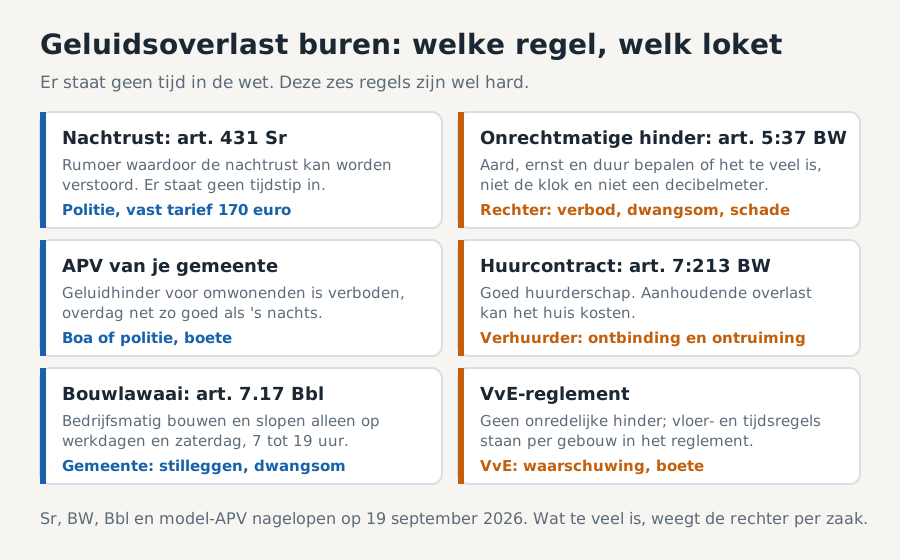
There are six rules you can actually invoke. They differ in who enforces them and what the consequence is, and that is exactly what most pages skip. For one you call the police, for another you write to the owners' association, for a third you have to go to court yourself.
In addition, since 2017 the mayor has a power of his own for serious and repeated residential nuisance: article 151d of the Municipalities Act (Gemeentewet). If the municipal council has adopted this in a bylaw, the mayor can impose a behavioural order on the resident or the landlord (an order subject to a periodic penalty) and, if nothing else works, a ban on being in or near the home for ten days, extendable to four weeks. It is the only instrument by which an owner too can temporarily be kept out of his own house.
| Rule | What it says | Who enforces | Possible consequence |
|---|---|---|---|
| Article 431 Criminal Code | Noise or neighbourhood disturbance by which the night's rest can be disturbed is an offence. No time stated. | Police | Fixed tariff of 170 euros (offence code H 200 in the Public Prosecution Service's 2026 tariff booklet), plus 9 euros administration costs; the legal maximum is 550 euros (first category from 1 January 2026) |
| Municipal bylaw (APV; model bylaw article 4:6, other noise nuisance) | Operating devices or sound equipment, or acting in a way that causes noise nuisance for a resident, is prohibited. Day and night. | Enforcement officer (boa) or police | For a private person in daytime a fixed tariff of 170 euros (code H 205); at night it falls under H 200. For a business also an order subject to a periodic penalty |
| Article 5:37 Civil Code, unlawful nuisance | An owner may not cause nuisance to another property through noise or vibration to a degree that is unlawful under article 6:162. Through 6:162 it also applies to tenants. | You, in court (summary proceedings or a full case) | Injunction with a penalty payment, order to take measures (insulation, floor, relocation), damages |
| Article 7:213 Civil Code, good tenancy | A tenant must behave as a good tenant; persistent nuisance is a breach of contract. | The landlord | Behavioural order, termination of the tenancy and eviction (article 6:265 Civil Code) |
| Owners' association (VvE) regulations | No unreasonable nuisance to other residents; often rules on floors, DIY hours and music. | The VvE board and the general meeting | Warning, fine under the regulations, in the last resort denial of the use of the apartment |
| Article 7.17 Buildings Decree (Bbl) | Commercial building and demolition work only on weekdays and Saturdays between 7 am and 7 pm, with a maximum number of days per noise level. | The municipality (building inspection) | Work stopped, order subject to a penalty; evenings and Sundays only with an exemption |
Criminal Code articles 23 and 431, Civil Code articles 5:37, 6:162, 6:265 and 7:213, Bbl article 7.17, the VNG model bylaw and the Public Prosecution Service's Feitenboekje Parkeren en Overlast 2026 (page 31), checked on 19 September 2026. Fine categories were raised on 1 January 2026.
Which rule applies in your situation: the situation table
The same racket falls under a different rule depending on who makes it and where you live. This is how it works out for the ten situations most cases are about. The last column says honestly how likely a complaint is to succeed, based on what courts decided in 2025 and 2026.
| Situation | Rule that applies | First port of call | Chance of success |
|---|---|---|---|
| A party or loud music in the middle of the night, one-off | Article 431 Criminal Code and the bylaw | Police (0900-8844 for ongoing nuisance) | High: the officer can fine on the spot, but a single night does not make a court case |
| Music or TV through the wall every day, also in daytime | Bylaw and article 5:37 Civil Code | Conversation, then a log, then municipality and court | Reasonable, provided you can prove duration and frequency; a log kept for weeks weighs more than one evening's measurement |
| Upstairs neighbours walking, stamping, dragging chairs on a hard floor | VvE regulations and article 5:37 Civil Code | VvE board | High if the floor does not meet the regulations; low for normal living noise on a floor that does |
| Dogs barking for hours a day | Article 5:37 Civil Code, sometimes the bylaw | Conversation, then court | Reasonable: in January 2026 the Rotterdam court limited a neighbour to three dogs |
| The neighbours' air conditioner or heat pump hums in the garden | Bbl article 4.107(2) (40 dB at the boundary in the evening and at night, 45 in daytime) and article 5:37 Civil Code | Municipality (building inspection), then court | High for a unit installed after 1 April 2021 that exceeds the limit: in July 2026 the Gelderland court ordered the nuisance stopped |
| Renovation next door by a contractor, evenings or Sundays | Bbl article 7.17 | Municipality (building inspection) | High: the hours are fixed; outside 7 am to 7 pm on weekdays and Saturdays an exemption is needed |
| Neighbour doing his own DIY, drilling on Sunday morning | Only the bylaw and article 5:37 Civil Code; Bbl 7.17 does not apply to DIY | Conversation, enforcement officer if repeated | Low if occasional; high if it goes on for weeks at unreasonable hours |
| Nuisance from a tenant of a housing association or private landlord | Article 7:213 Civil Code via the landlord | The landlord, with your log | Reasonable to high with a file: in February 2026 the Gelderland court terminated a tenancy for noise nuisance |
| Children, normal living noise, the occasional party | No rule prohibits this | Conversation | Close to zero: normal living is not nuisance, not even in a poorly insulated house |
| A cafe, workshop or shop next to your home | Environmental plan and Bkl table 5.65.1 (50, 45, 40 dB(A) per part of the day) | Municipality or environmental service, which can measure | High: this is the only situation with hard decibel limits per time slot |
Rules checked on 19 September 2026. The cases are listed further down with their ECLI numbers. The chance of success is an estimate based on published rulings, not a guarantee.
How many decibels are allowed: what the law requires and what it does not
The question of how many decibels of noise are allowed has an uncomfortable answer: between two homes there is no decibel limit on what you may produce. There are requirements for what the wall or floor must block, and those apply to new builds only. For an existing home from 1965 the law sets no minimum sound insulation between you and the neighbours; the level of the day it was built is the level that applies.
These are the figures that do exist, with what they apply to. They are here because a judge sometimes uses them as a yardstick, and because a neighbour who breaches one of these limits is a far easier case than a neighbour who simply lives loudly.
| Limit | Value | Applies to | Where it is written |
|---|---|---|---|
| Airborne sound between two homes | Difference of at least 52 dB | New builds only | Bbl articles 4.113 and 4.114 |
| Impact sound between two homes (walking, stamping) | At most 54 dB | New builds only | Bbl table 4.112 |
| The neighbours' installations (toilet, tap, ventilation, heat pump, lift) | At most 30 dB in your living space | New builds and newly installed systems | Bbl article 4.107(1) |
| Outdoor air conditioner or heat pump unit at the boundary | At most 40 dB in the evening and at night, 45 dB in daytime | Units installed since 1 April 2021 | Bbl article 4.107(2) |
| Hard floor in an apartment | Impact sound improvement of more than 10 dB compared to the bare concrete floor | Apartments under the 2017 Model Regulations or house rules with that standard | Model Regulations 2017; see our guide on hard floors |
| Business next to a home, on the facade | 50 dB(A) daytime, 45 evening, 40 night | Cafes, shops, workshops | Bkl table 5.65.1 |
| Building and demolition work on the facade | Up to 60 dB(A) unlimited, 60 to 65 dB(A) at most 50 days, 65 to 70 at most 30 days, 70 to 75 at most 15 days, 75 to 80 at most 5 days | Commercial building and demolition | Bbl table 7.17 |
| What your neighbour may produce himself (music, voices, dogs) | No figure | Everyone | Article 5:37 Civil Code: nature, severity and duration |
Buildings Decree (Bbl) and Environmental Quality Decree (Bkl), text in force on 19 September 2026. For the outdoor unit the law says 40 dB; the calculation rule in the Environmental Regulation allows 5 dB in daytime, hence 45 by day.
- A decibel meter on your phone is not evidence. In April 2026 the Amsterdam court wrote that noise measurements say nothing about the nature, duration and intensity of the sound, and that the standard in the Buildings Decree does not apply to a dispute between neighbours in an existing building.
- A measurement does count if it was done by an acoustic consultant according to NEN 5077 or the industrial noise measurement manual, with a report. That costs a few hundred euros and is often worth it in a full court case; not for a first conversation with the neighbours or the VvE.
- The municipality can measure and enforce itself where a business is involved. Between neighbours the municipality does not measure; then you depend on your log and witnesses.
When a court calls it unlawful nuisance
Article 5:37 Civil Code refers to article 6:162 for the yardstick, and the Supreme Court fixed that yardstick on 3 May 1991 (ECLI:NL:HR:1991:ZC0235): whether nuisance is unlawful depends on the nature, severity and duration of the nuisance and the damage it causes, in connection with the further circumstances of the case. That sentence returns in almost every ruling about neighbours, and it determines what you have to prove.
- Nature: is the noise avoidable? Music, a dog left alone all day, an air conditioner too close to the boundary, can be avoided. Footsteps, a crying baby, a shower at six in the morning cannot. Avoidable noise weighs more heavily.
- Severity: how loud and how intrusive? Bass and vibration weigh more than the same number of decibels of voices, and noise at night more than in daytime.
- Duration and frequency: one evening is never unlawful, twice a week for six months can be. That is why the log matters more than the measurement.
- Surroundings: in a poorly insulated 1958 walk-up you have to tolerate more than in a detached house. The court looks at what is normal in this building and this neighbourhood, and whether you could have known it was noisy when you bought or rented.
- What the other side already did: a neighbour who laid an underlay, moved the speakers and sent the dogs to a sitter stands stronger than one who rejects everything. Conversely the complainant stands stronger if he first tried a conversation and mediation.
- How that played out in 2026: a bathroom relocated above the neighbours' bedroom in Amsterdam was not unlawful nuisance, because showering and flushing are normal living. An outdoor air conditioner unit in Gelderland was, because the 40 dB from the Bbl was exceeded and the unit could have been placed elsewhere.
Upstairs neighbours and hard floors: the owners' association route
In an apartment you first take a different route than in a terraced house. The deed of division and the house rules of the owners' association (VvE) bind every owner and, through the landlord, every tenant in the building. The 2017 Model Regulations prohibit hard floor coverings outside the kitchen and bathroom unless the floor meets a set standard; the fallback is an impact sound improvement of more than 10 dB. If the upstairs floor does not meet that, you do not have to prove the nuisance is unlawful: the breach of the regulations is enough.
This is how you use that route. Ask the board which model regulations apply and whether there are house rules on floors or hours. Ask the upstairs neighbours for the specifications of the underlay; a manufacturer gives a measured value in dB. If there is nothing or only a thin mat, write to the board asking it to enforce. The board can impose a fine if the regulations provide for it, and in the last resort the general meeting can deny the use of the apartment (article 5:112(4) Civil Code). If the board does nothing, you can ask the court yourself to hold the owner to the regulations.
What the route does not do: remove living noise on a floor that does comply. Anyone living in a 1960 building with a 14 centimetre concrete floor hears the upstairs neighbours walk, even on a floor that meets every requirement. Then only article 5:37 remains, with the weighing above, and for normal living that almost always goes the way of the upstairs neighbours. What does help is a suspended ceiling with resilient bars and insulation on your side; that is work for a professional and usually costs a few thousand euros per room.
Tenant as the source or the victim: what the landlord must and may do
If the neighbour is a tenant, you have a port of call an owner does not have: his landlord. Article 7:213 Civil Code obliges a tenant to behave as a good tenant, and nuisance to neighbours falls under that. The landlord can first impose a behavioural order (no music after a set hour, no visitors after midnight) and, on repetition, ask the court to terminate the tenancy and evict. The Gelderland court did so in February 2026, with an arrangement under which the tenant could stay as long as he kept to the agreements.
If you are a tenant yourself and the noisemaker rents from the same landlord, you can also hold that landlord to your own enjoyment of the property: persistent nuisance from a fellow tenant that the landlord can act against counts as a defect in your home (article 7:204 Civil Code). The landlord must remedy the defect (7:206), and as long as he does not you can claim a rent reduction (7:207), for social housing through the Rent Tribunal (Huurcommissie), within six months of reporting the defect in writing. There is a limit. In May 2026 the The Hague court dismissed a tenant's claim because the landlord had already done enough to limit the nuisance. The landlord must act; he does not have to win.
If you rent from a different landlord than the neighbours, that landlord is of no use to you: he can only enforce against his own tenants. Then you take the same route as an owner, through the municipality, mediation and the court on the basis of article 6:162 Civil Code.
Renovations and DIY neighbours: the hours that do exist
Here hard hours do exist, and they are in article 7.17 of the Buildings Decree (Besluit bouwwerken leefomgeving): commercial building and demolition work is carried out only on weekdays and Saturdays between 7 am and 7 pm. On top of that, table 7.17 sets the number of days a given noise level may hit your facade: up to 60 dB(A) unlimited, then decreasing to zero days above 80 dB(A). If a contractor wants to work in the evening, at night or on a Sunday, the municipality has to agree through a tailored requirement or an exemption, and many municipalities have policy rules with fixed hours for that.
Note the word commercial. The neighbour who demolishes his own kitchen on Sunday morning does not fall under 7.17. For him only the bylaw (noise nuisance to residents) and article 5:37 Civil Code apply. One Sunday morning of drilling is then not an offence; three months of every weekend from eight till eight can be. VvE regulations may contain DIY hours, and then those apply.
What to do about a contractor exceeding the hours: call or email your municipality's building inspection with the address, date and time. The municipality can stop the work and impose a periodic penalty, and that happens faster than with any other form of noise nuisance, because the standard is hard.
The log: the evidence the court, the landlord and the VvE want to see
Almost every dismissed case lacks the same thing: proof of duration and frequency. Whoever says it happens every evening must be able to show it. This is what makes a file strong, in order of weight.
- A log with, for each occasion, the date, start time, end time, what you heard and where you were at the time. Not afterwards from memory, but on the day itself. A notebook or a note on your phone is enough; a table covering three months weighs more than everything below.
- Sound recordings with date and time, in addition to the log. Only record what is audible from your own home; a microphone against the wall or in the neighbours' garden breaches their privacy and turns against you.
- Statements from others: other neighbours, visitors, a community police officer who attended. Two households reporting the same thing remove the suspicion of oversensitivity.
- Reports to the police, the municipality, the landlord or the VvE, with date and reference number. Every report is proof that it was happening and that you raised it properly.
- Your own letters and the replies. A registered letter with a concrete request (bass off after 10 pm, lay an underlay, do not leave the dog alone) and a reasonable deadline shows the court that you gave the other side the chance to fix it.
- A measurement report from an acoustic consultant, only once you are heading for a full court case. For summary proceedings or a letter to the landlord you do not need it.
Step by step: from conversation to penalty payment
This is the order in which courts and landlords expect you to proceed. Skipping a step costs you points later.
- Go round, in daytime, without blame. Most upstairs neighbours do not know you hear their chairs. Say what you hear, when, and what you are asking. Do this before you put anything on paper.
- Start the log the same day. Even if the conversation went well: if nothing changes, you have evidence from day one.
- Call in neighbourhood mediation (buurtbemiddeling). It exists in 93 percent of municipalities, is paid for by the municipality and housing associations and is free for you; two thirds of cases end with a positive result. A judge almost always asks whether you tried this.
- Pick the port of call that fits your situation from the table above: the landlord for a tenant, the VvE board for an apartment, building inspection for a contractor, the police for nighttime disturbance, the municipality or environmental service for a business. Report in writing and keep the reply. For serious and repeated nuisance you can ask the mayor for a behavioural order under article 151d of the Municipalities Act.
- Send the neighbours a registered letter with what you are asking and a deadline of two to four weeks. Announce that you will take legal steps after that. If you have legal expenses insurance, this is also the moment to report the case.
- If the nuisance persists, ask the court for an injunction with a penalty payment. In urgent cases that can be done in summary proceedings, usually within a few weeks; a full case takes longer but can also result in measures and damages. Without legal expenses insurance, summary proceedings with a lawyer usually cost a few thousand euros, and the loser pays part of the winner's costs.
- Stop taking matters into your own hands. Banging back, cutting the power, filming the neighbours in their garden or posting them on social media turns the case around: then you are the one acting unlawfully.
What the courts actually decided: the numbers and six cases from 2026
On 19 September 2026 rechtspraak.nl lists 620 published civil rulings containing the words noise nuisance, neighbours and nuisance (geluidsoverlast, buren, hinder). Those are only the published cases; most subdistrict court cases are never published. The number per year is stable, and the outcomes show a pattern: complaints about avoidable noise backed by a file win, complaints about living noise without a file lose.
| Year of ruling | Published civil rulings |
|---|---|
| 2021 | 50 |
| 2022 | 65 |
| 2023 | 87 |
| 2024 | 53 |
| 2025 | 69 |
| 2026, up to 19 September | 37 |
Count on uitspraken.rechtspraak.nl, search terms geluidsoverlast buren hinder, field of law civil, 19 September 2026. In addition 84 administrative and 10 criminal rulings.
- Gelderland District Court, 8 July 2026, ECLI:NL:RBGEL:2026:5663: the neighbours had to stop the noise nuisance from their outdoor air conditioning unit. The court took the 40 dB standard of article 4.107(2) Bbl into account in assessing how serious the nuisance was.
- Amsterdam District Court, 1 April 2026, ECLI:NL:RBAMS:2026:4205: claim dismissed. Noise measurements say nothing about the nature, duration and intensity of the sound, and the noise standard of the Buildings Decree does not apply between neighbours in an existing building.
- Amsterdam District Court, 10 June 2026, ECLI:NL:RBAMS:2026:5557: a bathroom moved to a spot above the neighbours' bedroom produced noise, but that was not unlawful nuisance.
- Rotterdam District Court, 21 January 2026, ECLI:NL:RBROT:2026:624: noise and odour nuisance from dogs. The neighbours were no longer allowed to keep more than three dogs.
- Gelderland District Court, 20 February 2026, ECLI:NL:RBGEL:2026:1487: the tenancy was terminated and eviction ordered for noise nuisance, because the tenant had breached article 7:213 Civil Code, the general terms and a behavioural order; the tenant was given an arrangement tied to the judgment.
- The Hague District Court, 28 May 2026, ECLI:NL:RBDHA:2026:13790: a tenant sued his landlord over noise from neighbours. Dismissed: no unlawful nuisance, and the landlord had done enough to limit the nuisance.
If you are the source: this prevents a case
If you receive a complaint yourself, the cheapest route is almost always a measure rather than a defence. Whoever can show he did something stands stronger before every body, and most measures cost less than one hour of a lawyer.
- Under a hard floor, lay an underlay with a measured improvement of more than 10 dB, and keep the specification. In an apartment that is often compulsory; in a terraced house it is the argument that ends every complaint about footsteps.
- Keep speakers and subwoofers away from the shared wall and off the floor, on a mat or decoupled feet. Bass travels through concrete as vibration and that is what the neighbours hear.
- Place an air conditioning or heat pump unit as far as possible from the boundary and from the neighbours' bedrooms, and ask the installer for the calculation of the noise level at the boundary; for units since 1 April 2021 that is a legal requirement.
- If you renovate with a contractor, keep to 7 am to 7 pm on weekdays and Saturdays, and warn the neighbours in advance with the expected duration. If you do it yourself, keep evenings and Sunday mornings free, even though that is not written anywhere.
- Have a shared wall or a ceiling insulated if the building is noisy: a stud wall with resilient bars or a suspended ceiling with insulation makes a difference of 10 to 15 dB in practice. Post a job for it and ask for a price per square metre; a professional who has done this before can tell you in advance what it will achieve.
Done reading?
Describe the job in two minutes. Floor fitters respond with their price, you compare and choose. Free, with no strings attached.
Post your job for freeFrequently asked questions
What time are you allowed to make noise under Dutch law?
No law sets a time. Article 431 Criminal Code bans noise that can disturb the night's rest, without a time, and your municipal bylaw bans noise nuisance for residents at any hour: of the ten largest municipalities not one names a quiet period in the article. The 10 pm quoted everywhere is a custom. Only for businesses (7 am, 7 pm and 11 pm as boundaries) and for commercial building work (7 am to 7 pm on weekdays and Saturdays) are there real hours.
Can you drill or do DIY on a Sunday in the Netherlands?
Yes, if you do it yourself. The building hours of article 7.17 Bbl apply only to commercial building and demolition. For a DIYer only the bylaw and article 5:37 Civil Code apply: occasional drilling on a Sunday is not an offence, weeks of every weekend from early morning to late evening can be. VvE regulations may prescribe DIY hours, and then those apply.
How many decibels of noise nuisance are allowed?
Between homes there is no decibel limit on what you may produce. There are insulation requirements for new builds (52 dB airborne, 54 dB impact), 40 dB at the boundary for an air conditioning or heat pump unit since 1 April 2021, and 50, 45 and 40 dB(A) per part of the day for businesses. For the neighbour with music or dogs the court weighs nature, severity and duration, not a measurement.
How much is the fine for noise nuisance from neighbours?
The fixed tariff is 170 euros, plus 9 euros administration costs: offence code H 200 for disturbing the night's rest and H 205 for daytime noise nuisance by a private person (Public Prosecution Service tariff booklet 2026). The legal maximum under article 431 Criminal Code is 550 euros. For persistent nuisance a periodic penalty from the municipality or the court comes on top, and for a tenant termination of the tenancy.
What can the police do about noisy neighbours?
For nighttime disturbance the police can attend, speak to the neighbours and issue a fine under article 431 Criminal Code (maximum 550 euros) or the bylaw. The police do not resolve a long-running conflict; for that you need the landlord, the VvE, neighbourhood mediation or the court. Every police report is evidence for your file, though.
Can my neighbour be evicted for noise nuisance?
If he rents, yes: persistent nuisance breaches article 7:213 Civil Code and the landlord can ask the court to terminate the tenancy and evict. The Gelderland court did so in February 2026. An owner cannot be put out of his house; the court can impose an injunction with a penalty payment, and in a VvE the general meeting can deny the use of the apartment.
Can the municipality remove someone from their home for noise nuisance?
Temporarily, yes. For serious and repeated nuisance the mayor can impose a behavioural order under article 151d of the Municipalities Act and, if nothing else works, a ban on being in or near the home for ten days, extendable to four weeks. This requires the municipal council to have adopted that power in a bylaw, and it applies to tenants and owners alike.
What can I do about noise from the upstairs neighbours?
First check whether the floor complies with the VvE regulations: the 2017 Model Regulations require an impact sound improvement of more than 10 dB. If the floor does not comply, the board can enforce without you having to prove unlawful nuisance. If it does comply and it is living noise, only insulation on your side helps, such as a suspended ceiling with resilient bars.
How long may a renovation next door make noise?
Commercial building work is allowed only on weekdays and Saturdays between 7 am and 7 pm (article 7.17 Bbl). Each noise level has a maximum number of days: up to 60 dB(A) on your facade unlimited, 60 to 65 dB(A) 50 days, 65 to 70 dB(A) 30 days, 70 to 75 dB(A) 15 days, 75 to 80 dB(A) 5 days. Outside those hours an exemption from the municipality is required.
Is a barking dog noise nuisance?
A dog that barks now and then is not; a dog that barks for hours a day because it is left alone can be unlawful nuisance under article 5:37 Civil Code. In January 2026 the Rotterdam court limited neighbours to three dogs for noise and odour nuisance. Some municipalities also have a bylaw article on nuisance from animals.
Can I report noisy neighbours anonymously?
With the police (0900-8844) and most municipal reporting points you can report without the neighbours hearing your name; the officer does not name the reporter. With the landlord, the VvE and the court anonymity does not work: there your log is the evidence, and it carries your name and address. Anyone who wants to win a case has to become visible at some point. Neighbourhood mediation is never anonymous, because both neighbours sit at the table.
Sources
Every claim on this page comes from one of these sources. They were checked on 30 August 2026. Legislation changes, so check the source itself if anything matters to you.
- Dutch Criminal Code, article 431 (noise or neighbourhood disturbance by which the night's rest can be disturbed) and article 23 (fine categories, first category 550 euros from 1 January 2026)
- Public Prosecution Service, Feitenboekje Parkeren en Overlast 2026 (January 2026 edition), page 31: code H 200 disturbing the night's rest 170 euros, code H 205 noise nuisance by a private person 170 euros
- Dutch Civil Code Book 5, article 37 (nuisance between properties), with Book 6 article 162 (tort) and Book 7 article 213 (good tenancy)
- Municipalities Act (Gemeentewet), article 151d: behavioural order by the mayor and the ten-day ban on being in or near the home
- Buildings Decree (Besluit bouwwerken leefomgeving), articles 4.107 (installations and outdoor units), 4.113 and 4.114 with table 4.112 (sound insulation between homes in new builds) and 7.17 (building and demolition work, hours and day values)
- The bylaws of Amsterdam (CVDR72510), Rotterdam (CVDR373493), The Hague (CVDR11313), Utrecht (CVDR318782), Eindhoven (CVDR415534), Groningen (CVDR646003), Tilburg (CVDR626908), Almere (CVDR96108), Breda (CVDR611200) and Nijmegen (CVDR677751), noise nuisance article
- Environmental Quality Decree (Besluit kwaliteit leefomgeving), table 5.65.1 (standard values for noise from businesses on a home per part of the day)
- VNG model municipal bylaw, article 4:6 other noise nuisance, and the Utrecht bylaw as an example of the local version
- Supreme Court 3 May 1991, ECLI:NL:HR:1991:ZC0235, the yardstick for unlawful nuisance: nature, severity and duration of the nuisance and the damage caused, in connection with the further circumstances
- Rechtspraak, published civil rulings on noise nuisance between neighbours, count per year and the six cases cited
- Centre for Crime Prevention and Safety (CCV), neighbourhood mediation: offered by 93 percent of municipalities, two thirds of cases with a positive result
Tools for your own address
Three things you can check here for free that you will not find like this anywhere else. They run on open data from the Dutch Land Registry, the buildings register and the national energy agency, so the answer applies to your house and not to an average.
This is not legal advice
We set out what the rules say and where they are. Your situation may differ, and in a dispute your own contract, your deed of division or your local council's bylaw takes precedence. If you cannot work it out, Het Juridisch Loket, the Huurcommissie or a lawyer can help.