Noise from the neighbours' heat pump: what is allowed, and what can you do?
Sources checked on 30 August 2026
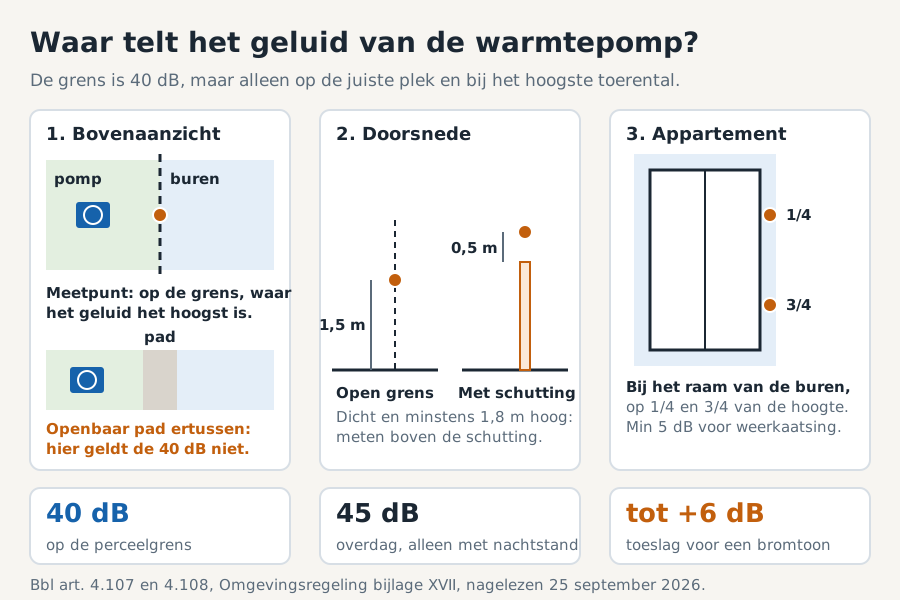
An outdoor heat pump or air conditioner installed or replaced since 1 April 2021 may not cause more than 40 dB at the property boundary with the neighbours (article 4.107(2) Building Works Decree). During the day 45 dB applies, but only if the unit has a separate night mode. The level is determined at maximum speed, at 1.5 metres height, with a penalty of up to 6 dB for a humming tone. Hear the neighbours' pump? Talk first, then ask the municipality to enforce. For an older pump, the court uses the same 40 dB as its yardstick.
Rather have it done?
Post your job for free. Air conditioning installers near you respond with their own price and you choose. Your money stays safe until you approve the work.
What are the noise limits for a heat pump?
The rule is in the Building Works Decree (Besluit bouwwerken leefomgeving, Bbl). Article 4.107(2): an installation for heating or cooling placed outside the home may cause at most 40 dB at the property boundary with a plot on which another home stands. That covers an air-to-water heat pump, a hybrid pump and the outdoor unit of an air conditioner, since that also produces heat or cold.
The rule took effect on 1 April 2021, then as article 3.8(2) of the Building Decree 2012. Since 1 January 2024 it has been in the Bbl, under the Environment and Planning Act. The content did not change.
The 45 dB during the day mentioned on many sites is not a second limit. It is a correction in the calculation method of the Environment and Planning Regulation: if the installation has a separate setting for the evening and night (19:00 to 07:00), the daytime level may be counted 5 dB lower. Without a night mode, 40 dB applies day and night.
| Situation | Limit | Where | Article |
|---|---|---|---|
| Outdoor unit, neighbours on their own plot | 40 dB | At the property boundary | 4.107(2) Bbl |
| Same, daytime, pump with a separate night mode | 45 dB (07:00 to 19:00) | At the property boundary | Annex XVII Environment and Planning Regulation |
| Flat, neighbours in the same building | 40 dB | At the neighbours' openable window | 4.108(3) Bbl |
| Installation audible inside the neighbours' home | 30 dB | In their living room or bedroom | 4.107(1) Bbl |
| Audible humming tone | Penalty of 0 to 6 dB | Added to the measured level | Annex XVII Environment and Planning Regulation |
Building Works Decree and Environment and Planning Regulation, current text checked on 25 September 2026.
Where and how is the noise measured?
It is not a measurement with an app in your garden. The Environment and Planning Regulation (article 5.59 and Annex XVII) sets out exactly how the level is determined, and a measurement that does not follow it says little. These are the points that count:
- The pump runs at the highest speed of the chosen setting for at least one minute. Also while heating, cooling, making hot water and defrosting.
- The measuring point is on the property boundary, 1.5 metres above the ground, where the noise is loudest.
- If there is a shared, fully closed fence or wall of at least 1.8 metres, the measuring point is 0.5 metres above it.
- If the unit hangs on a wall or stands on a roof or balcony, the measuring point is 1.5 metres above the bottom of the unit.
- For a flat, the measurement is taken at the neighbours' window, at a quarter and three quarters of its height, and 5 dB is deducted for reflection.
- If there is a clear humming tone, 0 to 6 dB is added, in steps of 1 dB.
How far from the neighbours must a heat pump be?
There is no legal minimum distance. A pump may stand close to the boundary as long as it stays below 40 dB there. What distance that takes depends on the sound power of the unit (the dB(A) figure on the energy label) and on the spot: against a wall or in a corner the sound reflects and the unit sounds louder.
The table below is a worked example using the standard formula for sound in open air, without a humming tone and without a screen. It shows why a unit in a recess or corner is so often too loud. For an actual installation the government calculation tool is decisive.
| Sound power of the unit | Free-standing on the ground | Against a wall | In a corner or recess |
|---|---|---|---|
| 50 dB(A) | 1.3 metres | 1.8 metres | 2.5 metres |
| 55 dB(A) | 2.2 metres | 3.2 metres | 4.5 metres |
| 58 dB(A) | 3.2 metres | 4.5 metres | 6.3 metres |
| 60 dB(A) | 4.0 metres | 5.6 metres | 8.0 metres |
| 62 dB(A) | 5.0 metres | 7.1 metres | 10.0 metres |
| 65 dB(A) | 7.1 metres | 10.0 metres | 14.2 metres |
Indicative distance to the property boundary for 40 dB, calculated as Lp = Lw + 10 log(Q / 4 pi r squared) with Q = 2, 4 and 8. A humming tone can roughly double the distance. Own calculation, 25 September 2026.
Does the rule also apply to a heat pump from before 2021?
Not as a building rule. The 40 dB applies to installations placed from 1 April 2021, and the part of the Bbl on existing buildings contains no noise rule. A pump installed in 2019 does not have to be brought up to the standard.
Two things change that. If the old pump is replaced, the new one must meet 40 dB: article 5.14(2) Bbl applies the same level to alterations as to new builds. And in a dispute between neighbours, the court uses 40 dB as its yardstick, also for an older pump. The Utrecht subdistrict court did so in 2023, referring to a 2017 Supreme Court ruling.
When does the 40 dB not apply?
The limit applies at the boundary with a plot on which a home stands. In three situations that is not the case:
- There is public land between the two plots, such as a municipal path or green strip. The plot then does not border a residential plot and the boundary value does not apply (IPLO).
- On that side there is no home, but for example a business or a garage plot.
- The heat pump belongs to a business. Then the municipal environmental plan regulates the noise, not the Bbl.
Bothered by the neighbours' heat pump: how to handle it
Most cases are solved without a measurement and without a court, because the fix is often small: a different setting, a quarter turn or dampers under the unit. Work through these steps in order and keep track of when you hear the pump from the very first step.
- For one week, write down when you hear the pump, for how long and what it sounds like: buzzing, humming or vibrating. Pay special attention to the night.
- Talk to the neighbours and ask three concrete things: is the night mode on and does it start at 19:00, can the unit turn a quarter away from you, and does it stand on vibration dampers?
- If that does not help, bring in neighbourhood mediation (buurtbemiddeling). In most municipalities it is free, and the conversation takes place with two trained volunteers.
- Ask the municipality in writing to enforce article 4.107(2) Bbl. Mention the installation date if you know it and attach your log. The municipality must decide within eight weeks.
- If that achieves nothing, you can ask the subdistrict court to stop the nuisance, for example with a night ban. That goes through articles 5:37 and 6:162 of the Civil Code.
What if the municipality's measurement is wrong?
A measurement taken in the wrong spot or at the wrong speed can come out too low. In the case before the 's-Hertogenbosch Court of Appeal (2024), the environmental service measured below 40 dB, but a counter-report showed it had not measured on the property boundary or in the loudest setting. The court followed the counter-report. So for any measurement, check:
- Was it measured on the property boundary, or somewhere in your garden?
- At what height, and was a fence of 1.8 metres or higher taken into account?
- Was the pump running at maximum speed, and was it also measured during defrosting?
- Was the humming tone assessed, and was a penalty added for it?
- Was the 5 dB daytime correction only applied if the pump really has a separate night mode?
When does the court call it unlawful nuisance?
The civil court does not test against the Bbl but against article 5:37 of the Civil Code: excessive nuisance is not allowed. The 40 dB is one of the things it weighs, alongside the time of day, how long it lasts, the neighbours' health and what the owner has already done. Three rulings show how that turns out.
| Ruling | Situation | What was measured | Outcome |
|---|---|---|---|
| Arnhem-Leeuwarden Court of Appeal, 15 November 2022 | Pool heat pump in a recess, about 40 cm from the boundary, installed before 1 April 2021 | Expert: above 40 dB, measured 0.5 metres above the closed fence | Night ban from 23:00 to 07:00 until measures are taken, with a penalty payment |
| 's-Hertogenbosch Court of Appeal, 9 July 2024 | Hybrid pump on a garage roof, about 1.5 metres from the boundary, December 2021 | Environmental service below 40 dB; counter-report at least 7 dB above, about 12 dB with humming tone | Night ban from 23:00 to 07:00 upheld, with a penalty payment |
| Utrecht subdistrict court, 24 April 2024 | Monobloc unit on the side wall under the neighbours' bedroom window, 2019 | Expert investigation | No unlawful nuisance: the owner had taken measures each time |
Rulings on rechtspraak.nl: ECLI:NL:GHARL:2022:9854, ECLI:NL:GHSHE:2024:2214 and ECLI:NL:RBMNE:2024:2643, read on 25 September 2026.
Humming and vibration
Not all noise travels through the air. A unit on a wooden roof, a balcony or directly against the wall passes vibrations into the structure, and indoors you then hear a low hum that is barely noticeable outside. That is structure-borne noise.
A low humming sound weighs more heavily in the measurement because of the penalty for a tonal component, up to 6 dB. The fix is usually in the mounting: rubber or spring dampers under the unit, flexible pipe connections, and no unit on a light roof or balcony.
What helps, and who pays for it?
Whoever has the pump installed must meet the standard (articles 4.3 and 5.3 Bbl), and whoever causes nuisance must end it. So the measure is first of all for the owner of the pump. Neighbours may agree otherwise; in the Arnhem-Leeuwarden case a fifty-fifty split had been proposed earlier. These are the measures, from small to large:
- Switch on the night mode, starting at 19:00 and not only at 22:00.
- Turn the unit a quarter so the fan does not blow towards the boundary.
- Vibration dampers under the unit and flexible pipe connections.
- A noise screen or enclosure made for this purpose, so the pump still gets enough air.
- Move the unit, out of a corner or recess and further from the boundary. The 's-Hertogenbosch Court of Appeal held it against the owner that he had not looked into other locations.
Rented homes, flats and owners' associations
If you rent and are bothered by a pump that the landlord had installed at the complex, report it to the landlord. The landlord is the one who builds and must meet the standard, and must make sure you can live undisturbed.
If you live in the same building, such as above each other in a block of flats, the 40 dB applies at the neighbours' openable window (article 4.108(3) Bbl) instead of at a property boundary.
If you want to install a heat pump or air conditioner yourself on a balcony, facade or roof of a flat, you usually need permission from the owners' association (VvE), because those parts are shared. Check the deed of division and the regulations.
Installing a heat pump or air conditioner yourself: arrange this first
Anyone installing a pump now avoids everything above with a few choices in advance. Permit-free or not, the Bbl always applies.
- On the ground, an outdoor unit is permit-free up to 1 metre high and 2 square metres. On a facade or roof, your municipality's environmental plan decides. For a listed building you always need a permit.
- Choose a unit with a low sound power and a night mode, and set it to start at 19:00.
- Check the location with the government calculation tool, or have the installer do it and ask for the result in writing.
- Do not place the unit in a corner or recess, or on a light roof or balcony without dampers.
- Tell the neighbours in advance where it will go. A neighbour who helps choose the spot rarely complains later.
Done reading?
Describe the job in two minutes. Air conditioning installers respond with their price, you compare and choose. Free, with no strings attached.
Post your job for freeFrequently asked questions
How far from the neighbours must a heat pump be?
There is no fixed distance in the law. What counts is the noise at the property boundary: it may not exceed 40 dB there. A quiet unit free-standing on the ground can be one and a half metres away, a loud unit in a corner sometimes needs ten metres or more. The distance table above gives a worked example per sound power.
What are the noise limits for a heat pump?
At the property boundary with the neighbours at most 40 dB (article 4.107(2) Bbl), for pumps installed or replaced since 1 April 2021. During the day 45 dB applies, but only if the pump has a separate night mode. In a block of flats 40 dB applies at the neighbours' window, and 30 dB inside their home.
When does a heat pump make the most noise?
On cold days and especially cold nights, because the pump then runs at a higher speed, and while defrosting the outdoor unit and making hot tap water. That is exactly why the calculation method requires the level to be determined at maximum speed and also during defrosting. A measurement on a mild afternoon therefore says little.
Can I claim compensation for noise from a heat pump?
You can, if the nuisance is unlawful and you can prove damage (article 6:162 of the Civil Code). In practice, people who are bothered mainly ask for the nuisance to stop: the three rulings on this page were about a night ban and measures to the pump, not money. Keep your log and any measurement reports, because they determine what you can prove.
Is heat pump noise excessive nuisance between neighbours?
That depends on the level, the time of day, the duration, the neighbours' health and what the owner has already done (articles 5:37 and 6:162 of the Civil Code). Above 40 dB and especially at night a ban is likely: two courts of appeal imposed a night ban from 23:00 to 07:00. If the owner has taken measures, the court may reject the claim.
How much noise may you hear from your neighbours?
For installations it is fixed: the outdoor unit of a heat pump or air conditioner at most 40 dB at the property boundary, and a neighbour's installation at most 30 dB inside your living room or bedroom (article 4.107 Bbl). For music, voices or a dog there is no decibel limit; there the court weighs nature, severity and duration.
Does the noise limit also apply to a heat pump installed before 2021?
Not as a building rule: the 40 dB applies to pumps installed from 1 April 2021. If an old pump is replaced, the new one must comply (article 5.14(2) Bbl). And in a neighbour dispute the court also uses 40 dB as its yardstick for an older pump.
Where do I report nuisance from the neighbours' heat pump?
First to the neighbours themselves, then to neighbourhood mediation. If that achieves nothing, submit a written enforcement request to the municipality under article 4.107(2) Bbl, with your log attached. The municipality decides within eight weeks. A report under the local bylaw is not the right route here, because heat pump noise at homes is regulated in the Bbl.
Is a night mode from 22:00 enough?
Not for the 5 dB daytime correction: the calculation method assumes a separate setting for the period from 19:00 to 07:00. If the night mode only starts at 22:00, 40 dB simply applies during the day.
Sources
Every claim on this page comes from one of these sources. They were checked on 30 August 2026. Legislation changes, so check the source itself if anything matters to you.
- Building Works Decree (Besluit bouwwerken leefomgeving), articles 4.3, 4.107, 4.108, 5.3 and 5.14 (installation noise and alterations), current text
- Environment and Planning Regulation (Omgevingsregeling), article 5.59 and Annex XVII (method for determining noise from heating and cooling installations), current text
- IPLO, Noise from building installations in new builds (40 dB at the property boundary, public land in between, calculation tool)
- Dutch government, Calculation tool for noise from outdoor heating and cooling installations
- Arnhem-Leeuwarden Court of Appeal 15 November 2022, ECLI:NL:GHARL:2022:9854, pool heat pump in a recess, night ban
- 's-Hertogenbosch Court of Appeal 9 July 2024, ECLI:NL:GHSHE:2024:2214, hybrid pump on a garage roof, measurement in the wrong place
- Midden-Nederland District Court 24 April 2024, ECLI:NL:RBMNE:2024:2643, and interim ruling ECLI:NL:RBMNE:2023:281, 2019 pump on the side wall
Tools for your own address
Three things you can check here for free that you will not find like this anywhere else. They run on open data from the Dutch Land Registry, the buildings register and the national energy agency, so the answer applies to your house and not to an average.
This is not legal advice
We set out what the rules say and where they are. Your situation may differ, and in a dispute your own contract, your deed of division or your local council's bylaw takes precedence. If you cannot work it out, Het Juridisch Loket, the Huurcommissie or a lawyer can help.