Power out: what can you check yourself?
Sources checked on 30 August 2026
First check whether the neighbours are out too. If they are, it is an outage at the grid operator and you report it there; there is no point touching your fuse box. If only you are without power, a residual current device or a circuit breaker has almost certainly tripped. You can reset it yourself, but only after you work out which appliance tripped it. If it trips again immediately, or you smell burning, touch nothing and call an electrician.
Rather have it done?
Post your job for free. Electricians near you respond with their own price and you choose. Your money stays safe until you approve the work.
First: is it you or the grid?
Look outside or at the neighbours. If the street lighting is off and the neighbours are out too, it is a grid outage and there is nothing you can do but report it. Check gasenstroomstoringen.nl or call the national outage number 0800-9009 (free, 24 hours a day): by postcode you can see straight away whether your grid operator already knows about it.
If only your house is out while the neighbours have light, the problem is behind your meter and it is your installation. That is usually not a fault but exactly what the protection is supposed to do.
If one room is dead while the rest of the house works fine, a single circuit has tripped. That is the most harmless version.
The fuse box, from left to right
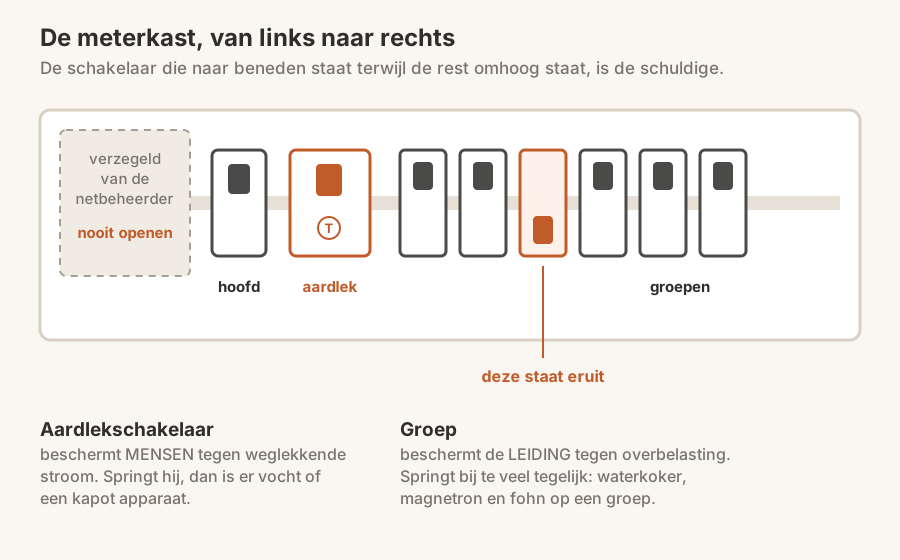
A modern Dutch fuse box has a main switch, one or two residual current devices and a row of circuit breakers behind them. A switch pointing down while the rest point up is the culprit.
A residual current device protects against current leaking away, usually through moisture or a faulty appliance. It protects people. If it trips, something is wrong with an appliance or there is moisture in a cable or outdoor socket.
A circuit breaker protects the cable against overload. It trips when you switch on too much at once: kettle, microwave and hairdryer on the same circuit. Annoying, but not dangerous.
If your box has no residual current device but screw-in fuses you replace, your installation predates 1975. That is not illegal, but it is worth having an electrician look at it, certainly if you have renovated a bathroom or have outdoor sockets.
Do not confuse the two: a residual current device (the wide switch with a test button, usually 1 or 2 per box) protects people against a leak to earth and drops the whole circuit group beneath it. A circuit breaker, the separate narrow switch per circuit, only protects that one circuit's wiring against overload or a short. If only one room trips while the rest keeps working, it is almost always the circuit breaker, not the residual current device.
Working through the fuse box, step by step
This order goes from safe to less safe. If anything differs from what is described below, stop and call someone; electrics is the one job where carrying on by feel is genuinely dangerous.
- First look outside and at the neighbours. If everyone is out, it is a grid fault and your fuse box has nothing to do with it.
- Open the fuse box and find the switch pointing down while the rest point up.
- If that is the residual current device (the wide one with a test button), first switch off ALL appliances on the tripped circuits and pull the plugs.
- Push the switch back up. If it stays up, the fault is in an appliance and not in the installation.
- Plug them back in one at a time and wait a few seconds after each. The plug that trips it is the culprit.
- If it trips again immediately with nothing plugged in, touch nothing further and call an electrician.
- If you smell burning, see a black mark on a socket or a switch feels warm: stop at once, main switch off, and call.
Finding which appliance is doing it
Switch off everything on the tripped circuit and pull the plugs. Then push the switch back up. If it stays up, the fault is in one of the appliances and not in the installation.
Now plug them back in one at a time, waiting a moment after each. If it trips at a particular appliance, you have found it. With a residual current device it is often an old washing machine, a boiler, or an outdoor socket with water in it.
If the switch keeps tripping immediately with nothing plugged in, the fault is in the fixed installation. Stop trying. The same applies if you smell burning, see a black mark on a socket, or the switch feels warm.
When you need an electrician
There is one hard line: everything behind the socket or behind the switch in the fuse box is work for a competent person. Replacing a plug you may do yourself; adding a circuit you may not.
Call someone if the residual current device trips again immediately with nothing plugged in, if it keeps coming back without a clear cause, if there is a burning smell, or if water has reached the installation.
An electrician in the Netherlands normally charges 45 to 75 euro per hour plus a call-out fee. Outside office hours a surcharge applies. Tracing a fault usually takes one to two hours; if the cause is a damaged cable, the repair comes on top.
What it costs in 2026
Most faults cost nothing: resetting the residual current device yourself or plugging something back in is free. Once you need an electrician, these are roughly the amounts involved.
| Work | Price | Notes |
|---|---|---|
| Tracing a fault | 45 to 75 euro per hour | plus call-out fee; usually 1 to 2 hours of work |
| Emergency visit outside office hours | surcharge on top of the hourly rate | ask for this separately in advance |
| Having a circuit added | 100 to 300 euro per circuit | depending on space in the fuse box and cable length |
| Replacing or adding a residual current device | 115 to 165 euro | for an installation without one, predating 1975 |
Always ask separately in advance for the hourly rate, the call-out fee and the emergency surcharge, so you compare on the same basis.
What you never do
Tape down or bypass a residual current device because it keeps tripping. It trips because current is leaking away, and that is exactly the scenario it exists for. Bypassing removes the protection and leaves the problem.
Fit a heavier fuse because the circuit cannot handle the load. The fuse protects the cable in the wall; a heavier fuse means the cable is allowed to get hot before anything switches off.
Open the fuse box behind the sealed cover. Everything before the meter belongs to the grid operator and is sealed; breaking that seal is a criminal offence and extremely dangerous.
Done reading?
Describe the job in two minutes. Electricians respond with their price, you compare and choose. Free, with no strings attached.
Post your job for freeFrequently asked questions
How do I know it is a grid operator outage?
If the neighbours are also without power or the street lighting is off. Every grid operator has an outage map and a national reporting number where you can check by postcode whether a report already exists.
My residual current device keeps tripping. What causes that?
Usually moisture or a degraded appliance. Classics are an outdoor socket with rain in it, an old washing machine or dishwasher, and a boiler. Find it by unplugging everything and plugging back in one at a time.
Can I add a circuit to the fuse box myself?
No. Work in the fuse box behind the switches belongs to a competent person. Faulty work can also be a reason for your insurer not to pay out after a fire.
What does an electrician charge to trace a fault?
Count on 45 to 75 euro per hour plus a call-out fee, and one to two hours of searching. Outside office hours a surcharge applies. Ask separately for the hourly rate, the call-out fee and the emergency surcharge.
Why does the power cut out when I switch on the kettle?
You are over the limit of that circuit. A kettle draws around 2,000 watts; together with a microwave or a hairdryer on the same circuit that is too much. Spread the appliances over different circuits or have one added.
I still have screw-in fuses instead of breakers. Must that be replaced?
It does not have to be, but it is sensible. An installation without a residual current device lacks protection against leaking current, and that is precisely the protection for people. With a bathroom or outdoor sockets it is worth a quote.
Sources
Every claim on this page comes from one of these sources. They were checked on 30 August 2026. Legislation changes, so check the source itself if anything matters to you.
- Netbeheer Nederland, outages and the national reporting number
- Dutch government, using electricity safely at home
- Techniek Nederland, working on an electrical installation
- Brandweer Nederland, fire safety and electrics
- Milieu Centraal, energy at home and appliances
- Consumentenbond, electricians and installation work
- NEN 1010, the Dutch standard for low-voltage installations
- Homedeal, cost of extending a fuse box 2026 (Dutch)
- Homedeal, cost of connecting a residual current device 2026 (Dutch)
- Gas- en Stroomstoringen, national outage map and reporting (Dutch)
Tools for your own address
Three things you can check here for free that you will not find like this anywhere else. They run on open data from the Dutch Land Registry, the buildings register and the national energy agency, so the answer applies to your house and not to an average.
This is not legal advice
We set out what the rules say and where they are. Your situation may differ, and in a dispute your own contract, your deed of division or your local council's bylaw takes precedence. If you cannot work it out, Het Juridisch Loket, the Huurcommissie or a lawyer can help.