Boundary by prescription: is the strip yours now, and what can the other side still claim?
Sources checked on 30 August 2026
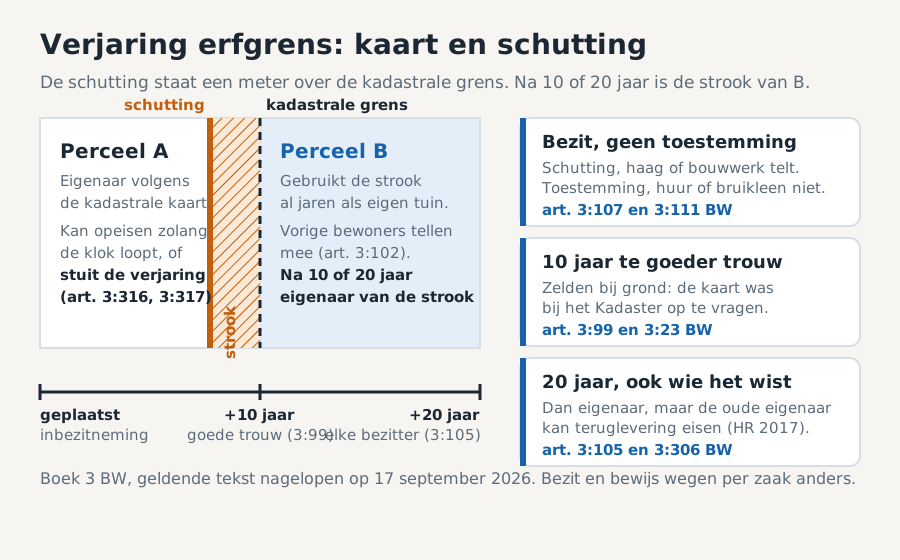
The cadastral boundary is not always the legal boundary. Whoever has possessed a strip of the neighbour's land for ten years in good faith (article 3:99 Dutch Civil Code), or twenty years regardless (3:105 with 3:306), has become its owner. Possession means acting as the owner: a fence, hedge or structure on the strip (3:107). Use with permission, rent or loan does not count (3:111). The years of previous residents carry over (3:102). Whoever took the land knowing it belonged to someone else can still be ordered to hand it back after the period ends (Supreme Court, 24 February 2017).
Rather have it done?
Post your job for free. Gardeners near you respond with their own price and you choose. Your money stays safe until you approve the work.
Cadastral boundary or boundary in use: which one counts
On the cadastral map the boundary runs in one place. In the garden the fence stands a metre further along, and has done for as long as anyone remembers. Those two boundaries exist side by side and do not have to coincide. The map shows what the Land Registry (Kadaster) once surveyed; who owns the strip in between is decided by the Dutch Civil Code.
The Kadaster says so itself: it does not track whether a boundary has shifted by prescription and does not answer the ownership question. A civil-law notary or the court does that, and only afterwards is the new boundary entered in the registration. Until then the map shows the old line, even if the strip legally belongs to the neighbours.
This guide is about that strip. First which period applies, then whether your use counts as possession, then who can claim what, and finally how to record it or stop it. Every rule comes with its article so you can check it yourself. Where the boundary exactly lies and how you find out is covered in the guide on determining the boundary.
Which period applies to you: 10 or 20 years
There are two routes to ownership by prescription, and which one applies to you depends on one question: could the possessor reasonably believe the strip was his?
With land the answer is almost always no. Article 3:23 says a claim of good faith fails if it comes down to not knowing what could be found in the public registers. The cadastral map is available to anyone, so whoever put a fence over the boundary could have known. That is why nearly every boundary case runs on the twenty-year route.
- Ten years, in good faith (article 3:99 paragraph 1): whoever has possessed a strip for ten uninterrupted years and was rightly entitled to see himself as owner (3:118) becomes the owner. Good faith is presumed; whoever says it was absent must prove it (3:118 paragraph 3). Once in good faith you remain so, even if you find out later (3:118 paragraph 2).
- Twenty years, regardless (article 3:105 paragraph 1 with 3:306): the owner's claim to recover his land expires after twenty years. Whoever possesses the strip at that moment becomes the owner, even if he always knew the land belonged to the neighbours.
- The clock starts the day after the other party became possessor (article 3:314 paragraph 2). Not the day the owner noticed, and not the day of the last argument.
- The years of previous residents count, on both sides of the boundary (article 3:102). Whoever buys a house with a fence that has stood for fifteen years does not have to start over.
Possession or mere use: the possession table
This is where most cases turn. Prescription only works with possession: holding the strip for yourself, as if you were the owner (article 3:107). Whoever holds the strip for someone else, for instance with permission, is a holder and not a possessor, and a holder remains a holder as long as the owner does nothing to change that (3:111). Whether something is possession, the court judges from the outside: what could a passer-by see (3:108). Isolated acts on land someone else already possesses are not enough (3:113 paragraph 2).
This is how it works out per situation, with the cases in which the court decided on it.
| Situation | Possession or use | Article | What the court said |
|---|---|---|---|
| Fence or gate over the boundary, with the strip on your side | Possession | 3:107, 3:108 | Fence plus hedge on municipal land was possession: resident became owner (District Court North Holland, 30 October 2024) |
| Hedge in the wrong place, strip behind it taken into your garden | Possession, if the hedge really encloses the strip | 3:107, 5:36 | A hedge alone was not enough once the reconstruction showed where the boundary lay (District Court Amsterdam, 28 January 2026) |
| Tiles, driveway or paving extended beyond the boundary | Usually possession, if the paving is part of your plot | 3:108 | Land drawn into the garden belonged to the neighbour after twenty years (Court of Appeal Arnhem-Leeuwarden, 7 July 2026) |
| Only mowing grass or weeding on the strip | Use | 3:113 paragraph 2 | Maintenance alone is an isolated act, not possession |
| Parking a car or walking across to the road | Use | 3:113 paragraph 2 | Parking and access by tenants was not possession; the strip stayed with the owner (Court of Appeal Arnhem-Leeuwarden, 7 July 2026) |
| Extension, shed or garage partly over the boundary | Possession | 3:107 | A structure is the clearest act of possession there is |
| Use with permission, rent or loan | Holding, never counts | 3:111 | A tenant or someone with permission never acquires by prescription, however long it lasts |
| A path over the strip to the back | Use of the land, not possession | 5:72, 3:99 | This can create a right of way by prescription, but not ownership |
Books 3 and 5 of the Dutch Civil Code, current text checked on 17 September 2026. The cases are published on rechtspraak.nl; the ECLI numbers are listed further down with the figures.
Who can claim what: the roles table
In a prescription question there are always four people at the table, even if only two stand in the garden: the possessor who thought it was his land, the possessor who knew better, the old owner, and the buyer who has just bought the house. The law is different for each of them.
| Role | Is the strip his | What can he claim | How he starts or stops the clock |
|---|---|---|---|
| Possessor in good faith | After ten years (3:99) | Registration of his ownership (3:17 paragraph 1 under i) and, if the location is uncertain, boundary determination by the court (5:47) | The clock runs from the day after taking possession (3:314 paragraph 2) |
| Possessor who knew it was not his land | After twenty years (3:105 with 3:306) | Registration as owner; the old owner can however claim retransfer as compensation (Supreme Court 24 February 2017) | The clock runs, but an acknowledgement that the land belongs to the other resets it to zero (3:318) |
| Old owner, period still running | Yes, until the day the period is complete | Eviction and return of the strip (5:2), boundary determination by the court (5:47), or a written permission that turns the possessor into a holder (3:111) | Interruption: written demand plus summons within six months (3:316 and 3:317 paragraph 2) |
| Old owner, period complete | No, unless the possessor acted in bad faith | Retransfer or money as compensation, within five years of finding out (6:162, 6:103, 3:310) | This claim expires too: five years after awareness, at most twenty years after the taking of possession |
| New buyer of the house with the strip | Yes, if the previous owner had already become owner by prescription; otherwise his period continues (3:102) | Everything the previous owner could claim, if the deed passes it on (District Court Rotterdam, 9 June 2021) | Before signing, lay the map next to the fence |
Articles from Books 3, 5 and 6 of the Dutch Civil Code, current text 17 September 2026. What the court can do under 5:47: divide the uncertain area or award it entirely to one party, with or without compensation (5:47 paragraph 3).
The period check: work it out in three steps
None of the pages on this subject let you do the sums yourself. This is how, with a table for the most common years.
| Boundary feature placed in | Ten years complete in (good faith) | Twenty years complete in (any possessor) |
|---|---|---|
| 1996 | 2006 | 2016 |
| 2001 | 2011 | 2021 |
| 2006 | 2016 | 2026 |
| 2011 | 2021 | 2031 |
| 2016 | 2026 | 2036 |
| 2021 | 2031 | 2041 |
The period starts the day after the taking of possession (3:314 paragraph 2) and is therefore complete on the same calendar day ten or twenty years later.
- Find the year the fence, hedge, paving or extension arrived at its current spot. Count the years of previous residents (3:102). Old sales photos, aerial photos and the seller's questionnaire are the best sources here.
- Decide whether the possessor was in good faith. With land that is rarely the case, because the map could be requested from the Kadaster (3:23). So count with twenty years, and with ten years only if there was a concrete reason to think the strip belonged, such as a wrong boundary marking by a surveyor.
- Check whether anything happened in those years that reset or stopped the clock: a written permission (3:111), an acknowledgement by the possessor (3:318), or a written demand followed by a summons within six months (3:317 paragraph 2). If not, the period is complete in the year from the table.
Land back after the period: the Heusden judgment
Until 2017 prescription after twenty years was the end of the story. Since the Supreme Court judgment of 24 February 2017 (ECLI:NL:HR:2017:309, municipality of Heusden) that is different for anyone who knew what he was doing. Whoever takes and keeps a strip in possession while knowing it belongs to someone else acts unlawfully (6:162). The old owner can then claim damages, and the court can order those damages in kind: the strip must go back (6:103).
The judgment also settles three things that have come back in every case since.
- The possession does not actually have to have been seen by the owner. It is enough that it was visible from the outside; only with land so inaccessible that nobody could see it is there no possession.
- The possessor cannot blame the old owner for not checking his land regularly. Without a concrete reason an owner does not have to go and see whether his boundaries are still right.
- The claim for retransfer has its own period: five years after the owner knew the strip was gone and who had it, and at most twenty years after the taking of possession (3:310 paragraph 1). Whoever waits too long keeps only the money claim, and after that nothing.
- This is how it plays out in practice: in East Brabant the old owner got his strip back on 23 January 2025 from possessors who knew the land was not theirs, and their successors did not escape it. On 3 July 2025 a resident was allowed to keep a prescribed piece of back garden against payment to the municipality, while two other pieces had to be vacated. The Arnhem-Leeuwarden Court of Appeal refused retransfer on 7 July 2026 because bad faith had not been shown.
New neighbours, new buyer: the clock keeps running
Whoever buys a house takes over the running prescription, on both sides of the boundary (article 3:102). So the new neighbours cannot start counting again, and as a buyer neither do you have to. If the period was already complete before the sale, the previous owner had already become owner of the strip, and that strip passes with the transfer.
It works the other way round too. The Rotterdam District Court ruled on 9 June 2021 that the claim for retransfer, which the seller had against neighbours who knew they were on his land, passed to the buyer through a general clause in the deed of transfer. The buyer could therefore claim what the seller could claim. This is on no other page about this subject, and it is exactly the question people ask when buying.
This is how you check it before you sign.
- Lay the cadastral map next to the actual fence. The map costs a few euros at the Kadaster; a deviation of more than half a metre is a reason to ask further.
- Request the field survey if the map and the fence do not match. That is the surveyor's original measurement sketch, with distances from fixed points. How that works is in the guide on determining the boundary.
- Read the seller's questionnaire on the question about boundaries and disputes with neighbours. A seller who conceals an ongoing dispute can be held to that himself.
- Ask the seller when the fence or hedge was placed and whether the neighbours ever gave permission. That answer decides whether the strip already belongs to the house, or whether the clock is still running.
- Have the notary include a clause passing on all claims concerning the boundary. Then you can later claim what the seller could claim.
Stopping the clock: how to interrupt the prescription
If the period is still running, you can stop it. But not with an angry letter alone: that is the mistake that comes back most often in case law. Article 3:317 paragraph 2 says that for this type of claim a written demand only interrupts if a summons or another act of legal proceedings follows within six months (3:316). After those six months the letter no longer counts and the clock simply keeps running.
- Send a registered letter saying the strip is yours, that you want it back and that you interrupt the prescription. Name the cadastral reference and the date. Keep the proof of posting.
- Within six months choose one of two routes. Route one: summon the neighbours and ask the court for eviction or boundary determination (5:47). Route two: record together in writing that the neighbours use the strip with your permission. That makes them holders and the prescription stops running (3:111). The second route keeps the peace in the street and costs no proceedings.
- Have the neighbours acknowledge the land if you can. A written acknowledgement that the strip is yours also interrupts the prescription (3:318), and that acknowledgement does not need a deed.
- Do none of this verbally. A chat over the hedge is neither an interruption nor a permission for the court; what matters is what you can show on paper.
Evidence: what the court wants to see
Whoever relies on prescription must prove he possessed the strip long enough. Good faith is presumed; whoever says it was absent must show it (3:118 paragraph 3). In the cases of 2025 and 2026 this was accepted or found missing.
- Aerial photos per year. Many municipalities and the Kadaster have yearly aerial photos, and a fence or hedge can be traced on them year after year. This is the strongest evidence for the start date.
- Old sales photos and building drawings. A photo from the sales brochure of twenty years ago shows where the boundary feature stood then.
- Invoices for the fence, the paving or the extension, with date and address.
- Statements from previous residents and neighbours about when the feature arrived and whether permission was ever given.
- The field survey and a boundary reconstruction by the Kadaster. In Amsterdam on 28 January 2026 the neighbours claimed the boundary lay under the hedge, the presumption of article 5:36. A reconstruction showed the boundary ran elsewhere, the possession was not unambiguous, and the owner got his strip.
- The opposite happened in North Holland on 30 October 2024: a yew hedge together with a fence on municipal land was for the court a clear act of possession, and the resident became owner after ten years.
Municipal land: the same rules, a different opponent
A strip of green behind the fence, a piece of verge by the driveway: many prescription cases are not about neighbours but about the municipality. The rules are the same, the opponent behaves differently. Since the Heusden judgment municipalities actively track down where residents have drawn municipal land into their gardens, and they do so with aerial photos and a letter offering purchase, rent or vacating.
Here too the court decides per case. The resident in North Holland won in 2024 on the ten-year route, because the municipality could not show he should have known better. The resident in East Brabant was allowed in 2025 to keep a prescribed piece against payment, while two other pieces had to go back. If you receive such a letter, the period check and the possession table above work exactly the same, and a written reply within the stated deadline is always the first step.
What the courts really decided: the figures and five cases
On rechtspraak.nl there are, on 17 September 2026, 1,488 published documents with the words prescription and boundary (verjaring erfgrens), 1,427 of them civil. That is more than one published case every three days, and the number has been stable for five years. Published is a selection; the real number is higher.
| Year of judgment | Published judgments |
|---|---|
| 2021 | 118 |
| 2022 | 150 |
| 2023 | 135 |
| 2024 | 145 |
| 2025 | 150 |
| 2026, up to 17 September | 106 |
Count on uitspraken.rechtspraak.nl, search term verjaring erfgrens, 17 September 2026.
- Of the hundred most recent cases on acquisitive prescription of a strip of land (May 2025 to August 2026) the summary states the outcome in 23 cases: 13 times the prescription claim succeeded, 10 times not. Those who won almost always had a fence, hedge or structure that had demonstrably stood for a long time. Those who lost had been given permission, had only done maintenance, or could not prove the start date.
- District Court North Holland, 30 October 2024, ECLI:NL:RBNHO:2024:10996: yew hedge plus fence on municipal land was possession; the resident was in good faith and became owner after ten years.
- District Court East Brabant, 23 January 2025, ECLI:NL:RBOBR:2025:255: the strip had prescribed, but the possessors and their successors knew it was not their land; the old owner got it back as compensation in kind.
- District Court East Brabant, 3 July 2025, ECLI:NL:RBOBR:2025:4078: a piece of back garden had prescribed and could be kept against payment to the municipality; two other pieces had to be vacated.
- District Court Amsterdam, 28 January 2026, ECLI:NL:RBAMS:2026:94: the presumption that the boundary lies in the middle of the hedge (5:36) was rebutted by a boundary reconstruction; no unambiguous possession, the owner got his strip.
- Court of Appeal Arnhem-Leeuwarden, 7 July 2026, ECLI:NL:GHARL:2026:4425: land drawn into the garden had become the neighbour's through twenty years of possession; land his tenants only used as parking and access was not possession and stayed with the owner.
Recording it: from outcome to the Kadaster
If the strip has become yours by prescription, nothing changes in the registration by itself. The Kadaster only adjusts the map once there is a registrable document. This is how you get that done.
- If the neighbours agree, have a civil-law notary draw up a declaration of prescription. Both parties sign, the notary registers the declaration under article 3:17 paragraph 1 under i, and the new boundary enters the registration.
- If the neighbours do not agree, ask the court for a declaratory judgment that you have become owner by prescription, possibly combined with boundary determination (5:47). The judgment is the registrable document.
- If you want the new boundary visible on the ground, have a boundary reconstruction done. The Kadaster then marks the boundary with pegs. That costs from 559 euros for a boundary up to five hundred metres and 1,118 euros up to a thousand metres (Kadaster rates, consulted on 17 September 2026). For an ordinary garden the first band is always enough.
- Put the outcome in your own file too: the judgment or declaration, the reconstruction drawing and the photos. At a later sale this is exactly what the buyer and the notary want to see.
If the strip has become yours: what you do today
The judgment or the declaration is the beginning, not the end. After that the garden has to match the paper.
- Have the new boundary registered, as described above. Without registration the same discussion starts again at the next sale.
- Put the fence or gate on the new boundary if it is not there yet. If it stands exactly on the boundary, it is jointly owned and the neighbours share in maintenance and replacement (5:62). How high it may be is in the guide on fences.
- Make the boundary visible with a post, an edge or a change in paving. A boundary you can see does not get shifted by accident again.
- Post a job for moving the fence or relaying the paving. Gardeners and pavers do this daily, and the price guide for garden work shows roughly what it costs.
If the strip has become the neighbours': what you do today
Then too there is a list, and it is shorter than you think. The strip is no longer yours, but the rest of your garden is exactly as big as it was yesterday.
- First check whether the possessor knew the land was yours. If so, you can claim retransfer or compensation within five years (Heusden judgment, 3:310). A letter from you or a previous owner from that time is worth gold here.
- Record the conversation with the neighbours if you settle it together: who has the new boundary registered, who moves the fence, who bears the costs. Dated and signed by both.
- Move the gate, fence or hedge to the new boundary and relay the paving that lies over it. That is work for a gardener or paver, and it is a job you can post here.
- Rearrange the garden. A metre less at the side can often be absorbed with a narrower border or another spot for the shed, and a gardener sees that faster than you do.
Done reading?
Describe the job in two minutes. Gardeners respond with their price, you compare and choose. Free, with no strings attached.
Post your job for freeFrequently asked questions
Can a cadastral boundary prescribe?
The cadastral boundary itself does not change by prescription; the ownership of the strip next to it does. After ten years of possession in good faith (3:99) or twenty years of possession regardless (3:105 with 3:306) the strip belongs to the possessor. The map keeps showing the old boundary until a notarial declaration or a judgment has been registered (3:17 paragraph 1 under i).
What is the prescription period for a boundary fence?
Ten years if the possessor was in good faith (article 3:99), otherwise twenty years (3:105 with 3:306). The period starts the day after the fence, hedge or wall was taken into possession as a boundary (3:314 paragraph 2). With land the twenty years almost always apply, because the cadastral map could be requested by anyone (3:23).
Does the prescription keep running when new neighbours arrive?
Yes. Whoever takes over a house continues the running prescription (article 3:102). That applies to the side using the strip and to the side that has lost it. So new neighbours do not start counting again, and a new buyer can claim what his seller could claim if the deed passes it on.
Can a wrong boundary prescribe?
A wrongly placed fence does not make the boundary wrong, but whoever lives behind it as owner for ten or twenty years becomes owner of the strip (3:99 or 3:105). From that moment the boundary in use is the legal boundary. The map at the Kadaster shows the old line until the new boundary is registered.
How do I prevent my land from prescribing?
Interrupt the prescription in writing and summon within six months (articles 3:316 and 3:317 paragraph 2), or record together on paper that the neighbours use the strip with your permission. Then they are holders and not possessors, and a holder never acquires by prescription (3:111). A written acknowledgement by the neighbours that the land is yours also interrupts the prescription (3:318).
Can I still get back land that has become the neighbours' by prescription?
Only if the possessor knew it was your land. Then he acted unlawfully and the court can order him to retransfer the strip as compensation (Supreme Court 24 February 2017, ECLI:NL:HR:2017:309, with 6:162 and 6:103). That claim itself expires five years after you found out (3:310), so do not wait.
Does prescription also apply to municipal land?
Yes, the same articles apply to a strip of municipal land behind the fence. Since the Heusden judgment municipalities actively track this down with aerial photos and then offer purchase, rent or vacating. In 2024 a resident in North Holland won on the ten-year route; in 2025 a resident in East Brabant was allowed to keep a prescribed piece against payment.
I rent my home. Can I acquire land by prescription?
No. A tenant holds the home and the garden for the landlord and is therefore a holder, not a possessor (3:107 and 3:111). If a tenant has used a strip of the neighbours' land for years, at most the landlord as owner of the rented property can derive something from it, and only if the use counts as possession for him.
Sources
Every claim on this page comes from one of these sources. They were checked on 30 August 2026. Legislation changes, so check the source itself if anything matters to you.
- Dutch Civil Code Book 3, title 4 (acquisition by prescription, articles 99 to 106), title 5 (possession and holding, 107 to 125) and title 11 (prescription of claims, 306 to 325), current text
- Dutch Civil Code Book 5, articles 36 (presumption of the middle of the boundary feature), 47 (boundary determination by the court) and 62 (shared boundary feature), current text
- Supreme Court 24 February 2017, ECLI:NL:HR:2017:309 (municipality of Heusden), on retransfer after prescription in bad faith
- Kadaster, Boundary prescription: when does it apply, and Boundary reconstruction with rates
- Rechtspraak, published judgments on prescription and boundaries, count per year and the five cases named
Tools for your own address
Three things you can check here for free that you will not find like this anywhere else. They run on open data from the Dutch Land Registry, the buildings register and the national energy agency, so the answer applies to your house and not to an average.
This is not legal advice
We set out what the rules say and where they are. Your situation may differ, and in a dispute your own contract, your deed of division or your local council's bylaw takes precedence. If you cannot work it out, Het Juridisch Loket, the Huurcommissie or a lawyer can help.