Party walls and the right of access: who pays, who decides, and may you use their land?
Sources checked on 30 August 2026
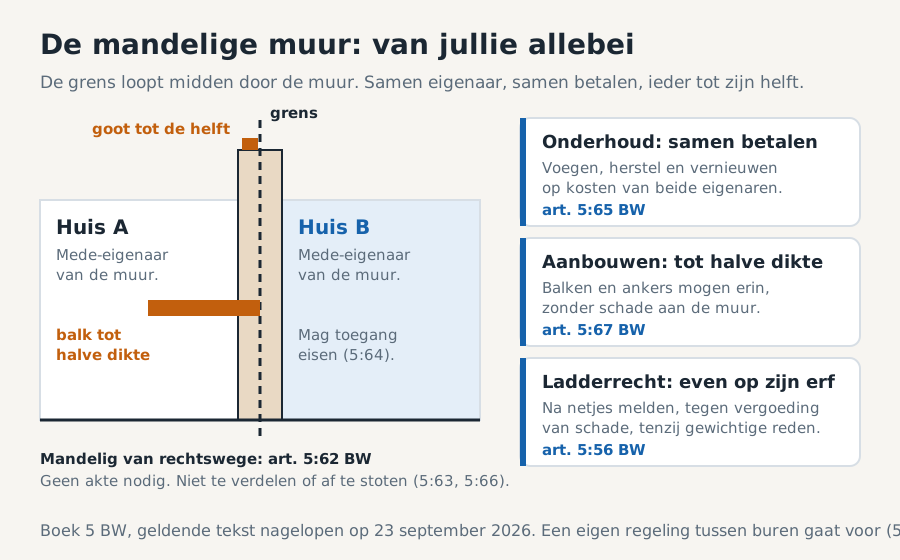
A wall shared by two houses, or a free-standing wall, fence or hedge with the boundary running lengthwise underneath, belongs to both neighbours: in Dutch law it is 'mandelig' (article 5:62 of the Civil Code). Maintenance, repair and renewal are paid jointly, normally half each (5:65 with 3:166 and 3:172). Each owner may build against it and set beams into it up to half its thickness (5:67). If work requires you to stand on the neighbours' land for a while, they must allow it after proper notice, against compensation for damage (5:56). This is known as the 'ladder right'.
Rather have it done?
Post your job for free. Plasterers near you respond with their own price and you choose. Your money stays safe until you approve the work.
Is your wall a party wall? How to tell
'Mandelig' means: owned jointly, and tied to the houses. You cannot sell your share separately and you cannot demand that the wall be divided (article 5:63 of the Dutch Civil Code). When you sell your house, your share of the wall passes to the buyer automatically.
A wall needs no deed. The law makes it a party wall as soon as one of these situations applies:
- A wall shared by two houses, garages or other buildings with different owners: the wall between two terraced houses or a semi-detached pair (5:62 paragraph 2).
- A free-standing wall, fence or hedge with the property boundary running lengthwise underneath (5:62 paragraph 1). If the garden wall stands right on the boundary, it belongs to you both.
- Not a party wall: a wall that stands entirely on one of the two plots, even if it sits right against the boundary. It belongs privately to the owner of that land.
- Partly a party wall: if your neighbour builds an extension against your outside wall, only the section both buildings now share becomes jointly owned. The part above it stays yours. The Zeeland-West-Brabant court therefore had a neighbour remove an air conditioning unit he had fixed to that wall above his extension (16 April 2025).
Who pays, who decides: eight situations
Most questions about a shared wall can be answered in one line once you put the article next to it. Below are the eight situations that come up most often in Dutch case law. If you and your neighbour have agreed something else in writing, that agreement takes precedence (5:69 with 3:168).
| Situation | What you may do | Who pays | Article | What the court said |
|---|---|---|---|---|
| Maintenance, pointing, cleaning | Ordinary maintenance can be arranged by either owner | Jointly, half each | 5:65, 3:170 para 1, 3:172 | Neighbours who did not cooperate constructively with necessary repairs had to pay the damage caused by the delay (The Hague court, 30 October 2024) |
| Crack in the wall | Necessary repairs, arranged together | Jointly, half each | 5:65 | Repair was needed, but the court gave the neighbour more time because of his situation (Amsterdam court, 22 April 2025) |
| Foundation under the wall | Demand repair when it is necessary | Jointly, but the court can shift it | 5:65, 3:172 | The neighbour had to allow the repair but paid a quarter instead of half, because there had been no proper consultation beforehand (The Hague Court of Appeal, 10 June 2025) |
| Building against the wall | Build against it, beams and anchors up to half its thickness | The builder pays for his own work | 5:67 | An extra storey using the full width of the wall without consent had to go, unless the neighbours were compensated (Amsterdam Court of Appeal, 24 February 2026) |
| Gutter on the wall | A gutter up to half its thickness, no water onto the neighbours' land | Whoever installs it | 5:68 | Stated literally in the law |
| Window or other opening | Decide together; within two metres of the boundary with a view only with consent | Whoever wants the window | 3:170 para 3, 5:50 | Building plans with windows in and next to the shared wall needed consent (Amsterdam court, 8 November 2017) |
| Neighbour demolishes his house | Ask him to prevent damage and finish your wall | The one demolishing | 5:37, 6:162 | Whoever demolishes must prevent damage to the adjoining house and have the exposed side wall properly finished (Den Bosch Court of Appeal, 16 January 2007) |
| Scaffolding or ladder on the neighbours' land | Temporary use after proper notice | Whoever has the work done compensates damage | 5:56 | Without proper notice and an offer of compensation, the court refused the request (Rotterdam court, 3 March 2025) |
Dutch Civil Code Books 3 and 5, current text checked on 23 September 2026. The rulings are published on rechtspraak.nl; their references are listed further down.
May I build on a party wall?
Yes, up to half. Article 5:67 paragraph 1 gives each co-owner the right to build against the shared wall and to set beams, joists, anchors and other works into it up to half its thickness, provided the wall and whatever the neighbours have lawfully attached to it are not harmed.
Paragraph 2 is the part hardly anyone knows. Except in emergencies, a neighbour may demand that before work starts an expert determines how it can be done without harming the wall or his own works. If your neighbour plans an extension or extra storey against your shared wall, that is the tidy route for both of you: a structural engineer looks first, and everyone knows where they stand.
Using the full width of the wall goes beyond your half. In February 2026 the Amsterdam Court of Appeal ruled that an extra storey built over the entire width of the dividing wall without consent had to be removed, unless the builder compensated the neighbours.
Who pays for repairing a party wall or its foundation?
You both. Article 5:65 says jointly owned party structures are maintained, cleaned and where necessary renewed at the expense of all co-owners. How the bill is split is set out in Book 3: the shares are equal (3:166 paragraph 2) and each contributes according to his share (3:172). With two houses, that means half each.
That half is the starting point, not an automatic rule. In June 2025 The Hague Court of Appeal ruled on foundation repair under a party wall. The repair was necessary, so the neighbour had to cooperate. But because the owner who had the work done had not consulted constructively beforehand, the neighbour paid a quarter instead of half. Talking first is not only polite, it affects what you get back.
It works the other way too. In October 2024 The Hague court held that neighbours who did not cooperate constructively in repairing a crack in their shared wall were liable for the extra damage caused by the delay. A crack in the wall you share always starts with a conversation and a joint inspection.
- Take dated photos of the damage, from both sides if possible.
- Send the neighbours a short letter: what you see, that the wall belongs to you both (5:62), and that you want a professional to look at it together.
- Have a professional put the cause and the repair in writing, with a quote you both receive.
- Agree in writing who places the order and how you split the costs, half each unless there is a reason to split it differently.
- If you cannot agree, the subdistrict court can impose an arrangement (3:168 paragraph 2).
My neighbour wants a window or opening in the wall
A window in a shared wall is not maintenance but a change to something you own together. Decisions like that are made together (article 3:170 paragraph 3). On top of that the two-metre rule of article 5:50 applies: a window, door or balcony overlooking the neighbours' land within two metres of the boundary is only allowed with their consent.
A wall standing exactly on the boundary is by definition within those two metres. A window in it overlooking the neighbouring plot is therefore always something to agree together, preferably in writing. In a 2017 case at the Amsterdam court, building plans for a corner property ran into exactly this: the shared wall could not be removed without consent and the windows conflicted with 5:50.
My neighbour is demolishing his house: who finishes the wall?
An owner may demolish his own house. But he has to take the house next door into account. The Den Bosch Court of Appeal put it clearly in 2007: whoever demolishes breaks the existing situation for his own benefit, must investigate what damage could occur, must prevent it as far as possible, and must have the neighbours' exposed side wall properly finished. The Civil Code explicitly names removing support as a form of nuisance (5:37).
Whether the wall is still a party wall after demolition is not settled in a single article. It depends on what remains and what is built afterwards. What you can always do: ask for a baseline survey of your own house before demolition starts, with photos of cracks and a description of the wall. That gives you a record of what changed.
Can the neighbour remove a shared boundary wall, fence or hedge?
Not on his own. A party wall, fence or hedge belongs to you both, and removing it is not maintenance. You decide that together (3:170). For the ordinary wall between two houses, and for a wall, fence or hedge between two plots in a built-up area, a neighbour also cannot give up his share to escape the costs (5:66 paragraph 3).
Does your neighbour not want a new boundary at all? In a built-up area you can demand that he cooperates in a two-metre dividing wall on the boundary, with the costs split equally (5:49), unless a local rule says otherwise. How that works with a fence and a permit is covered in the guide on fence height.
The ladder right: the law in one sentence
The word 'ladder right' is not in the law. It is the common name for article 5:56 of the Dutch Civil Code, which says in short: when work on a property makes it necessary to use another property temporarily, the owner of that property must allow it after proper notice and against compensation, unless he has serious reasons to refuse or postpone it.
That contains four conditions, and the court looks at all four:
- Necessary: the work cannot reasonably be done another way. It does not have to be absolutely necessary; it is enough that there is no reasonable alternative (Northern Netherlands court, 29 March 2024).
- Temporary: scaffolding for the duration of the work, not a permanent passage. For a lasting right to cross someone's land you need an easement, such as a right of way.
- After proper notice: you announce in advance what, where, when and for how long. The law sets no deadline. As a rule of thumb: a few days for a ladder, a few weeks for scaffolding.
- Against compensation: you pay for or repair damage to the garden, paving or fence. Take photos together beforehand, so there is nothing to argue about afterwards.
When may a neighbour refuse the ladder right?
Only with a serious reason, or when the four conditions are not met. A poor relationship with the neighbours is not in itself a serious reason. A few cases show how the court weighs it:
- Conditions not met: in March 2025 the Rotterdam court rejected a ladder-right claim for a new-build project. There was no proper notice, no offer of compensation, and the neighbour also had serious reasons.
- Refusing without good reason: in June 2024 the Gelderland court found that refusing a neighbour access to build a roof extension from the adjoining plot was unlawful.
- A possible serious reason: in interim proceedings in February 2026 the Limburg court found it sufficiently plausible that the neighbour could have a serious reason, and rejected the claim.
- Materials too: the ladder right can also cover temporarily bringing building materials across the neighbouring plot (The Hague court, 27 March 2024).
- Tenants too: if the neighbour rents his house, he cannot refuse either. The Overijssel court ruled this in May 2026, applying article 5:56 together with 7:220 of the Civil Code.
How to ask properly: what goes in your letter
Whether it is scaffolding or repairing your shared wall, a short letter or email in advance prevents most disputes. And if things still go wrong, it is the proper notice the court asks about. Include:
- What needs doing and why it cannot be done otherwise, for example pointing on the side wall or repairing the crack in the wall you share.
- Where you need to stand or what you need: a ladder, scaffolding of a given length, or access to the wall (5:64).
- When it starts and how long it takes, with the name of the professional doing it.
- That you will take photos together beforehand and pay for or repair any damage (5:56).
- For repairs to the shared wall: that the wall belongs to you both (5:62), that you want to share the costs (5:65), and that you both receive the quote.
- A date by which you would like an answer, and how to reach you.
What the courts decided in 2024 to 2026
We searched the rechtspraak.nl register for published civil rulings on party walls and articles 5:65 and 5:67. From 2024 up to 23 September 2026 there are 60. They are mostly about money for repairs: 22 cases concern repairs or cracks, 17 the foundation and 11 an extension or extra storey. Twelve were interim proceedings and seventeen appeals.
For the ladder right we found 44 rulings mentioning it over the same period. The common thread: those who give proper notice and offer compensation usually get access. Those who turn up with a contractor without asking usually do not.
The rulings named on this page, so you can read them yourself:
- The Hague Court of Appeal 10 June 2025, ECLI:NL:GHDHA:2025:1065, foundation repair, neighbour pays a quarter.
- The Hague court 30 October 2024, ECLI:NL:RBDHA:2024:17616, crack in party wall, damage from delay.
- Amsterdam court 22 April 2025, ECLI:NL:RBAMS:2025:2588, repair yes, but with a delay.
- Amsterdam Court of Appeal 24 February 2026, ECLI:NL:GHAMS:2026:501, extra storey over the full width of the wall.
- Zeeland-West-Brabant court 16 April 2025, ECLI:NL:RBZWB:2025:2246, wall partly shared after an extension.
- Den Bosch Court of Appeal 16 January 2007, ECLI:NL:GHSHE:2007:AZ6339, demolition and finishing the side wall.
- Rotterdam court 3 March 2025, ECLI:NL:RBROT:2025:2717, ladder right refused.
- Overijssel court 8 May 2026, ECLI:NL:RBOVE:2026:2514, a tenant must allow the ladder right too.
The next step: someone who actually looks at the wall
With a party wall the next step is almost always practical. A baseline survey before the neighbours demolish or put up scaffolding. A bricklayer for pointing or a crack. A plasterer or painter to neatly finish an exposed wall. With a quote you both see, the conversation about the half is quickly settled.
On JouwPro you post that job for free and local professionals respond with their own price. Mention in your description that it concerns a shared wall, so everyone knows straight away that the quote goes to two addresses.
Done reading?
Describe the job in two minutes. Plasterers respond with their price, you compare and choose. Free, with no strings attached.
Post your job for freeFrequently asked questions
What is a party wall ('mandelige muur')?
A wall owned jointly by two neighbours and tied to their houses. That is the case for a wall shared by two buildings, such as between two terraced houses (article 5:62 paragraph 2 of the Dutch Civil Code), and for a free-standing wall, fence or hedge with the boundary running lengthwise underneath (5:62 paragraph 1). No deed is needed.
Which article of the Dutch Civil Code covers party walls?
Article 5:62 says when a wall is a party wall. Article 5:65 makes you pay jointly for maintenance and renewal, 5:67 lets each owner build against it up to half its thickness, and 5:68 lets each lay a gutter up to half. The split of costs is in 3:166 and 3:172. Agreements you make together take precedence (5:69).
Do I need my neighbours' consent for work on a party wall?
Not for ordinary maintenance or work that cannot wait; either owner may do that alone (article 3:170 paragraph 1). Building against it and setting beams up to half its thickness is also allowed without consent, as long as the wall is not harmed (5:67), but the neighbours may demand that an expert looks first. A window, demolition or a major change is decided together.
Who pays for repairing a party wall?
You both, normally half each (article 5:65 with 3:166 and 3:172). The court can depart from that. In 2025 a neighbour paid a quarter of a foundation repair, because the owner who had the work done had not consulted properly beforehand (The Hague Court of Appeal, 10 June 2025). So talk first and share the quote.
What is the difference between a party structure and ordinary joint ownership?
A party structure ('mandeligheid') is a special form of joint ownership. In ordinary joint ownership anyone can ask for division. With a party wall that is not possible, and your share is tied to your house: it passes on sale and cannot be sold separately (article 5:63 of the Dutch Civil Code).
Can the neighbour remove a shared boundary wall, fence or hedge?
Not without you. Removing it is not maintenance but a decision about something you own together, and that is made together (article 3:170). For a wall between two houses or a boundary in a built-up area he also cannot give up his share to escape the costs (5:66 paragraph 3).
What is the ladder right?
The right to temporarily use the neighbours' land for work on your own house or garden, for example for a ladder or scaffolding, when it cannot be done otherwise. You give notice in advance and compensate any damage. The neighbours may only refuse or postpone with a serious reason. It is in article 5:56 of the Dutch Civil Code.
When can you refuse the ladder right?
When there is a serious reason, or when the conditions are not met: the work can be done differently, it is not temporary, no proper notice was given or no compensation was offered. A poor relationship with the neighbours is not in itself a serious reason. In 2025 the Rotterdam court rejected a request because notice and compensation were missing.
May I enter the neighbours' garden for maintenance without consent?
Not without giving notice. The ladder right gives you a right of access, but you have to announce it in advance and agree on timing and damage. If the neighbours refuse without a serious reason, the court decides, often in interim proceedings. You do not simply walk into their garden.
Does the ladder right apply if the neighbours rent?
Yes. In May 2026 the Overijssel court ruled that a tenant may not refuse temporary use for work on the neighbouring house either (article 5:56 together with 7:220 of the Dutch Civil Code). Notify both the tenant and the owner, so everyone is informed.
Does this also apply in an apartment building with an owners' association?
Not inside an apartment building: there the deed of division sets out what is shared and the owners' association decides on maintenance. If the building adjoins another house, the wall between those two buildings is a party wall (article 5:62 paragraph 2). On the apartment side, the owners' association then acts on behalf of the owners.
Sources
Every claim on this page comes from one of these sources. They were checked on 30 August 2026. Legislation changes, so check the source itself if anything matters to you.
- Dutch Civil Code Book 5, articles 37, 49, 50, 56 and 60 to 69 (nuisance, dividing wall, windows, ladder right and party structures), current text
- Dutch Civil Code Book 3, articles 166, 168, 170 and 172 (shares, arrangement, management and costs of joint ownership), current text
- The Hague Court of Appeal 10 June 2025, ECLI:NL:GHDHA:2025:1065, foundation repair of a party wall, neighbour pays a quarter
- Den Bosch Court of Appeal 16 January 2007, ECLI:NL:GHSHE:2007:AZ6339, demolition and finishing the neighbours' side wall
- Overijssel court 8 May 2026, ECLI:NL:RBOVE:2026:2514, a tenant must allow the ladder right too
- Rechtspraak, published civil rulings on party walls, 5:65, 5:67 and the ladder right, count 2024 to 2026
Tools for your own address
Three things you can check here for free that you will not find like this anywhere else. They run on open data from the Dutch Land Registry, the buildings register and the national energy agency, so the answer applies to your house and not to an average.
This is not legal advice
We set out what the rules say and where they are. Your situation may differ, and in a dispute your own contract, your deed of division or your local council's bylaw takes precedence. If you cannot work it out, Het Juridisch Loket, the Huurcommissie or a lawyer can help.