Hidden defect in the house you bought: who pays, and what now?
Sources checked on 29 September 2026
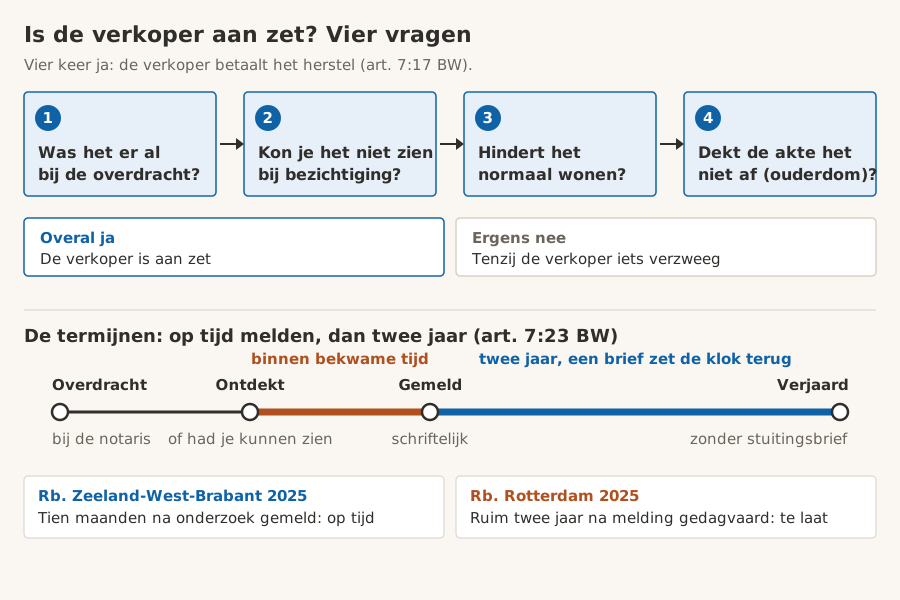
The seller is responsible if the defect was already there at transfer, you could not see it at the viewing, it hinders normal living and the purchase deed does not exclude it (article 7:17 Dutch Civil Code). Report it in writing within a reasonable time after discovery. From that report you have two years to settle it, and a letter restarts that period (article 7:23). Have a professional record the defect first and repair only after that.
Rather have it done?
Post your job for free. Roofers near you respond with their own price and you choose. Your money stays safe until you approve the work.
Four questions the court asks
Whether a defect is the seller's problem depends on four questions. Answer them for your own situation and you know where you stand.
- Was the defect already there at transfer? A leak that starts a year later is yours. If the cause is older, that counts. You have to make that plausible, which is why a report on the cause matters so much.
- Could you not see it at the viewing? A fresh damp patch behind a cupboard you could not see. A crack anyone can see, or a roof the agent mentioned, counts differently.
- Does it hinder normal living? A home must have the qualities needed for normal use (article 7:17(2) Dutch Civil Code). A leaking roof hinders that. A dated window frame does not.
- Does the deed not exclude it? Older homes often have an age clause in the deed. It can exclude a defect that comes with the age of the house. More on that below.
Per defect: when is the seller responsible?
This is the lookup table. Find your defect, see when it is usually the seller's and when it is not, and which professional can record and repair it.
Use the table as a starting point. The court always looks at everything together: the age, the price, what the questionnaire said and what you could have seen.
| Defect | Usually the seller if | Usually yours if | Who records it |
|---|---|---|---|
| Leaking roof or dormer | It already leaked and the questionnaire said no leaks | It started after a storm or the roof was visibly worn | Roofer |
| Banging or creaking roof | It bangs often and loudly because of how it was laid | It ticks now and then in the heat, or it was disclosed | Roofer or building surveyor |
| Leak inside or in an extension | The cause is older than the transfer | You worked on it yourself before it was recorded | Plumber or roofer |
| Sewer leaking or not connected | It does not work or is not connected | It is the old sewer of an old house and the deed has an age clause | Plumber or drain specialist |
| Foundation or subsidence | It could not be seen and the seller knew | Cracks were visible or it is known in the area | Building surveyor |
| Damp and mould | Damp was freshly painted or boarded over | It is condensation from too little ventilation | Building surveyor or insulation installer |
| Wood rot or woodworm | It was behind finishing and not visible | It was visible on frames or beams | Carpenter or pest controller |
| Asbestos | The seller knew and did not say | The house is from before 1994 and the deed has an asbestos clause | Asbestos survey |
What counts as a hidden defect, and what does not?
The law does not use the words hidden defect. It says the home must meet what you could expect under the sale, and in any case what is needed for normal living (article 7:17 Dutch Civil Code). Lawyers call a home that falls short non-conforming.
What usually does not count: wear that comes with age, something you could have seen at the viewing, something the seller disclosed, and wishes you did not put in the sale. A twenty-year-old boiler that gives up is bad luck, not a defect, if it still worked at transfer.
The age clause: what it does and does not cover
With an older home the deed often says the seller cannot vouch for defects related to age. Such a clause is not a free pass. It covers what you can expect from a home of that age, not everything.
Two rulings show the difference. In Limburg (2025) a 62-year-old house had a leaking sewer. The court ruled against the buyers: with the age clause they knew old sewers may need replacing, and it was not established that the sewer already leaked at the sale.
In Zeeland-West-Brabant (2023) the deed also had an age clause and the agent had said the roof could creak in the wind. Still the buyer won. The roof banged 66 times in one week above the noise limit, and the cause was the way the roof panels had been laid. That has nothing to do with age.
The buyer's duty to investigate, the seller's duty to disclose
As a buyer you must look around reasonably, and the seller must tell what he knows. The seller's duty to disclose comes first: if he kept quiet about something he knew, he cannot argue that you should have found it.
The questionnaire at the sale weighs heavily. If the seller filled in that there were no leaks, you may rely on that. In the dormer case (2025) that was exactly why the buyer did not have to investigate further.
No building survey? You keep your rights. But if you saw something that raises questions, such as a damp patch or a sagging floor, you are expected to ask or have it checked. What a surveyor would have seen may then count against you.
How long can you come back on a hidden defect?
There are two clocks. The first runs from discovery: you report the defect within a reasonable time (article 7:23(1) Dutch Civil Code). No fixed number of weeks applies, except when you bought from a business: then within two months is always in time.
May you have an expert look first? Yes. The court finds it reasonable that you first want to know the cause, as long as that investigation moves quickly. In the dormer case the buyer reported more than ten months after the first survey, and that was still in time because the seller suffered no harm from it.
The second clock starts at the report: two years later your claim is time-barred (article 7:23(2)). A letter in which you clearly reserve your right to repair or compensation restarts that period. In Rotterdam (2025) this went wrong: liability claimed in March 2023, summons only in April 2025, time-barred.
If the seller knew and kept quiet, you can also rely on mistake (article 6:228 Dutch Civil Code). For that you have three years after discovery (article 3:52).
What you have to prove
You have to show that the home did not meet what you could expect, and that the defect was already there at transfer. That second point often decides the case, and a report made before the repair is where you make the difference.
In The Hague (2025) a buyer lost over a leaking extension because the statements about the defect dated from after their own work on that extension. Nobody could see any more what it looked like at transfer. The lesson: record first, then demolish or repair.
How to handle it, in five steps
This is what the buyers who won had in common: they recorded the defect before anything changed, and there was a reasoned report or a quote naming the cause.
- Take dated photos and videos, and write down when you first noticed the defect.
- Do not demolish or repair anything yet, except what is needed to prevent worse, such as a tarp over the roof. Record that too.
- Have a professional describe the defect: the cause, since when it is likely there, how it should be repaired and what that costs. In the banging roof case the court worked from the roofing company's quote.
- Report it to the seller in writing, with the photos and the report. Email works, a registered letter is stronger proof.
- Give the seller a reasonable period to respond or have it repaired. If he does not respond, you can have it repaired yourself and claim the costs from him.
A report you can copy
Keep it businesslike and short. This is a draft, adjust it to your situation:
Dear [seller's name], on [transfer date] I bought the home at [address] from you. On [date] I discovered that [description of defect]. According to [company name] the cause is [cause], and it was already there at transfer. This hinders normal use of the home. I hereby notify you under article 7:23 Dutch Civil Code and reserve all rights, including repair and reimbursement of costs. Please let me know within fourteen days how you want to resolve this. I enclose the photos and the report.
Five rulings that show it
Every case stands on its own, but together they show what matters. All five read in full in the open data of the Dutch judiciary.
| Ruling | Defect | Outcome and why |
|---|---|---|
| District court Zeeland-West-Brabant, 8 November 2023, ECLI:NL:RBZWB:2023:7993 | Banging roof | Buyer wins despite an age clause: the roof was laid wrongly and banged far above the noise limit. Damage set on the roofing company's quote. |
| District court Zeeland-West-Brabant, 24 September 2025, ECLI:NL:RBZWB:2025:6498 | Leaking dormers | Home does not conform, and reporting after ten months was in time because the seller suffered no harm. The amount of damage follows later. |
| District court Limburg, 3 December 2025, ECLI:NL:RBLIM:2025:13194 | Leaking sewer | Buyer loses: age clause on a 62-year-old house, and it was not established that the sewer already leaked at the sale. |
| District court The Hague, 1 May 2025, ECLI:NL:RBDHA:2025:7734 | Leaking extension | Buyer loses: not shown that the defect was there at delivery. The statements dated from after their own work on the extension. |
| District court Rotterdam, 24 December 2025, ECLI:NL:RBROT:2025:15216 | Mice and a toilet | Buyer loses: summons issued more than two years after the report, so time-barred. |
A leak after buying your home
With a leak nearly everything turns on one question: was it already leaking, or did it start later? A leak that appears with the first heavy rain after transfer points to an old cause. A leak after a storm a year later does not.
Have the cause found before anything is sealed over. Traces of earlier repairs, such as fresh sealant or a new piece of ceiling, are often the strongest proof that the seller knew. A roofer or plumber can describe what he sees and how old it is.
A banging roof after buying
A roof that bangs loudly in heat or cold is usually caused by roof panels fixed too tightly, so they cannot expand. That is a construction fault, not wear, and an age clause usually does not help the seller then.
What counts is how often and how loud. In the 2023 case it was measured for a week, and the court compared the peaks with the noise limits of the Activities Decree because there is no separate standard for a banging roof. So have it measured and have a roofer describe how the panels were laid.
Having the defect recorded and repaired
For your report to the seller you need a description of the cause and a quote for the repair. Post it as a job on JouwPro with the photos, and ask in the description for a quote that names the cause, the repair method and what can be reused. Professionals nearby bid, and you choose who does it.
Done reading?
Describe the job in two minutes. Roofers respond with their price, you compare and choose. Free, with no strings attached.
Post your job for freeFrequently asked questions
How long can you come back on hidden defects?
You report the defect within a reasonable time after you discovered it or could have. From that report you have two years before your claim is time-barred (article 7:23 Dutch Civil Code). A letter reserving your rights restarts those two years. There is no fixed end date counted from the sale itself.
Who carries the burden of proof for hidden defects?
The buyer. You must make it plausible that the home did not meet what you could expect, and that the defect was already there at transfer. The latter works best with a professional's report describing the cause and its age, made before anything was repaired.
Is a leak a hidden defect?
It can be, if it already leaked at transfer, you could not see it at the viewing and the seller did not disclose it. A leak that arises later from a storm or wear is for the new owner. Have the cause recorded before you repair anything.
What does not count as a hidden defect?
Wear that comes with the age of the house, defects you could see at the viewing, things the seller disclosed, and what an age clause in the deed excludes. Something that does not hinder normal living, such as a dated kitchen, is also outside it.
What if you did not have a building survey done?
You keep your rights. The seller still has to disclose what he knows. But if you saw signs that raise questions, such as damp patches or cracks, and did not have them checked, the court may find you did not meet your duty to investigate.
Can you still act on hidden defects after two years?
Yes, if you only discover the defect later. The two years run from your report, not from the sale. If you already reported it, send a letter reserving your rights within those two years. That restarts the period. If the seller knew, there is also mistake, with three years from discovery (article 3:52 Dutch Civil Code).
Sources
Every claim on this page comes from one of these sources. They were checked on 29 September 2026. Legislation changes, so check the source itself if anything matters to you.
- Dutch Civil Code Book 7, article 7:17 (what you may expect) and 7:23 (reporting and limitation), current text
- Dutch Civil Code, article 6:228 (mistake) and 3:52 (period)
- District court Zeeland-West-Brabant 8 November 2023, ECLI:NL:RBZWB:2023:7993, banging roof
- District court Zeeland-West-Brabant 24 September 2025, ECLI:NL:RBZWB:2025:6498, dormers and duty to report
- District court Limburg 3 December 2025, ECLI:NL:RBLIM:2025:13194, sewer and age clause
- District court Rotterdam 24 December 2025, ECLI:NL:RBROT:2025:15216, limitation after the report
- Juridisch Loket (Dutch legal aid desk), hidden defects in a purchased home
Tools for your own address
Three things you can check here for free that you will not find like this anywhere else. They run on open data from the Dutch Land Registry, the buildings register and the national energy agency, so the answer applies to your house and not to an average.
This is not legal advice
We set out what the rules say and where they are. Your situation may differ, and in a dispute your own contract, your deed of division or your local council's bylaw takes precedence. If you cannot work it out, Het Juridisch Loket, the Huurcommissie or a lawyer can help.