Blocked toilet: what can you do yourself and when do you call someone?
Sources checked on 30 August 2026
If only the toilet is blocked and the rest of the house drains normally, the blockage sits just behind the bowl and a plunger or an auger usually clears it. If water comes back up in the shower or the kitchen when you flush, it sits deeper and pushing will not help. On your own property you pay for the unblocking; if it is in the municipal pipe, the municipality does. Expect 120 to 180 euro for a normal toilet unblocking, with a surcharge of 25 to 100 percent outside office hours.
Rather have it done?
Post your job for free. Plumbers near you respond with their own price and you choose. Your money stays safe until you approve the work.
First: does the rest of the house still drain?
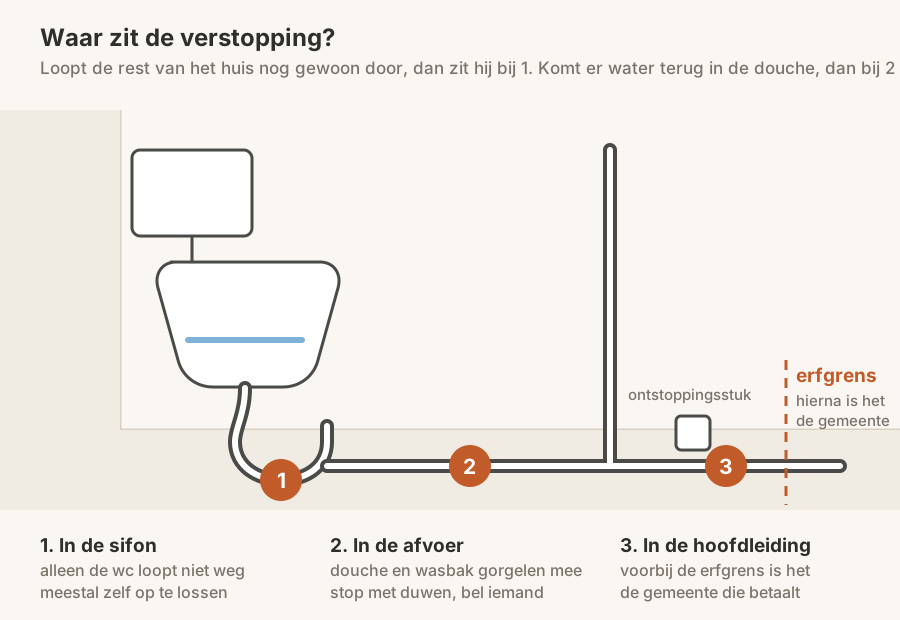
This is the only question that matters at the start, and it costs nothing. Run the kitchen tap and the shower. If those drain normally while only the toilet stays full, the blockage is in the bend directly behind the bowl. That is the easy case.
If water rises in the shower tray, the sink gurgles, or you smell sewer inside, the problem is in the main drain that everything feeds into. Pushing does not help there; you only compact the blockage. This is the moment to stop and call someone.
If the bowl is full to the rim, do not flush again. Every extra flush is six to nine litres with nowhere to go, and an overflowing toilet turns a blockage into a damage claim.
What to try yourself, in this order
An old-fashioned plunger costs around eight euro and clears most ordinary blockages. Make sure there is water in the bowl: a plunger works on water pressure, not on air. Push gently and pull back firmly; the pulling motion is what loosens the blockage.
If that does not work, a drain auger is the next step. That is a flexible cable you turn through the bend. Feed it in slowly and never force it. On old ceramic drains or a loose bowl, too much force creates cracks that cost far more than the unblocking.
What to avoid: chemical drain cleaners based on caustic soda. They rarely shift a real blockage, they attack older pipes, and if a technician has to come afterwards he is working in caustic liquid. Some companies refuse the job for that reason or charge extra.
Boiling water is stubborn advice you should not follow on older plastic drain pipes. Warm tap water is fine; boiling water can loosen a glued joint.
Preparation: what to set out before you start
Unblocking is dirty work and it goes wrong more often than people expect. Five minutes of preparation saves an hour of cleaning and sometimes an insurance claim.
- Lay old towels or a sheet around the bowl. Water going over the rim runs straight into the seams of a wooden floor.
- Wear rubber gloves that reach past the wrist. Sewage does not belong on your skin.
- Have one bucket ready to scoop water out and a second for the dirty water.
- Know where the main tap is before you start, not after.
- Used chemical drain cleaner? Wear eye protection and never mix it with anything else.
Unblocking it yourself, step by step
This order is not arbitrary: it runs from the least invasive method to the most invasive. Do not skip a step, because every skipped step increases the chance you cause damage that costs more than the unblocking itself.
- Do not flush again. If the bowl is full, every extra flush is six to nine litres with nowhere to go.
- Put on a rubber glove and see whether you can spot the cause. A toy, an air freshener or a wad of paper you simply take out by hand, and you are done.
- Scoop water out until the bowl is about a third full. Too full does not work and it splashes; completely empty does not work either, because a plunger needs water.
- Place the plunger over the opening so the rubber cup is fully submerged and no air can get in.
- Push down gently and then pull up firmly. Repeat ten to fifteen times. The pulling motion loosens the blockage, not the pushing.
- If that fails, pour a bucket of warm tap water with a dash of washing-up liquid into the bowl and wait twenty minutes. The soap makes grease slippery; warm tap water is enough, boiling water is not.
- Still blocked? Turn a drain auger slowly through the bend. If you feel resistance, keep turning but do not force it through.
- If it still does not drain after two attempts with the auger, stop. From here you break more than you fix.
Do baking soda and vinegar actually work?
This is the most repeated advice on the internet and it is only half true. Baking soda and vinegar react with each other and that fizzes, and the fizzing looks like something is happening.
With a thin layer of grease in the drain it does help: it loosens the layer and it is harmless to your pipes. With a real plug of toilet paper or a wet wipe it does nothing, because the fizzing has no force and the reaction is over within a minute.
The practical rule: try it on a drain that runs slower than normal. On a toilet that stands completely still, skip this step and reach for the plunger.
What you should not do afterwards is pour chemical drain cleaner on top. You then no longer know what is in the bowl, and that is exactly the situation where a technician refuses to work.
Who pays: you, your landlord or the municipality
The line runs at the property boundary. The sewer on your own plot is yours to maintain. The pipe under the public road belongs to the municipality. That is the national arrangement and nearly every Dutch municipality states it on its website.
In practice: first have it checked on your own property. If the blockage turns out to lie beyond the boundary, report it to the municipality and they will clear it. Most municipalities do not reimburse your investigation, so ask what an inspection costs first.
If you rent, a blockage is in principle for the landlord, unless it was caused by misuse. Wet wipes, cat litter and cooking fat are the classics that shift the bill to the tenant. Always report it to your landlord in writing before you call anyone yourself.
What it costs in 2026
A normal toilet unblocking costs between 120 and 180 euro. That includes the call-out and the first half hour of work; most companies use a starting rate of 100 to 120 euro and then charge per hour.
The hourly rate of a drain company is between 60 and 120 euro. If the blockage sits deeper and needs high-pressure flushing, it rises; a camera inspection is charged separately.
Outside office hours, at weekends or on public holidays a surcharge of 25 to 100 percent applies. That is the difference between tonight and tomorrow morning, and with a second toilet in the house it is a real choice.
Always ask separately for the starting rate, the hourly rate and the emergency surcharge. An advertised price of "from 49 euro" is almost always the call-out only.
| Item | Amount | What it covers |
|---|---|---|
| Unblocking a toilet | 120 to 180 euro | Call-out plus the first half hour of work |
| Call-out rate | 100 to 120 euro | What most firms charge before the clock starts |
| Hourly rate after that | 60 to 120 euro | Per hour, on top of the call-out rate |
| Out of hours surcharge | 25 to 100 percent | Evening, weekend or public holiday |
Amounts include VAT, taken from national drain clearing firms. An advert saying "from 49 euro" almost always covers the call-out only.
Prevention, and this is not an empty phrase
By far the most blockages a technician removes are not toilet paper but wet wipes. Even wipes labelled flushable do not break up the way toilet paper does; they stick together and combine with fat into a plug.
Cooking fat and oil do not belong in the drain. They solidify as they cool and form the layer everything else sticks to. An empty container and the general waste bin are enough.
If there is a tree near your sewer connection and you have repeated trouble, have a camera run through the pipe once. Root ingrowth is one of the few causes that does not resolve itself and only gets worse.
Done reading?
Describe the job in two minutes. Plumbers respond with their price, you compare and choose. Free, with no strings attached.
Post your job for freeFrequently asked questions
How do I know whether the blockage is mine or the municipality's?
If all drains in the house are slow at once and water comes back up, it is probably in the main pipe. Where exactly shows at the inspection point on the property boundary; a drain company can measure which side it is on. If it is on the street side, it is the municipality.
Can I use chemical drain cleaner?
You may, but it is rarely effective on a real blockage and it damages older pipes. If a technician does come afterwards, tell him you used it: he has to take protective measures and some companies charge extra for that.
What does unblocking a toilet cost outside office hours?
Expect the normal rate plus 25 to 100 percent. On a normal 120 to 180 euro toilet unblocking that comes to 150 to 360 euro. With a second toilet in the house, waiting until morning is often the sensible choice.
I rent. Who pays for the unblocking?
In principle the landlord, unless the blockage was caused by misuse. Always report it in writing first and give the landlord the chance to arrange it; calling someone yourself without reporting usually leaves you with the bill.
Why does my toilet keep blocking?
Repeated blockages point to something structural: a drain with too little fall, subsidence, or root ingrowth. Repeated unblocking costs more over time than one camera inspection that finds the cause.
Can I flush it out with a pressure washer myself?
Do not. An ordinary pressure washer does not have the right hose or nozzle for a sewer and the pressure can break an old clay pipe or a glued joint. That is exactly the kind of damage an insurer treats as your own fault.
Sources
Every claim on this page comes from one of these sources. They were checked on 30 August 2026. Legislation changes, so check the source itself if anything matters to you.
- Municipality of Arnhem, blocked sewer: who is responsible
- Municipality of Westland, what to do with a blocked sewer
- Municipality of Veenendaal, reporting a blocked sewer
- Municipality of Oldebroek, blocked sewer
- Rioolkring, cost of sewer unblocking 2026
- ORS Rioolservice, cost of sewer unblocking
- Ontstoppingsdienst.nl, common prices for unblocking
Tools for your own address
Three things you can check here for free that you will not find like this anywhere else. They run on open data from the Dutch Land Registry, the buildings register and the national energy agency, so the answer applies to your house and not to an average.
This is not legal advice
We set out what the rules say and where they are. Your situation may differ, and in a dispute your own contract, your deed of division or your local council's bylaw takes precedence. If you cannot work it out, Het Juridisch Loket, the Huurcommissie or a lawyer can help.