Can I still buy rat or mouse poison myself?
Sources checked on 30 August 2026
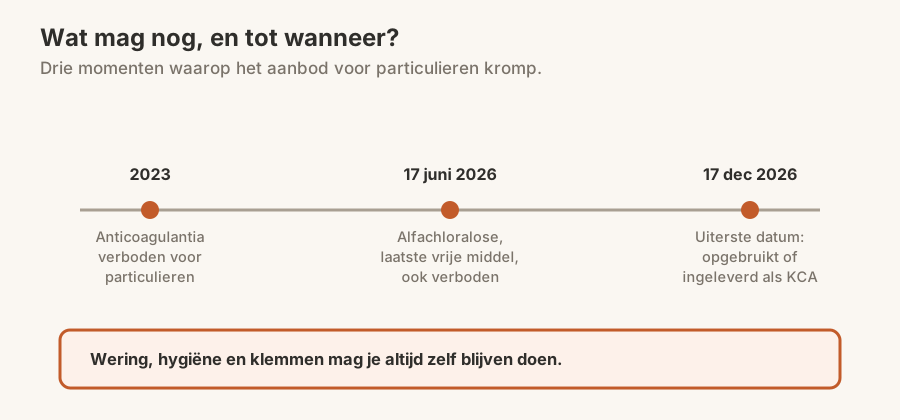
The Dutch knowledge and advice centre for pests, KAD, reports that private individuals have not been allowed to buy poison based on anticoagulants since the 2023 rule change. The last product that stayed on sale after that, mouse poison based on alphachloralose, may no longer be sold to private individuals since 17 June 2026 either. Still have a box at home? You must use it up or hand it in as chemical waste by 17 December 2026 at the latest. Proofing, hygiene and traps are still yours to do.
Rather have it done?
Post your job for free. Pest controllers near you respond with their own price and you choose. Your money stays safe until you approve the work.
What changed?
KAD, which carries out no pest control itself and therefore has nothing to sell, reports that buying poison based on anticoagulants has been prohibited for private individuals since the 2023 rule change.
Mouse poison based on alphachloralose stayed on sale after that as the only product you could still just buy in a shop, in bait boxes. That authorisation has now also been withdrawn: sale to private individuals is banned since 17 June 2026, and using it or keeping it in stock is banned from 17 December 2026. So this is not part of the 2023 rule change, but a later and separate step.
The Ctgb, which decides which biocides are authorised in the Netherlands, allows rodenticides based on anticoagulants only for trained professional users working to integrated pest management. The Human Environment and Transport Inspectorate enforces this.
If you want to know what is currently still authorised for private use, check the Ctgb authorisation register or the government portal biociden.nl. It lists per product who may use it and under what conditions. Web shops that claim otherwise have an interest in doing so.
Why these rules exist
Poison works slowly. A rat or mouse that takes it is weakened for days, and a weakened animal is exactly what cats, owls and birds of prey catch. That is why outdoor use carries strict conditions.
There is a second issue. Research into resistance in brown rats and house mice, submitted to the Dutch Senate, shows the products no longer work as they should in some places. Years of laying out poison breeds the population that no longer dies from it.
In short: topping up bait blocks yourself for years is not only prohibited, it is also the way to make the problem bigger than it was.
What can you do yourself?
Proofing is the only thing that lasts. A mouse gets through a gap you cannot fit your little finger into, so seal gaps around pipes, vents, the crawl space hatch and where the facade meets the roof. Use material they cannot gnaw through, not expanding foam.
Take the food away. Bird feed, a spilled feeder, dog mess, compost with kitchen scraps and open rubbish bags are the reason they stay at your place and not at the neighbours'.
Traps are yours to use. Set them along the wall where the animals run, not in the middle of the room, and check them daily. If you find a dead animal, do not handle it with bare hands.
If you see several animals during the day, you already have a population rather than a passer by. That is the moment to call a professional.
Who is responsible: you or the council?
The main line is simple. On your own land and in your own home you are responsible, as owner or as tenant. In public space and where the municipal sewer leaks, the council is.
Exactly where that line falls differs per municipality and is set out in the local bylaw and on the council website. Councils such as Rotterdam and Utrecht explain on their own pages what they do and do not do and where to report.
If you rent, it also depends on your tenancy agreement and on whether the problem stems from a defect in the property. Report it to your landlord in writing before you call anyone in yourself, otherwise the bill stays with you.
What to look for in a pest controller
Ask whether they work to integrated pest management. That means inspection first, then proofing and removing food sources, and only a chemical product if it is genuinely needed. Anyone who starts with poison is doing it the other way round.
Ask about competence and about the quality mark. KPMB is the Dutch quality mark for pest management companies and gives you something to select on.
If you farm, the IPM-KBA certificate for rodent management on agricultural businesses has applied since 1 January 2023. That is a different scheme from the one covering your home.
Have them explain what happens after the treatment. A controller who only removes animals and leaves the gaps open will be back next year at your expense.
Done reading?
Describe the job in two minutes. Pest controllers respond with their price, you compare and choose. Free, with no strings attached.
Post your job for freeFrequently asked questions
Can I still buy rat poison as a private individual?
No. Poison based on anticoagulants has been prohibited for private individuals since the 2023 rule change, and mouse poison based on alphachloralose, the last product that stayed on sale, may no longer be sold either since 17 June 2026. What exactly is still authorised for private use can be checked in the Ctgb authorisation register.
Why may only a professional use poison?
The Ctgb allows rodenticides with anticoagulants only for trained professional users working to integrated pest management. The reasons are the risk to animals that eat poisoned rodents and the problem of resistance.
So what can I do about mice myself?
Proofing and trapping. Seal gaps with material they cannot gnaw through, remove food sources, and set traps along the walls where they run. That is also the only approach that solves the problem rather than postponing it.
Will the council deal with rats?
In public space and where the municipal sewer is involved, yes. On private land, no. What your council actually does is set out on your own council's website, because it differs.
I rent. Who pays for pest control?
That depends on your tenancy agreement and on the cause. If the problem stems from a defect in the property, such as a hole in the facade or a faulty sewer connection, that is for the landlord. Report it in writing before you call a controller yourself.
How do I recognise a good pest controller?
By the order they work in. Inspect first, then proof and remove food, and only use a chemical product if needed. Ask about competence and the KPMB quality mark, and ask what proofing happens after the treatment.
Sources
Every claim on this page comes from one of these sources. They were checked on 30 August 2026. Legislation changes, so check the source itself if anything matters to you.
- KAD: rodenticide legislation 2023 (Dutch)
- Ctgb: criteria for outdoor use of rodenticides (Dutch)
- Ctgb: rodenticides, safe for people, animals and the environment (Dutch)
- Dierplagenshop: mouse poison ban from 17 June 2026, alphachloralose (Dutch)
- Human Environment and Transport Inspectorate: pest management (Dutch)
- Biociden.nl: rodent management (Dutch)
- Dutch Senate: report on resistance to rodenticides (Dutch)
- Bureau Erkenningen: IPM-KBA for agricultural businesses (Dutch)
- KPMB: quality mark for pest management companies (Dutch)
- Rotterdam council on rats (Dutch)
- Utrecht council: preventing rat nuisance (Dutch)
- Dierenbescherming: mice and rats dossier (Dutch)
Tools for your own address
Three things you can check here for free that you will not find like this anywhere else. They run on open data from the Dutch Land Registry, the buildings register and the national energy agency, so the answer applies to your house and not to an average.
This is not legal advice
We set out what the rules say and where they are. Your situation may differ, and in a dispute your own contract, your deed of division or your local council's bylaw takes precedence. If you cannot work it out, Het Juridisch Loket, the Huurcommissie or a lawyer can help.