Mould on the wall: where does it come from and what do you do about it?
Sources checked on 30 August 2026
A mouldy patch up to half a square metre you can remove yourself with an approved mould remover from the supermarket. The real work is the cause, because mould only grows where it stays damp for a long time. If the patch comes back, appears in several places, or you smell something musty behind a cupboard, there is a leak, rising damp or a cold bridge. A moisture reading costs 0 to 50 euro, actual repair 800 to 4,500 euro. If you rent, report it to your landlord in writing.
Rather have it done?
Post your job for free. Painters near you respond with their own price and you choose. Your money stays safe until you approve the work.
First: is it condensation or is it coming from somewhere?
Almost all mould in Dutch homes falls into two groups, and the difference decides whether this is an hour of work or a bill of several thousand euro. Group one is condensation: warm, humid indoor air settling on a cold wall. You see it in the corner behind a cupboard, above the window, in the bathroom and on the north wall of a bedroom.
Group two is water getting into the wall from outside or from within: a leaking gutter, a failed silicone seal, rising damp from the ground, a leaking pipe in the floor. Those patches are usually darker, feel genuinely wet, and sit low near the floor or right under a window sill.
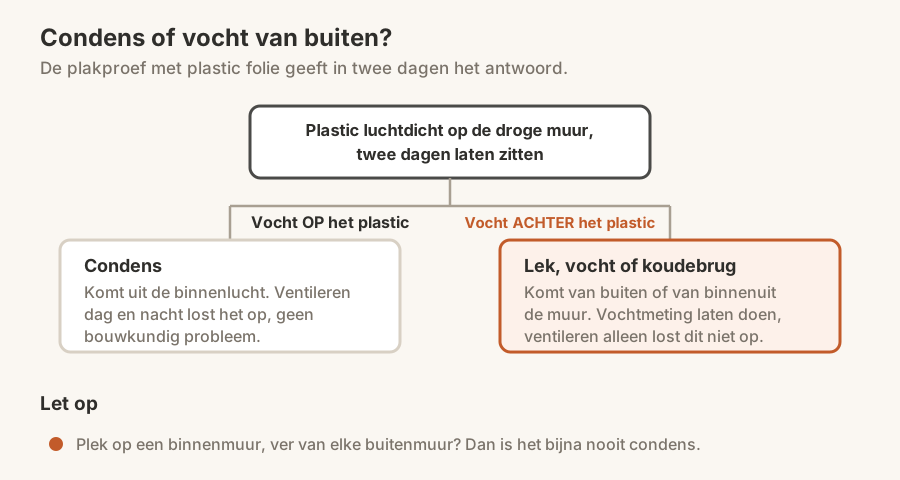
The quickest test costs nothing. Tape a piece of clear plastic, for example cut from a bin bag, airtight onto the dry suspect wall and leave it for two days. If the moisture is on the room side of the plastic, it is condensation. If it is on the wall side, the moisture is coming out of the wall itself and better ventilation will not fix it.
The four causes, and how to tell them apart
Mould is not the problem, it is the evidence. These four together explain almost everything you meet in a home. Work out which one it is before you buy a bottle, because the product is the same for all four and the solution for none of them.
- Condensation and too little ventilation. Black spots in corners, on cold bridges and behind furniture against an outside wall. Worse in winter, almost gone in summer. By far the most common cause.
- Rising damp. A stain that creeps up from the floor to about a metre high, often with white salt deposits and wallpaper coming loose. Mostly in homes built before 1970 without a working damp course.
- A leak from outside. A sharply defined patch under a window, near a gutter, or in the corner of a dormer. Clearly worse after a day of heavy rain and drying back a little afterwards.
- A leak from inside. A pipe in the floor or wall, or a bathroom where the sealant and tiling let water through. The patch stays wet even in a dry week. Close every tap and read your water meter again two hours later; if it has moved, it is a supply pipe.
Removing mould, step by step
This sequence is for a patch of no more than half a square metre on tiles, paint or plaster. Larger areas and porous materials such as wood, plasterboard or sealant follow different rules, which are in the stop rule below.
- Open a window and keep the door to the rest of the house closed. You are loosening spores and you want them going outside, not down the hallway.
- Put on gloves and an FFP2 dust mask. Wear clothes that can go straight into the wash afterwards.
- Wet the patch first with a plant sprayer of water. Dry sanding or dry scrubbing blows the spores into the room, which is exactly what you want to avoid.
- Use an approved mould remover. The packaging carries an authorisation number starting with NL or EU, or ending in an N. Without that number it is not a registered biocide, however confident the bottle sounds.
- Let it work as long as the packaging says, usually fifteen to thirty minutes, then wipe off with a damp cloth. Throw the cloth away instead of rinsing it out in the basin.
- Never mix anything yourself. Bleach together with an ammonia-based cleaner or with vinegar gives off toxic fumes, and a home-mixed solution is not an approved biocide anyway.
- Let the spot dry thoroughly for a few days and keep an eye on it. If the mould is back within two to three weeks, you have not touched the cause and cleaning again is pointless.
- Only paint over once the wall is genuinely dry. Anti-mould paint on a damp surface will come off again within a year.
The stop rule: when to give up on cleaning
There is a point where carrying on yourself only costs time while the underlying problem grows. Stop as soon as one of these five applies.
The patch is bigger than about half a square metre, or it appears in more than one place in the house. At that size it is no longer about showering with the door open.
The mould is in the material rather than on it: soft plasterboard, rotten wood, sealant discoloured all the way through, a chipboard floor that gives. Surface treatment achieves nothing there, the material has to come out.
The patch returns within a month of being removed. That means moisture is still arriving, so you look for the source, not the stain.
Someone in the house has asthma, COPD, another lung condition or a weakened immune system, or there is a baby. Have someone else do the cleaning and get the cause investigated sooner than you otherwise would.
You do not know where the moisture comes from and the patch is on an internal wall. Mould on an internal wall is almost never condensation and often points to a leaking pipe.
When you do not need a specialist for this
Damp companies advertise free inspections that end up recommending an injection treatment remarkably often. There is a sizeable category of mould where you need nobody, and it is more honest to write that down.
- Black spots on the sealant in the shower. That is surface dirt plus condensation. New sealant and wiping the walls down after showering solves it.
- A patch behind a cupboard against the outside wall. Move the cupboard five centimetres off the wall so air can pass behind it. That is the whole repair.
- Steamed-up windows and some mould on the window timber in winter. Leaving vents open and not drying laundry indoors does more than any treatment.
- A one-off patch after a leak that has already been repaired. Let it dry, treat it, done. You do not need a facade injected because water once stood there.
- A musty smell in the crawl space without mould in the living area. Annoying, but no reason for a five thousand euro ground seal as long as the floor is insulated and there is ventilation.
Renting? This is your route
Damp and mould are not automatically a landlord defect, because how a home is used plays a part. But as soon as the cause is structural, think of a leak, a cold bridge or a ventilation system that does not work, it is the landlord's responsibility and not yours.
Always report it in writing, by email or letter, with photos and a date. List the defects and ask for them to be fixed within six weeks. That written report is your most important evidence later; a phone call does not count.
If nothing happens, you can go to the Huurcommissie, the Dutch rent tribunal. It has a defects check that shows in advance whether your situation is serious enough. Mould falls into the heavier categories there, and the Huurcommissie can lower the rent temporarily until it is resolved.
You can also file a report with your municipality's building and housing inspectorate. They can formally instruct the landlord, and in practice that often works faster than a procedure.
What it costs in 2026
Doing it yourself is almost free: a bottle of approved mould remover costs 6 to 12 euro, gloves and an FFP2 mask another 10 euro together. That is the entire budget for a normal bathroom patch.
| Approach | Price | Notes |
|---|---|---|
| Cleaning it yourself | 6 to 22 euro | mould remover, gloves and an FFP2 mask |
| Mould treatment by a company | around 150 euro | for roughly 3 m²; removal only, not the cause |
| Moisture reading | 0 to 50 euro | often free from a damp company, but then part of a sales conversation |
| Injecting against rising damp | 800 to 2,200 euro | per facade |
| Cellar sealing | 125 to 200 euro per m² | depending on accessibility |
| Complete damp project | around 1,900 euro on average | outliers up to 4,500 euro, depending on cause and wall length |
What makes 2026 different from a few years ago is the balance between labour and materials. The products have barely risen, the man-hours have. So have several spots done in one visit rather than separately.
Prevention: dull, free and it genuinely works
Ventilation is the only measure that tackles every source of condensation at once, and it costs nothing. You ventilate day and night, all year round: vents open, mechanical ventilation never switched off. Opening a window for five minutes is airing, which is something else.
Showering: ventilation on the highest setting or the window open, and keep that up for twenty to thirty minutes afterwards. Wipe the walls down with a squeegee, which saves literally litres that would otherwise evaporate into the room.
Drying laundry indoors is the biggest silent moisture source there is. One machine load of wet washing releases two to three litres of water into your indoor air. Drying outside or using a condenser dryer with an outlet makes all the difference in a small flat.
Do not push furniture tight against a cold outside wall and do not let the bedroom cool right down. An unheated room that someone still sleeps in is the classic place where mould starts.
Mechanical ventilation should be cleaned every two years. A clogged unit moves a fraction of what it should, and the bathroom is exactly where you notice that.
Done reading?
Describe the job in two minutes. Painters respond with their price, you compare and choose. Free, with no strings attached.
Post your job for freeFrequently asked questions
Is black mould on the wall dangerous?
For healthy people a small patch is mostly a nuisance. Living in a damp home does raise the chance of coughing, breathlessness and worsening asthma, caused by mould and dust mites in the air. With asthma, COPD or a weakened immune system, acting quickly matters more, and it is better to have someone else remove a larger patch.
Does bleach or vinegar work against mould?
Bleach removes the colour on tiles, but it is not an approved mould remover and on porous material it never reaches the fungal threads. Use a product with an authorisation number starting with NL or EU. Never mix bleach with vinegar or an ammonia-based cleaner, because that combination gives off toxic fumes.
Why does the mould keep coming back in the same spot?
Because you are treating the stain and not the cause. Returning within a month means moisture is still arriving: a cold bridge, a leak or too little ventilation. Work out which of those three it is first; only then does cleaning make sense.
Can my landlord say I do not ventilate enough?
Saying it is allowed, but it comes with the obligation that the home can actually be ventilated and that he has informed you about it. If the mechanical ventilation does not work, vents are missing or there is a cold bridge, it is a structural defect. Report it in writing and let the Huurcommissie defects check judge it.
Do I have to strip wallpaper and plaster or can I paint over it?
If the mould is only on the paint layer or the wallpaper, you can repaint after treating and fully drying. If the plaster feels soft or crumbly, the mould is inside it and it has to come out. Painting over then hides the problem for about six months and after that it is back.
What does it cost to have the cause of damp investigated?
A single moisture reading costs 0 to 50 euro and many damp companies do it free as part of their quote. For an independent judgement you pay a building surveyor. That is worth it as soon as the proposed treatment goes above a thousand euro, because then you are buying certainty about the diagnosis rather than about the treatment.
Are pink or orange stains in the bathroom mould too?
Usually not. Pink or orange residue around the showerhead, in the grout or on the toilet rim is usually a bacterium, Serratia marcescens, not mould. It feeds on soap residue and dust and, like mould, likes damp, so the same approach works: clean with a mould remover or bleach and then ventilate better. If it keeps coming back, the cause is the same damp spot you would tackle for black mould too.
Sources
Every claim on this page comes from one of these sources. They were checked on 30 August 2026. Legislation changes, so check the source itself if anything matters to you.
- Kenniscentrum Z8-Water, pink stains in the bathroom (Dutch)
- Milieu Centraal, removing mould and damp in the home
- GGD Leefomgeving, removing and preventing mould
- RIVM, GGD guideline on mould and damp problems in homes
- Milieu Centraal, ventilating your home
- Rijksoverheid, getting your landlord to deal with poor maintenance
- Huurcommissie, defects check
- Homedeal, cost of damp treatment 2026
Tools for your own address
Three things you can check here for free that you will not find like this anywhere else. They run on open data from the Dutch Land Registry, the buildings register and the national energy agency, so the answer applies to your house and not to an average.
This is not legal advice
We set out what the rules say and where they are. Your situation may differ, and in a dispute your own contract, your deed of division or your local council's bylaw takes precedence. If you cannot work it out, Het Juridisch Loket, the Huurcommissie or a lawyer can help.