Mice in the house: what really works and what is wasted money?
Sources checked on 30 August 2026
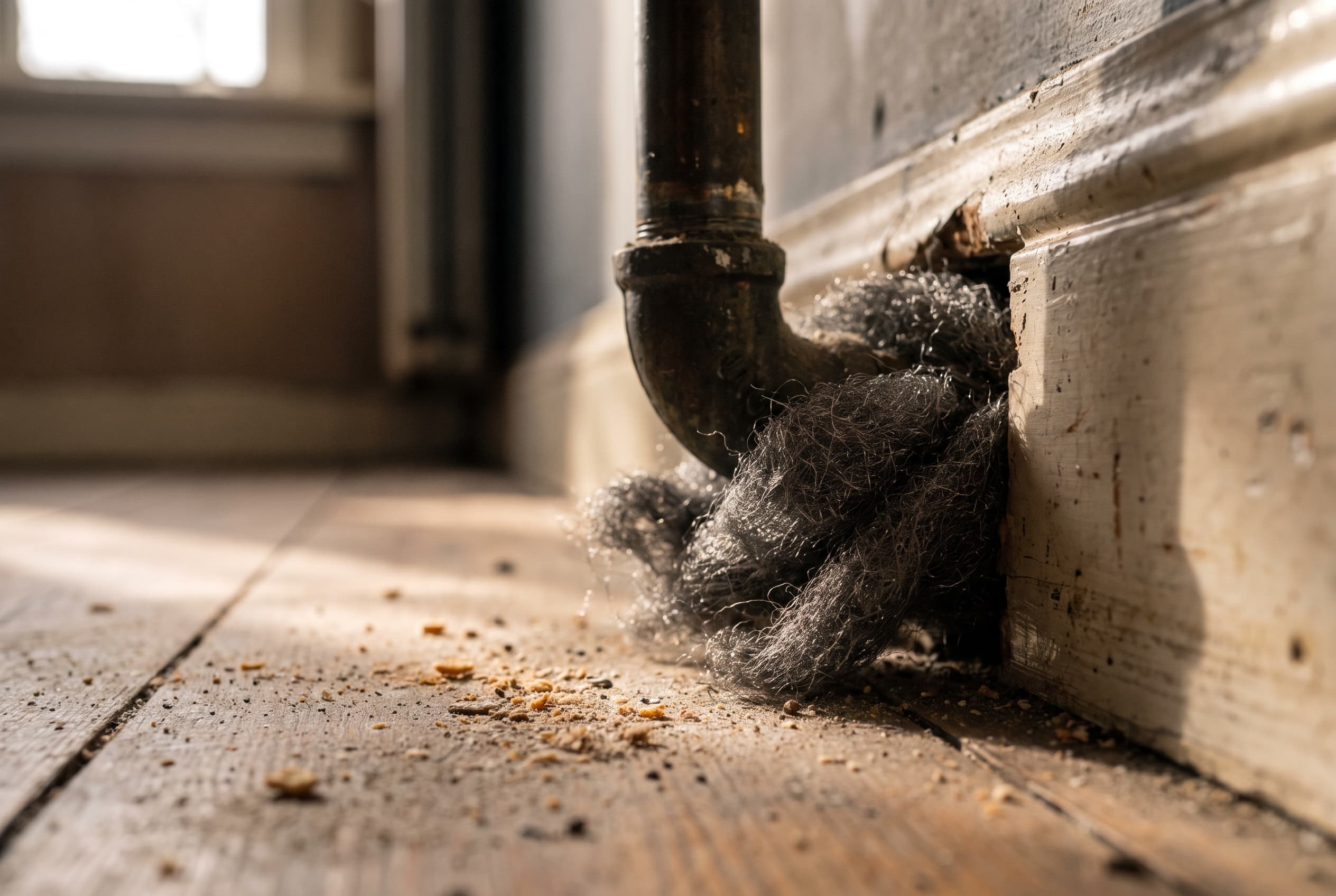
Getting rid of mice is mostly building work: seal every gap from about five millimetres with steel wool, mesh or mortar, and put all food in sealed containers. Only then do you set snap traps, at right angles to the wall where you see droppings. Poison is no longer an option for consumers, because the last freely available product may not be sold since 17 June 2026. If it is not solved after two weeks, call a certified pest manager. Expect 65 to 250 euro per treatment.
Rather have it done?
Post your job for free. Pest controllers near you respond with their own price and you choose. Your money stays safe until you approve the work.
Are you sure they are mice?
Droppings are the best evidence. Mouse droppings are black, roughly 3 to 8 millimetres long and 1 to 3 millimetres thick, pointed at the ends, and they look a lot like chocolate sprinkles. Rat droppings are two to three times bigger and thicker. That difference matters, because rats are handled differently and belong with a professional sooner.
Beyond that you usually hear them in the evening and at night: rustling behind a skirting board, in a suspended ceiling or in the cavity wall. You see gnaw damage on packaging, cables and insulation, and sometimes tail drag marks in the dust. A sharp ammonia-like smell in a cupboard means urine, and that means there is more than one mouse.
A house mouse lives about a year, is sexually mature at two months and has five to six young per litter, six to ten times in her life. That is why waiting two weeks to see if it passes is the worst plan available: in those two weeks the population has grown.
They eat only three to five grams a day. That is why a kitchen that looks clean still offers plenty: an open packet of muesli feeds a whole family.
Poison is no longer an option, and that is the biggest change
Since 2023 consumers may no longer use products based on anticoagulants or cholecalciferol. Those fall under the integrated pest management system, in which prevention and non-chemical methods come first and poison is a last resort used only by certified professionals.
What remained freely available after that was mouse poison based on alphachloralose, to be used only in the bait boxes designed for it. That authorisation has now been withdrawn as well. Sale has been banned since 17 June 2026, and using or keeping stock is banned from 17 December 2026.
In practice: if you still have a box in the shed, use it up this autumn or hand it in as chemical waste. Do not buy more, not through foreign webshops either. That is not only prohibited, it also solves nothing, because poison does not touch the cause.
The reasoning behind the rules is secondary poisoning. A mouse that takes poison does not die immediately and is eaten in the meantime by an owl, a cat or a hedgehog. Anticoagulants linger in the food chain for a long time.
What does work: exclusion first, trapping second
Setting traps without sealing the building is mopping with the tap running: you catch the mice inside while the next one walks in through the same hole. So the order is not optional.
- Seal every opening from about five millimetres. A mouse only needs half a centimetre and can jump some thirty centimetres high, so look above skirting height as well.
- Use material they cannot gnaw through: stainless steel wool, fine mesh, or mortar. Expanding foam alone is useless, they chew through it in one night.
- Watch the standard weak spots: under the front door, where pipes and cables enter the wall, around the meter cupboard, behind the kitchen units, at the soil vent pipe and at air bricks in the outside wall.
- Store everything edible in glass or hard plastic with a sealing lid. Bird seed, cat biscuits, candles and soap are all food to a mouse.
- Clear out the stored clutter they nest in: cardboard boxes against the wall, stacks of newspapers, boxes in the loft. Nesting material matters to them as much as food.
- If the gap is higher than two metres in a cavity wall and wider than seven millimetres, have it checked for protected species first. Bats and swifts use those openings, and sealing them shut is prohibited.
Getting rid of mice, step by step
This sequence works for the ordinary situation: one or a few mice in a home, no business premises, no ongoing infestation. Allow two weekends.
- Find the runs first. Mice travel along walls, not across the middle of a room. Look at where the droppings lie, that is your map.
- Seal every opening you can find in one afternoon, working from outside inwards. Start at ground level and the meter cupboard, because most of them come in there.
- At the same time clear away every food source and move it into sealed containers. Without this step your traps are less attractive than your kitchen cupboard.
- Then set snap traps, and set more than you think you need. For a single mouse, four to six, spread over the runs you have found.
- Place each trap at right angles to the wall, with the bait against the skirting. A trap in the middle of the room catches nothing.
- Bait with something sticky they cannot carry off: peanut butter, chocolate spread, a piece of nut. Cheese performs worse than its reputation.
- Check every day. Do not leave a caught mouse lying, and a trap that does not go off is in the wrong place. Move it a metre along the same wall.
- If it is still going after two weeks, or you catch more than a handful, stop trying yourself and call a certified pest manager. There is a nest or a structural entry point you have not found.
What does not work and what you should not do
More nonsense is sold around mice than around almost any other household problem. This is what keeps coming back and what it delivers.
- Ultrasonic repellers. There is no convincing evidence that they work, and mice get used to sound. The money is better spent on a roll of fine mesh.
- Peppermint oil, bay leaves, dried bulbs and similar home remedies. At best they move the problem to the next room.
- Glue boards. They cause unnecessary suffering: an animal cannot free itself and dies after days. The Dutch food safety authority NVWA files an official report when rats or mice are found on a glue board, under the rule that you must spare an animal unnecessary suffering. In 2024 there were 98 such reports.
- A cat as the plan. Some cats catch mice, many cats watch them. And a cat that eats a poisoned mouse gets ill itself.
- Buying poison abroad or through a webshop that ignores Dutch rules. That is prohibited, the risk is yours, and it does not close the entry point.
- Sealing a hole with expanding foam alone or a piece of cloth. Both are gone within a night.
The stop rule: when to call a pest manager
Doing it yourself is allowed and works in most homes. There are five moments when you should stop trying.
You are still catching mice after two weeks, or the numbers are not falling. Then there is a nest or an entry point you cannot find.
You hear rustling in a suspended ceiling, a cavity wall or a crawl space you cannot get into. Traps do not reach there and someone with a camera and experience should look.
It is rats rather than mice. Bigger droppings, heavier noise, burrows in the garden. Rats belong with a professional and often with a report to the municipality as well.
Cables have been gnawed or you smell scorching. Gnaw damage to electrics is a fire risk and that is no longer a matter of patience.
You live above or next to a restaurant, a supermarket or a vacant property. Then the source is probably not yours and only a joint approach works.
When you do not need a pest controller
Pest controllers like to sell a contract with four visits a year. In an ordinary home that is usually unnecessary, and it is fairer to say so.
One or two mice after the first cold night in autumn. That is the classic pattern: it gets cold outside and they look for warmth. Sealing up and a few traps is enough.
Droppings in the cupboard under the sink, where the pipe enters the wall. Sealing that gap with steel wool and mortar costs five euro and ten minutes.
A mouse in a shed, garage or storeroom with no connection to your home. Annoying, not an infestation.
What you can consider without an infestation: a one-off inspection where someone walks round with you and points out the entry points. That is cheaper than a treatment and it is exactly the knowledge people get stuck on.
Who pays: you, your landlord or the municipality
In your own home you are responsible for keeping mice out and dealing with them. The municipality helps with nuisance in public space and not inside homes, although many municipalities do give free advice.
If you rent, it depends on the cause. If the cause lies in the condition of the property, such as holes in the facade, gaps under the door or a broken soil vent, that is a defect and the landlord has to fix it. If it arises from how the home is used, it sits with the tenant.
The Besluit kleine herstellingen, the Dutch decree on minor repairs, lists pest control among the tenant's small maintenance, but only where the costs are minor and no structural defect lies behind it. A recurring infestation caused by holes in the facade therefore does not fall under it.
Report it in writing with photos, even if you expect the landlord to act straight away. Without that report you have a weak position if it drags on for months.
In a flat with a VvE, the owners association, the facade is common property. If the entry point is in the facade or the cavity, it is a VvE matter and not something you solve inside your own home.
What it costs in 2026
Doing it yourself is cheap: six snap traps 10 to 20 euro, a roll of fine mesh 10 to 15 euro, stainless steel wool 8 to 15 euro, a bag of mortar 10 euro. Fifty euro covers everything.
| Approach | Price | What is included |
|---|---|---|
| Doing it yourself (materials) | around 50 euro | traps, mesh, steel wool and mortar together |
| Small infestation, one room | 65 to 95 euro | inspection, traps or bait boxes, call-out |
| Medium infestation | 100 to 150 euro | extra sealing and a follow-up check |
| Large or recurring infestation | 150 to 250 euro (sometimes more) | several visits and structural sealing |
What makes 2026 different: now that poison has fallen away for consumers, a pest controller's work shifts from treating to excluding. So pay for closing the entry points, because that is the part that actually solves the problem. Always ask separately what is in the price: a quote of 65 euro without a follow-up is more expensive than one of 120 euro with it, as soon as you have to call twice.
Done reading?
Describe the job in two minutes. Pest controllers respond with their price, you compare and choose. Free, with no strings attached.
Post your job for freeFrequently asked questions
Can I still buy mouse poison as a consumer in 2026?
No. Poison based on anticoagulants and cholecalciferol has been off limits to consumers since 2023, and the authorisation for the last freely available product based on alphachloralose has been withdrawn. Sale has been banned since 17 June 2026, and using or keeping stock is banned from 17 December 2026.
How small a gap can a mouse get through?
About half a centimetre is enough. So seal everything from five millimetres, and do not only look near the floor: a mouse jumps some thirty centimetres high and climbs up rough brickwork and pipes.
Why am I catching nothing while there are clearly mice?
Almost always because the trap is placed wrong. Set it at right angles to the wall with the bait against the skirting, where droppings lie. Use sticky bait that cannot be carried off, and set several traps at once. If nothing happens in a week, move them a metre along the same wall.
Are mice dangerous to your health?
The main problem is contamination of food and surfaces by urine and droppings, and gnaw damage to cables and pipes. Disease transmission is uncommon in Dutch homes, but do clear droppings with gloves and dampen them first rather than sweeping dry, so nothing becomes airborne.
My landlord says it is down to my cleaning. Is that right?
It can play a part, but it is rarely the whole explanation. If there is a hole in the facade, a gap under the door or an open pipe penetration, that is a defect of the property and the landlord has to fix it. Report it in writing with photos of the openings, so the conversation is about the entry point and not about your worktop.
What does a pest controller charge for mice?
A small infestation in one room costs 65 to 95 euro including inspection and call-out, a medium one 100 to 150 euro, and a large or recurring infestation 150 to 250 euro or more. The number of visits and whether sealing the entry points is included make the difference.
What do I do with a dead mouse or a nest?
Never handle a dead mouse with bare hands. Put on gloves, put the animal in a double plastic bag and dispose of it with residual waste. Then clean the spot damp rather than sweeping or vacuuming it dry, so you do not stir up dust containing urine or droppings. If you find a nest with young, there is a good chance more adult mice are nearby: seal the entry point first and only set traps afterwards, otherwise the next mouse just walks straight back in.
Sources
Every claim on this page comes from one of these sources. They were checked on 30 August 2026. Legislation changes, so check the source itself if anything matters to you.
- Milieu Centraal, mice in the house
- Kennis- en Adviescentrum Dierplagen, the house mouse
- Ctgb, rodent control and the IPM system
- Dierplagenshop, mouse poison ban from 17 June 2026 (alphachloralose, Dutch)
- Answers to parliamentary questions on glue traps for rats and mice
- Besluit kleine herstellingen, the Dutch decree on minor repairs
- Homedeal, cost of mouse control 2026
Tools for your own address
Three things you can check here for free that you will not find like this anywhere else. They run on open data from the Dutch Land Registry, the buildings register and the national energy agency, so the answer applies to your house and not to an average.
This is not legal advice
We set out what the rules say and where they are. Your situation may differ, and in a dispute your own contract, your deed of division or your local council's bylaw takes precedence. If you cannot work it out, Het Juridisch Loket, the Huurcommissie or a lawyer can help.