Can I install an air conditioner myself?
Sources checked on 30 August 2026
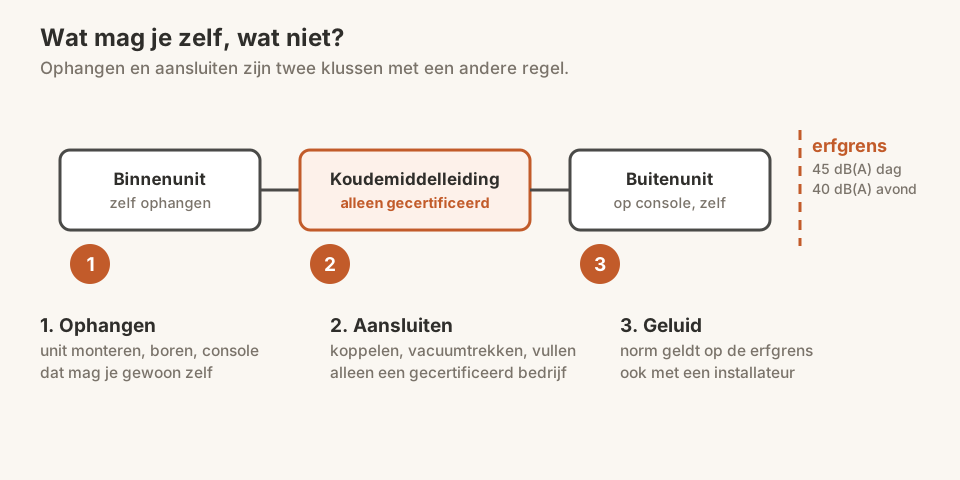
Mounting it yourself is fine. Connecting it is not. The refrigerant in a split air conditioner falls under the European F-gas Regulation, and only a certified company may work with it and buy it. The outdoor unit also has a noise limit at the property boundary: 45 dB(A) during the day and 40 dB(A) in the evening and at night.
Rather have it done?
Post your job for free. Air conditioning installers near you respond with their own price and you choose. Your money stays safe until you approve the work.
What can you do yourself?
Screwing the indoor unit to the wall, drilling the wall penetration, running the condensate drain, putting the outdoor unit on a bracket and having the electrical circuit installed. That is ordinary building and installation work and you can do it yourself or have a handyman do it.
The line is the refrigerant circuit. Connecting lines, pulling a vacuum, pressure testing and commissioning the system is work on a system containing fluorinated greenhouse gases, and that is reserved for certified engineers.
A portable air conditioner or a monoblock with a closed, factory filled circuit falls outside this. Nobody has to touch the refrigerant there, so you can set it up yourself.
Why do you need a certified company?
The F-gas Regulation (EU) 2024/573 has applied since 11 March 2024 and sets out who may work with fluorinated greenhouse gases. Suppliers may only sell refrigerant to certified buyers.
That is the practical reason doing it yourself falls over: you cannot get hold of the charge. And without the right equipment you will not pull the circuit down to vacuum either, which leaves moisture and air inside. You will not notice on day one, but the compressor will a few years later.
Simply ask for the company's certificate number when you get a quote. An installer who is vague about that is the installer you do not want.
Do you need a permit?
Usually not. There are permit free options for an air conditioner or heat pump on or near a home. The Dutch Environment Information Point sets out when that applies.
There are exceptions that often go wrong. For a listed building or in a protected townscape the rules are stricter and a permit is more often required. If you live in an apartment, you also need permission from the owners' association for anything on the facade or the roof, quite apart from what the council thinks.
Check with your council or through the Omgevingsloket before the engineer arrives. An outdoor unit that has to come off again is an expensive lesson.
The noise limit everyone forgets
An outdoor unit may not produce more than 45 dB(A) at the property boundary between 07:00 and 19:00, and no more than 40 dB(A) in the evening and at night. That limit has applied since 1 April 2021 and is part of the Buildings Environment Decree.
It is about where the unit sits, not only about the appliance. The same air conditioner standing free in a garden can go over the limit tucked into a corner against a solid fence. Ask the installer about the sound power of the unit and where they want to hang it, and keep distance from the boundary and from the neighbours' bedroom.
This is the most common reason neighbours complain and the council gets involved. It is also cheapest to solve before anything is mounted.
Do not count on subsidy
An ordinary split air conditioner is an air to air heat pump and does not qualify for the ISDE subsidy. That scheme covers air to water, water to water, ground to water and hybrid heat pumps.
Sellers are sometimes vague about this. If you want subsidy, you are looking for a different type of installation, not a different supplier of the same appliance.
Done reading?
Describe the job in two minutes. Air conditioning installers respond with their price, you compare and choose. Free, with no strings attached.
Post your job for freeFrequently asked questions
Can I mount the unit myself and only have it connected?
Yes, and many installers work this way. You mount the units, drill the penetration and arrange the power, they finish the refrigerant circuit and commission the system. Agree in advance who is responsible for what if a leak turns up later.
What is an F-gas certificate?
Proof that a company and its engineers may work with fluorinated greenhouse gases, such as the refrigerant in a split air conditioner. The requirement comes from the European F-gas Regulation, which has applied in its current form since 11 March 2024.
Do I need a permit for an air conditioner?
Usually not, but it depends on your home and where the outdoor unit goes. Listed buildings and protected townscapes have stricter rules, and in an apartment you also need permission from the owners' association. The Dutch Environment Information Point explains the permit free situations and your council decides.
How much noise may an outdoor unit make?
At the property boundary, no more than 45 dB(A) between 07:00 and 19:00 and no more than 40 dB(A) in the evening and at night. That limit is in the Buildings Environment Decree and has applied since 1 April 2021.
Can I get subsidy for an air conditioner?
Not through ISDE. A split air conditioner is an air to air heat pump and is not on the ISDE list. Air to water, water to water, ground to water and hybrid heat pumps are.
What happens if I connect it myself anyway?
In practice you get stuck, because you cannot buy the refrigerant. If you do it anyway, you are acting against the F-gas rules and you have no warranty left, neither on the installation nor on the appliance.
Sources
Every claim on this page comes from one of these sources. They were checked on 30 August 2026. Legislation changes, so check the source itself if anything matters to you.
- NVKL: the F-gas Regulation (EU) 2024/573
- RVO: technical inspections of heating and air conditioning systems
- Environment Information Point: permit free air conditioners and heat pumps
- Environment Information Point: noise from building installations
- Omgevingsdienst Twente: heat pumps, air conditioning and noise
- RVO: ISDE heat pumps for homeowners
- Nieuwegein council: installing an air conditioner or heat pump
Tools for your own address
Three things you can check here for free that you will not find like this anywhere else. They run on open data from the Dutch Land Registry, the buildings register and the national energy agency, so the answer applies to your house and not to an average.
This is not legal advice
We set out what the rules say and where they are. Your situation may differ, and in a dispute your own contract, your deed of division or your local council's bylaw takes precedence. If you cannot work it out, Het Juridisch Loket, the Huurcommissie or a lawyer can help.