Cracks in the wall: when is it serious and when is it not?
Sources checked on 30 August 2026
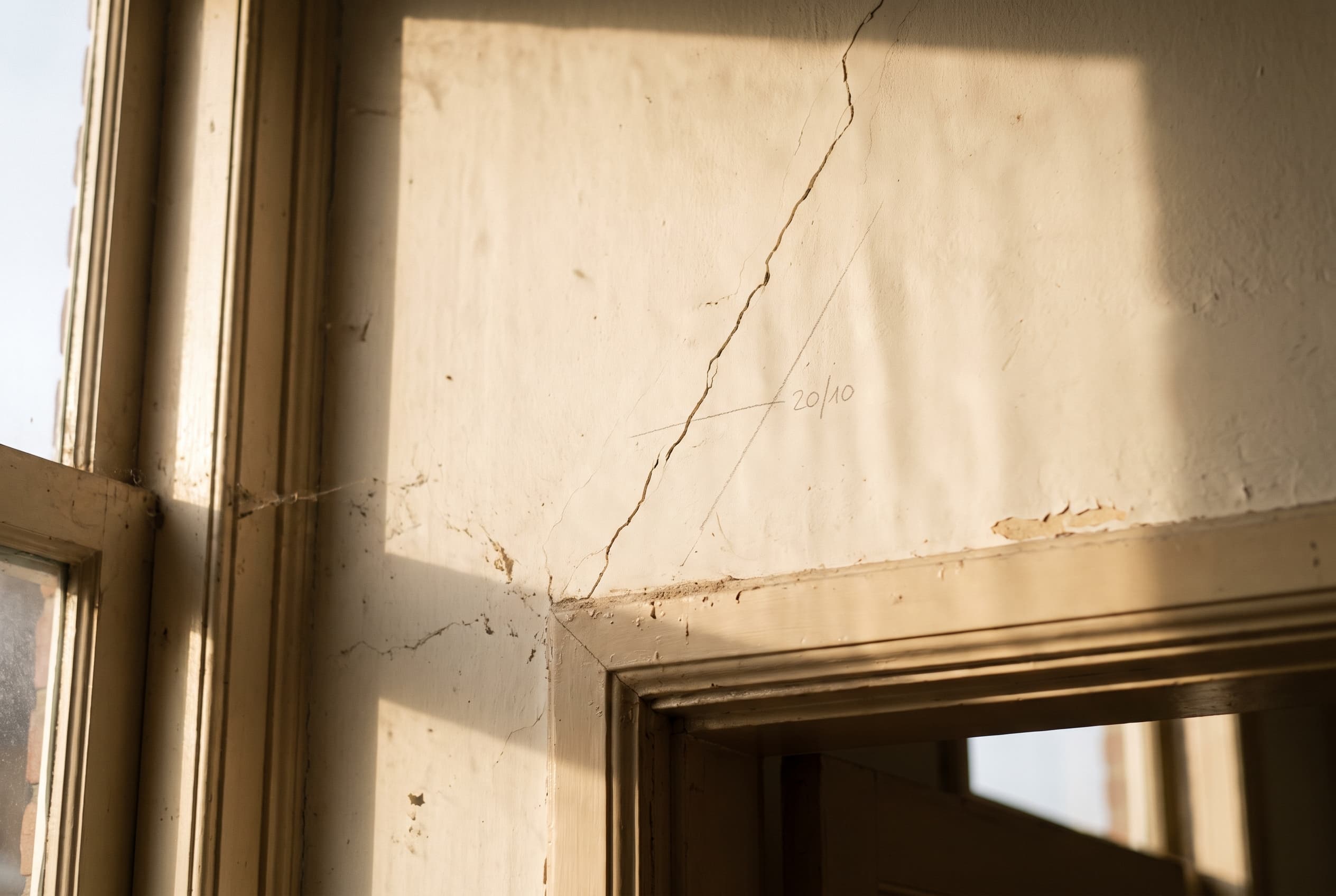
Most cracks in plaster are shrinkage cracks: hairline, straight and not moving. It becomes worrying with cracks running diagonally from a window or door corner, cutting through both brick and mortar, wider than about three millimetres, or combined with sticking doors and a sloping floor. Measure for three months whether the crack moves before you have anything repaired. A foundation quickscan costs 350 to 650 euro, a full foundation survey runs up to 7,000 to 9,000 euro.
Rather have it done?
Post your job for free. Plasterers near you respond with their own price and you choose. Your money stays safe until you approve the work.
Shrinkage or movement: the only distinction that counts
Every house gets cracks. New build dries out, plaster shrinks, timber moves with the seasons, and render cracks along the joint between two materials. That is normal and almost always cosmetic.
The question is not whether there is a crack, but whether it moves. A crack that does not move is a scar of something that once happened. A crack that widens month after month is a problem still in progress, and repairing before you know that is throwing money away.
Also look at which material the crack runs through. If it is only in the render or the paint, it is finish. If it runs straight through the bricks and not just the mortar joints, there has been tension on the masonry and that is structural.
And look at the shape. A straight vertical hairline crack above a door frame is shrinkage. A crack pulling diagonally away from a window corner and widening towards one end, or a stepped crack following the mortar joints, points to uneven settlement.
The warning signs, from mild to serious
This list runs from not worrying to call someone. Tick honestly what you recognise, because the combination says more than any single point.
- Hairline cracks in plaster, thinner than a millimetre, straight, not growing. Cosmetic. Fill and paint over if it bothers you.
- A crack of one to three millimetres that has been like that for years and does not change. Usually old work. Measure it, and repair only once it is standing still.
- A crack wider than about three millimetres, or one visibly growing within a few months. Measure now and have it assessed.
- Diagonal cracks from the corners of windows and doors, or stepped cracks through the mortar of the facade. The classic picture with uneven settlement.
- Doors and windows that start sticking after years of working fine. As little as one and a half millimetres of settlement is enough to make a door bind, so this is often the first signal, before the crack.
- A floor that noticeably slopes, for example a marble rolling off on its own. More than about five millimetres of fall per metre is reason for investigation.
- Cracks outside that continue inside in the same place, a height difference between the facade and the pavement, or neighbours in the same terrace with the same picture. That points to something in the ground rather than your plaster.
Measuring yourself before you call anyone
This is the cheapest and most useful step there is, and almost nobody takes it. Three months of measurements give a surveyor or foundation specialist exactly the answer they would otherwise have to wait for, and it often saves you a repeat inspection.
- Photograph every crack with a ruler or folding rule beside it, so the width is measurable in the picture. Put the date in the file name or write it on a note that appears in the shot.
- Mark a pencil line, not marker, across the crack in two places and write the date next to it. That way you also see movement along the length later.
- Stick a crack gauge over the crack, or make a plaster tell-tale: a small patch of plaster set across the crack. A crack gauge costs 15 to 25 euro each and has a grid you read the movement off.
- Note the reading every two weeks, with the date, in a simple list on your phone. Always measure in the same place and preferably at the same time of day.
- Keep this up for at least three months, and make sure a wet and a dry period are included. Groundwater moves with the seasons and that difference is exactly what you want to see.
- Meanwhile check the simple things outside: a blocked rainwater downpipe putting water into the ground right against the foundation, a leaking drainpipe, a tree close to the wall.
- If nothing moves in three months, you can have the crack repaired as a finish. If it does move, call a building surveyor or foundation specialist and take your measurements with you.
- Gather at the same time: the year your home was built, whether it stands on timber piles, and whether your municipality has designated your neighbourhood as a risk area. That saves the specialist half a day of archive work.
When it is your foundation, and when it is not
Foundation problems are not a fringe issue in the Netherlands. An estimated 425,000 buildings and homes will face foundation damage in the next ten years, rising to 780,000 towards 2050. Between 487,000 and 537,000 properties already carry an elevated risk of subsidence.
Two causes dominate. In homes on timber piles, mostly in the west and north, it is pile rot: if the pile heads end up above the water table, they rot. In homes founded directly on the soil it is uneven settlement of the ground, often worsened by dry summers.
It is probably not your foundation if the cracks are only indoors, only in plaster, and nothing is visible in the brickwork outside. A single crack above a door in a post-war home on piles is also rarely the start of something big.
It probably is the foundation if the picture is complete: diagonal or stepped cracks outside and inside, sticking doors, a sloping floor, and neighbours with the same story. Then the crack is a symptom and not the issue.
There are also causes that look like foundation trouble from the outside and are not: building or piling work nearby, a load-bearing wall removed in an earlier renovation, a steel beam deflecting above an extension. Those are often cheaper to fix, which is exactly why the diagnosis comes before the quote.
The stop rule: when you do not sit and measure
Three months of measuring is the advice when in doubt. There are situations where that is precisely wrong and you call someone straight away.
The crack appeared within days or weeks and is still growing, or you hear cracking. Fast movement never belongs to shrinkage.
Material is falling out of the crack, the wall bulges, or there is a visible kink in the facade. Then it is about load-bearing capacity, not finish.
There has been building, demolition, piling or excavation close to your home and the cracks appeared afterwards. Report it to the contractor and the municipality immediately and record everything; waiting here costs you your evidence.
The cracks appeared after a renovation in which a wall was removed or an opening was made. Call the structural engineer, not the plasterer.
A door or window sticks so badly it no longer closes, or a floor visibly slopes. The movement is then past the stage where measuring adds anything.
Do not do groundwork yourself to inspect the foundation. Digging a pit along a wall that is already moving can accelerate the settlement.
When you do not need an expert for this
Big numbers get thrown around when foundations come up, and some parties want to turn every crack into a survey. For a good share of cracks in Dutch homes that is unnecessary.
- Hairline cracks in a new build home in its first two years. The house is drying out. Fill with a flexible acrylic sealant and paint over, done.
- Cracks exactly on the joint between two materials, for example where plasterboard meets masonry or along a ceiling edge. That is a working joint; use flexible sealant there rather than hard fillers.
- A crack above a door frame that has been there since you moved in and does not change. Measure it for three months, then simply repair it.
- Shrinkage cracks in a cement screed or a newly plastered ceiling. Cosmetic, even if they look alarming.
- What you do without an expert: check the gutter and downpipe and make sure rainwater does not run into the ground beside the foundation. That is free and it is one of the few things you can improve yourself about the ground under your house.
What investigation and repair cost in 2026
Measuring yourself: a crack gauge costs 15 to 25 euro each. With three of them and a phone you have a record any specialist will take seriously.
| Survey or repair | Price | Notes |
|---|---|---|
| Foundation quickscan | 350 to 650 euro | archive research, visual inspection and measurements; usually the right first step |
| Building survey into crack cause | 400 to 900 euro | without exposing the foundation |
| Full foundation survey, single home | 2,500 to 5,000 euro | foundation exposed, timber samples taken, about 2 months lead time |
| Full building survey | 7,000 to 9,000 euro | for a complete building rather than one home |
| Foundation repair, mid-terrace house | 50,000 to 110,000 euro | plus around 10,000 euro of finishing indoors |
It is worth checking whether you qualify for the Fonds Duurzaam Funderingsherstel, the foundation repair fund available since 1 July 2025 for owners who cannot obtain a normal loan. The government added 20 million euro for 2026 to make it available nationally, and six frontrunner municipalities and regions have their own approach: Friesland, Emmen, Rivierenland, Rotterdam, Dordrecht and Zaanstad.
What insurance does, and mainly does not, do
There is little room for optimism here. Damage from a construction fault or from subsidence of the foundation is excluded as standard on a buildings insurance policy. The same goes for damage from poor maintenance and for slowly penetrating damp.
What can be covered is sudden damage with an identifiable cause, for example a burst pipe washing out the ground under your foundation. The cause then has to be sudden and unexpected, and you have to demonstrate it.
If there has been piling, building or demolition nearby, the address is the party that caused it, not your insurer. Report it in writing to the contractor and the municipality, and make sure you have before and after photos. On larger projects there is usually a pre-condition survey; ask for it.
If you live in the earthquake area in Groningen or northern Drenthe, damage from gas extraction does not run through your insurer but through a separate national scheme. Report it there rather than to your insurance company.
Renting, or living in a flat with a VvE?
If you rent, the structure of the building is always the landlord's responsibility. Cracks are not minor maintenance and do not fall under what you are expected to do. Report it in writing with photos and a date and ask for repair within six weeks.
If the landlord does nothing, you can go to the Huurcommissie, which can lower the rent temporarily for serious defects, and file a report with your municipality's building and housing inspectorate. With structural cracks the municipality usually takes that seriously, because their own responsibility is involved too.
In a flat, the load-bearing walls, the facade and the foundation are common property. Investigation and repair are then a matter for the VvE and are paid from the reserve fund, for which the VvE must reserve either following a multi-year maintenance plan or with at least 0.5 percent of the rebuild value per year.
In a VvE, always put it on the agenda of the general meeting, even if the crack is only visible inside your own flat. Foundation surveys are done on the whole building or the whole block; a survey of one flat alone rarely produces a usable answer.
Done reading?
Describe the job in two minutes. Plasterers respond with their price, you compare and choose. Free, with no strings attached.
Post your job for freeFrequently asked questions
From what width is a crack in a wall dangerous?
Width alone does not say everything, but as a rule of thumb: under a millimetre is almost always cosmetic, one to three millimetres means measure it, and above three millimetres is reason to have it assessed. More important than the width is whether it is growing and whether it runs through the bricks rather than the mortar joints.
How do I know whether a crack is still moving?
Stick a crack gauge or a plaster tell-tale across the crack and note the reading with a date every two weeks. Keep that up for at least three months, including a wet and a dry period. If nothing changes, the crack has settled and you can repair it. If it does change, take those measurements to a specialist.
Are diagonal cracks always foundation problems?
No, but they are the pattern to watch. Diagonal cracks from window and door corners and stepped cracks through the mortar arise from uneven settlement. That can be the foundation, but also a deflecting beam above an extension or a removed load-bearing wall. The diagnosis determines the amount, so it comes first.
Can I just fill the cracks and paint over them?
Only once you have established that the crack is no longer moving. Filling a moving crack gives you the same crack back within a year, and you have removed the best measuring instrument you had. Measure for three months, then repair. On working joints use flexible sealant rather than hard fillers.
What does a foundation survey cost?
A quickscan with archive research, inspection and measurements costs 350 to 650 euro and is usually the right first step. A full foundation survey in which the foundation is exposed costs roughly 2,500 to 5,000 euro for one home and rises to 7,000 to 9,000 euro for a complete building survey, with about two months of lead time.
Does my insurance cover foundation damage?
As a rule, no. Subsidence of the foundation and damage from a construction fault are excluded as standard on buildings insurance, as is poor maintenance. Only sudden damage with an identifiable cause, such as a burst pipe washing out the ground, may be covered. If there has been piling or building nearby, you address the party that caused it, not your insurer.
Sources
Every claim on this page comes from one of these sources. They were checked on 30 August 2026. Legislation changes, so check the source itself if anything matters to you.
- KCAF, step-by-step plan for foundation repair
- KCAF, investigating foundation risk and what it costs
- Rijksoverheid, government launches multi-year approach to foundation problems
- Schippers Bouwconsult, recognising foundation problems and 2026 costs
- Consumentenbond, what buildings insurance does not cover
- Huurcommissie, maintenance and defects in your home
- Rijksoverheid, how much a VvE must reserve for major maintenance
Tools for your own address
Three things you can check here for free that you will not find like this anywhere else. They run on open data from the Dutch Land Registry, the buildings register and the national energy agency, so the answer applies to your house and not to an average.
This is not legal advice
We set out what the rules say and where they are. Your situation may differ, and in a dispute your own contract, your deed of division or your local council's bylaw takes precedence. If you cannot work it out, Het Juridisch Loket, the Huurcommissie or a lawyer can help.