Can I lay laminate or a hard floor in my apartment?
Sources checked on 30 August 2026
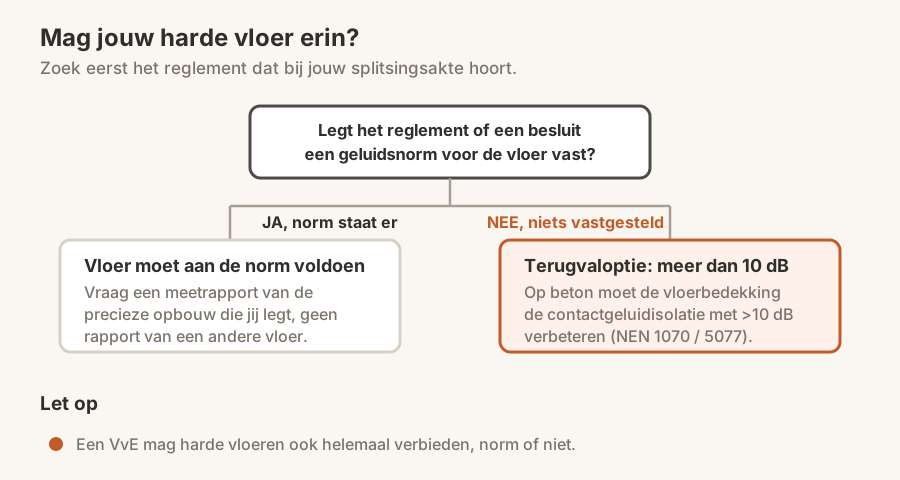
Only if your owners' association regulations allow it. The 2017 model regulations prohibit hard floor coverings except in the kitchen and bathrooms, unless standards have been set that your floor meets. If nothing has been set, the fallback applies: on a concrete floor the covering must improve impact sound insulation by more than ten decibels.
Rather have it done?
Post your job for free. Floor fitters near you respond with their own price and you choose. Your money stays safe until you approve the work.
First find out which regulations apply to you
There is no single rule for Dutch owners' associations. Your deed of division states which model regulations your building refers to, and that can be the 1973, 1983, 1992, 2006 or 2017 version. The wording on floors differs per version.
The deed of division takes precedence. On top of that there may be house rules and decisions taken by the general meeting about floors. Ask your board or property manager for all three before you order a floor.
Do that genuinely in advance. A floor that is down and has to come up again is the most expensive way to read this page.
The ten decibel rule
The 2017 model regulations prohibit parquet, laminate, stone and tiles except in the kitchen and the bathrooms. There is an exception: it is allowed if the covering meets standards set in the house rules or adopted by the general meeting, and if it causes no unreasonable nuisance to other residents.
If no such standards exist, the fallback in the regulations themselves applies. On a concrete floor the covering has to improve the impact sound insulation index by more than ten decibels.
That improvement has to be established in line with NEN 1070 or NEN 5077, or their successor. So it is a measurement, not a sales pitch.
Ten decibels is a threshold, not a free pass
If you do not meet the standard, unreasonable nuisance is presumed and you start a goal down. If you do meet it, that presumption falls away.
That is not the same as being in the right. Even above ten decibels there can still be unlawful nuisance if the noise is substantial in practice. Courts look at what the neighbours actually hear.
In practice that means your underlay is the floor, not the ceiling. A floating screed, a proper edge strip and no rigid connection between floor and wall or pipework do more than the last decibel on the product sheet.
An owners' association can also ban hard floors outright
That happens, and courts have upheld such bans. So you can live in a building where the answer is simply no, however good your underlay is.
Ask for permission in writing and have it minuted at the general meeting. A verbal nod from a board member who is gone next year is worth nothing once a neighbour complains.
If you want the ban changed, that is an agenda item for the general meeting, not a discussion with your property manager.
What your floor fitter has to deliver
Ask for a test report on the build up that will actually be laid at your place, meaning the combination of underlay and top layer as you are having it fitted. A report on a different build up says nothing about your floor.
Put your association's requirement into the quote word for word, with the figure. Then it is part of the job rather than something to argue about afterwards.
Watch the edges. Impact sound travels through every rigid connection: skirting that touches the floor, pipes coming through it, a door threshold screwed down tight. That is where it goes wrong in practice, not in the middle of the room.
Done reading?
Describe the job in two minutes. Floor fitters respond with their price, you compare and choose. Free, with no strings attached.
Post your job for freeFrequently asked questions
Can I lay laminate in an apartment?
It depends on your owners' association regulations. The 2017 model regulations prohibit hard floor coverings outside the kitchen and bathroom, unless the floor meets the standards that have been set. If nothing has been set, a concrete floor requires an improvement in impact sound insulation of more than ten decibels.
What does that ten decibels actually mean?
That the covering has to improve the impact sound insulation index of the bare concrete floor by more than ten decibels, established in line with NEN 1070 or NEN 5077. So it is a measured improvement of the complete build up, not a number on the underlay packaging.
Which model regulations apply to my building?
That is stated in the deed of division for your apartment. There are 1973, 1983, 1992, 2006 and 2017 versions and the floor provisions differ. Ask your property manager or the Land Registry for the deed.
Can my owners' association ban hard floors completely?
Yes. A full ban in the regulations is possible and courts have upheld such bans.
I meet the standard but the neighbours still complain. Now what?
The ten decibels is a threshold, not a guarantee. Above the standard the presumption of unreasonable nuisance falls away, but there can still be unlawful nuisance if the noise is substantial in practice. Usually the cause then sits in the edges and connections rather than in the underlay.
Do I have to ask the owners' association for permission?
Always ask in advance and in writing, even if you think you meet the standard. Have the decision minuted. That is your evidence if someone complains later.
Sources
Every claim on this page comes from one of these sources. They were checked on 30 August 2026. Legislation changes, so check the source itself if anything matters to you.
- Model regulations for division into apartment rights 2017 (pdf, Dutch)
- Appartementeneigenaar: model regulations 2017 (Dutch)
- Rijssenbeek Advocaten: hard floors in an owners' association and the 2017 model regulations (Dutch)
- VvE Belang on noise nuisance from floors (Dutch)
- Advocatenkantoor VvE on impact sound and unlawful nuisance (Dutch)
- VvE Advies: can an owners' association ban hard floors (Dutch)
- Flinck Advocaten on nuisance in owners' associations (Dutch)
Tools for your own address
Three things you can check here for free that you will not find like this anywhere else. They run on open data from the Dutch Land Registry, the buildings register and the national energy agency, so the answer applies to your house and not to an average.
This is not legal advice
We set out what the rules say and where they are. Your situation may differ, and in a dispute your own contract, your deed of division or your local council's bylaw takes precedence. If you cannot work it out, Het Juridisch Loket, the Huurcommissie or a lawyer can help.