Foundation problems: how to spot them and what to do first
Sources checked on 3 November 2026
You recognise foundation problems by diagonal cracks that widen, sticking doors and a sloping floor. Start with a QuickScan by a recognised firm, without digging, from € 295 (KCAF). That tells you quickly where you stand. For the repair there is a special loan, the Funderingslening Maatwerk. Just bought? Tell the seller in writing, shortly after you discover it (article 7:23(1) Civil Code).
Rather have it done?
Post your job for free. Plasterers near you respond with their own price and you choose. Your money stays safe until you approve the work.
Recognising foundation problems: what do you see and what do you do now?
You cannot see a foundation, so you recognise a problem by what the house does. One sign says little; several at once, or a sign that grows, calls for action. How to measure a crack and whether it moves is in the guide on cracks in the wall.
| Sign | What it can mean | What you do now |
|---|---|---|
| Diagonal cracks that widen, often from the corner of a window or door | The house moves unevenly | Measure the crack and record date and photos |
| Doors and windows that stick | The frame is under strain from a moving wall | Note since when, especially if it gets worse quickly |
| A floor that slopes or a gap between wall and floor | Part of the house sits lower | Put a spirit level or a marble down and take a photo |
| An extension or pavement that pulls away from the house | House and extension move differently | Photos and measuring; tell your neighbours if they have problems too |
| Crooked frames or a leaning facade | Uneven settlement | Have a QuickScan done, see below |
| Hairline cracks under a millimetre that do not grow | Mostly shrinkage of plaster | Keep an eye on them, nothing more is needed |
This is a first impression. A QuickScan by a recognised firm gives certainty.
Which houses are at risk?
The risk depends mostly on the year of construction, the type of foundation and the soil. Houses from before 1970 in urban areas more often have a wooden pile foundation or a shallow foundation on clay or peat. A house from the seventies or later usually stands on concrete piles and has a lower risk.
On FunderMaps (national foundations database, KCAF) you see within seconds what is known about your address.
Is your address not in the list yet? Owners can report it themselves. The risk class is an indication; a QuickScan gives certainty.
Where do foundation problems come from?
With a wooden pile foundation the pile heads are affected when a low groundwater level leaves them dry. With a shallow foundation on clay or peat the soil moves, for example in dry summers. Work next to your house, such as piling, digging or dewatering, can also have an effect.
The KCAF advises adjusting groundwater only in consultation with the neighbours and the municipality. That keeps the balance in the neighbourhood.
Who is responsible and who pays?
As an owner you usually arrange and pay for the approach yourself; an ordinary buildings insurance does not cover foundation damage (AFM, April 2026). That is why an early survey helps: you keep time to plan calmly and look at the loan. The table shows who arranges what per situation.
| Situation | Who arranges and pays | Legal basis | What you do |
|---|---|---|---|
| You live in your own home | You as owner. An early survey gives you time to plan | AFM, April 2026; KCAF | First a QuickScan; the risk class decides the rest |
| You have just bought | First see whether the seller should have told you and what the purchase deed says about the foundation. Tell him shortly after you discover it | Art. 7:17(2) and (5) and 7:23(1) Civil Code | See the guide on hidden defects in a bought house |
| You live in an apartment | The owners' association, for the shared parts. The foundation is usually shared; the deed of division and the rules give the details | Art. 5:106, 5:109 and 5:112(1) Civil Code; RVO | Put it on the agenda of the meeting |
| You rent | The landlord must fix defects, unless that is impossible or costs unreasonably much | Art. 7:204(2), 7:206(1) and 7:207(1) Civil Code | Report it in writing with photos, date and your request for repair. If your enjoyment of the home is reduced, you can also ask for a rent reduction (article 7:207 Civil Code) |
| Wooden piles at a low groundwater level | The municipality looks after the groundwater level in public space. For your own plot and building you arrange it yourself | Art. 2.16(1)(a)(2) Environment and Planning Act; IPLO | Ask the municipality about its groundwater policy and any measurements. Report the damage in writing |
| Building or piling work next to your house | The neighbour who has the work done (article 5:37 Civil Code) and the company doing it (article 6:162 Civil Code), if it is unlawful | Art. 5:37 and 6:162 Civil Code | Photos before and after, report in writing to the company and the neighbour. Also check your policy |
Laws read on wetten.overheid.nl on 3 November 2026. The two-month period in article 7:23 does not apply to the sale of a home; a reasonable time applies there.
Foundation survey: which kind and what does it cost?
Surveys go in steps, from light and cheap to heavy and expensive. You do all three with a firm recognised by the KCAF; the KCAF itself does not carry out surveys. Note: an aspirant firm is not the same as a recognised firm.
| Survey | What it does | When | Indicative price |
|---|---|---|---|
| QuickScan (preliminary, phase 0) | Desk study, looking at facade cracks, tilt and pointing. No digging. Gives a risk class low, medium or high, valid for three years | First step with signs, a purchase or financing | KCAF: from € 295. Providers: € 249 to € 800 |
| Phase 1 | More extensive survey above ground | With risk class high or clear damage | Providers: about € 1,000 to € 1,900 |
| Phase 2 | Inspection pits, timber survey, probing and bearing capacity | If the risk stays high, or to prepare repair | Providers: about € 2,000 to € 5,000 |
Consulted on 3 November 2026. Prices from providers; incl. or excl. VAT is stated per firm. As a rule a survey is not mandatory. According to Banken.nl (29 October 2026) the valuation report shows a foundation risk from A to E since 1 April 2026, and from 1 January 2027 a preliminary survey follows for mortgages with NHG at D or E.
What is in a QuickScan, and do you have to do all the steps?
A QuickScan (preliminary survey, also called Phase 0) answers one question: is there reason for further investigation? An expert assesses the building from the outside and combines that with available data. There is no digging and the foundation itself is not looked at. This is what it includes:
- A desk study: archive, building drawings, earlier surveys and data on settlement.
- A record of the cracks in the facades, with photos and a classification by crack width.
- Measurements of the tilt of the facades and of the distortion of horizontal joints.
- An assessment with a risk class (low, medium or high) and advice.
A risk report is not a survey
A foundation risk report uses available building and area data and models. You see the risk class, the sources, the reliability and the reference date. It is not a physical finding of how the foundation is doing (KCAF).
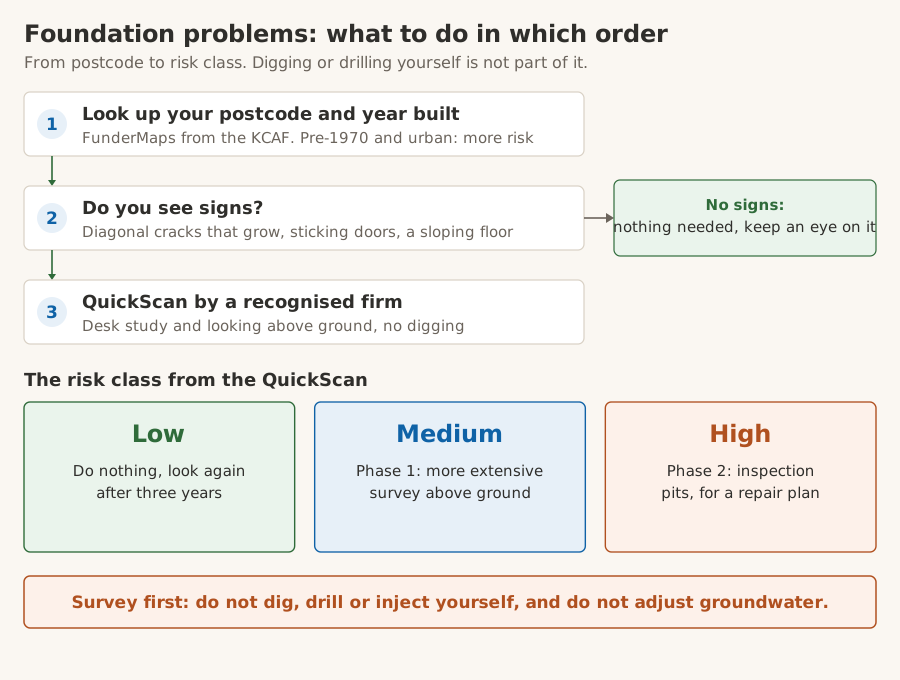
You also do not always have to go through every step. With clear damage or a specific technical question, a more extensive survey may be needed straight away, and a recent, suitable survey report can supply useful information. Let the expert decide what is still missing in your situation. After a QuickScan: with risk class low no further survey is needed, with medium you repeat it within three years and with high Phase 1 follows.
How to go about it
Follow this order. That way everything is on record and you are in a strong position with the owners' association or the seller.
- Look up your postcode and year of construction in FunderMaps and see whether your house is in a risk area.
- Record the signs: date, photos and the width of the crack, as in the guide on cracks in the wall.
- Ask the municipality and in your purchase papers for building drawings, piling records and earlier surveys (KCAF step 1).
- Talk to neighbours or the owners' association and put agreements in writing (KCAF step 2).
- Pick a recognised firm from the KCAF register and compare quotes for a QuickScan.
- Have the risk class decide whether Phase 1 and Phase 2 are needed.
- Only with a repair plan: arrange budget, quotes, permits and financing.
- Keep all reports and let your insurer know if anything changes about your house.
Survey first, then repair
Wait with digging, injecting, drilling or sanding cracks until you know the risk class, and do not adjust the groundwater yourself. That keeps the cause clearly visible to the firm and keeps your agreements and evidence clear towards the owners' association, the seller or whoever caused it. In an apartment building the foundation is usually shared and the owners' association arranges it.
How do you prevent foundation problems?
You cannot prevent it completely, but you can be early and not add damage:
- Before you buy a house with an increased risk, have a QuickScan done first.
- Do not adjust groundwater yourself; consult your neighbours and the municipality (KCAF).
- Record signs early, and keep all survey, design and completion documents (KCAF).
- Are the foundation details of your building wrong, or do you have a survey report? Pass it on to FunderMaps (KCAF).
What does foundation repair cost?
What repair costs depends on how much work is needed. The AFM (April 2026) works with three classes: limited work around € 30,000, large work around € 60,000 and very large work around € 120,000. Half of the cases stay under € 54,000 (median, AFM).
Plastering, floors and finishing come on top. The survey beforehand shows which class your house is in; so start with a QuickScan.
An early survey gives you time to arrange it calmly.
Loan and subsidy for foundation repair
For repair there is the Funderingslening Maatwerk from the Fonds Duurzaam Funderingsherstel, run by SVn. The fund has existed since 2017 and has been available nationwide since 1 July 2025; before that only in taking-part municipalities. The loan runs for 30 years and starts at € 2,500. According to Binnenlands Bestuur (24 September 2026) you pay no monthly costs for the first three years. It is meant for owner-occupiers who cannot borrow from a bank because of too low an income. It does not apply to housing associations and owners' associations. There is no general subsidy for repair.
Some municipalities have their own scheme for surveys or repair. Ask your municipality. For monuments the Restauratiefonds pays 50 percent of the costs, up to € 250, for a QuickScan or basic survey.
Buying or selling a home with a foundation risk
Do you see a foundation risk before signing, for example class D or E in a report you receive? Then the seller can rely on that later: what you knew or could reasonably have known when the purchase was concluded, you can hardly invoke afterwards as a defect (article 7:17(5) Civil Code). A risk class is an indication and not a finding of a defect. A valuation that only comes after signing does not change what you knew at signing. So have a QuickScan done before you sign, or agree a reservation or a condition subsequent on the result of a foundation survey. Also read the foundation clause and the age clause in the purchase deed: they often put the risk on you.
Already bought and you find out after the purchase? Tell the seller shortly after you discover it (reasonable time, article 7:23(1) Civil Code). The explanation with examples is in the guide on hidden defects in a bought house.
When can you keep an eye on it yourself?
Hairline cracks under a millimetre that do not grow, a house from after 1970 on concrete piles with a round crack in the plaster, or a crack that closes again after a dry summer: that is usually shrinkage and season. Measure, keep an eye on it and have a plasterer finish it.
Does a crack widen, run diagonally or do sticking doors come with it? Then a QuickScan quickly gives clarity.
After the repair: finishing
The foundation repair itself is done by a firm or contractor with that experience. For the finishing afterwards, such as plastering, a new floor, frames and painting, you ask up to 15 companies near you on JouwPro for a quote, free of charge. Add what the repair report says.
Frequently asked questions
What are the signs of foundation problems?
Diagonal cracks that widen, doors and windows that stick, a floor that slopes, a gap between wall and floor or an extension pulling away from the house. One sign says little; several at once or a growing crack calls for a QuickScan.
What are the most common foundation problems?
Pile heads being affected with a wooden pile foundation, because they dry out at a low groundwater level, and movement of a shallow foundation on clay or peat. Work next to your house can also have an effect. Houses from before 1970 see this more often.
Does my insurance cover foundation damage?
An ordinary buildings insurance does not usually cover foundation damage (AFM, April 2026). For damage from work next to your house an insurance can help; that is in the guide on cracks in the wall.
What does a foundation survey cost?
A QuickScan costs from € 295 according to the KCAF and € 249 to € 800 according to providers. Phase 1 is around € 1,000 to € 1,900 and Phase 2 around € 2,000 to € 5,000 according to providers. These are indications from providers; prices with and without VAT differ.
How can you check a foundation?
Yourself you can only record the signs: measure cracks, note doors and floor. A recognised firm checks the foundation itself, in steps: a QuickScan without digging, then if needed Phase 1 and Phase 2 with inspection pits. Start with your postcode and year of construction in FunderMaps.
Is a foundation survey mandatory?
Not as a rule. A valuation shows a foundation risk from A to E since 1 April 2026 (Banken.nl). For D or E a preliminary survey follows for mortgages with NHG from 1 January 2027, so that you do not meet surprises at the bank.
Is there a subsidy for repairing the foundation?
For repair there is the Funderingslening Maatwerk for owner-occupiers who cannot borrow from a bank. Some municipalities have their own scheme for surveys or repair; ask your municipality. For monuments there is the Restauratiefonds.
What do they check in a building survey?
A building survey looks at the visible condition of the house, such as cracks, tilt and damp. A QuickScan looks specifically at the foundation and is a good addition if you suspect a problem or live in a risk area.
Sources
Every claim on this page comes from one of these sources. They were checked on 3 November 2026. Legislation changes, so check the source itself if anything matters to you.
- AFM, Funderingsherstel: financierbaar voor woningeigenaren? (April 2026)
- KCAF, foundation risk surveys (QuickScan, Phase 1 and Phase 2)
- KCAF, step-by-step plan for foundation repair
- KCAF, FunderMaps (national foundations database)
- Rijksoverheid, can I get a loan to repair the foundation of my home?
- SVn, Fonds Duurzaam Funderingsherstel available nationwide from 1 July (1 July 2025)
- Binnenlands Bestuur, more demand for foundation repair loans (24 September 2026)
- Banken.nl, NHG takes foundation risk into account for mortgages (29 October 2026)
- RVO, foundation problems: what it is
- Atlas Leefomgeving, indicative areas of foundation problems
- IPLO, groundwater task of the municipality
- Restauratiefonds, foundation surveys for monuments
- Civil Code Book 7, articles 7:17, 7:23, 7:204 and 7:206
- Civil Code Book 5, articles 5:37 and 5:112
- Civil Code Book 6, article 6:162
- Environment and Planning Act (Omgevingswet), article 2.16 (groundwater task of municipalities)
Tools for your own address
Three things you can check here for free that you will not find like this anywhere else. They run on open data from the Dutch Land Registry, the buildings register and the national energy agency, so the answer applies to your house and not to an average.
This is not legal advice
We set out what the rules say and where they are. Your situation may differ, and in a dispute your own contract, your deed of division or your local council's bylaw takes precedence. If you cannot work it out, Het Juridisch Loket, the Huurcommissie or a lawyer can help.