Water in the crawl space: who is responsible and what do you do?
Sources checked on 3 November 2026
A thin layer of water under your floor is not a problem straight away. Who fixes it depends on the cause. A leaking pipe or drain is the owner's job, in a rental the landlord's if it affects your enjoyment of the home (article 7:206 Civil Code). With groundwater under your own home you are responsible as owner; the municipality looks after public space (article 2.16 Environment and Planning Act). Measure the level and take a photo first, then you know what to report and to whom.
Rather have it done?
Post your job for free. Plumbers near you respond with their own price and you choose. Your money stays safe until you approve the work.
Who is responsible for water in the crawl space?
There is no single answer, because it depends on where the water comes from and which position you are in. The table puts the situations side by side, with the legal basis.
The municipality looks after the water in public municipal space, such as the street and public green (article 2.16 Environment and Planning Act). Under and around your own house you handle it with the steps below.
| Situation | Who is responsible | Legal basis |
|---|---|---|
| A leaking pipe or downpipe of your own home | The owner of the home. In a rental the landlord, if it is a defect | Art. 7:204(2) and 7:206(1) Civil Code |
| Groundwater under your own owner-occupied home | The owner of the plot and building. The municipality looks after the water in public municipal space | Art. 2.16(1)(a)(2) Environment and Planning Act; IPLO; HHNK |
| Ongoing water in a rental home | The landlord, if it limits your enjoyment of the home. The law calls that a defect | Art. 7:204(2) and 7:206(1) Civil Code |
| Minor repairs in a rental, such as keeping ventilation grilles clear (as far as your contract and the Minor Repairs Decree say so) | The tenant | Art. 7:217 and 7:240 Civil Code; Minor Repairs Decree |
| A shared crawl space in an apartment building | The owners' association (VvE), if its rules designate the crawl space as shared. Otherwise the owner of the apartment | Art. 5:106, 5:109 and 5:112(1)(c) Civil Code; deed of division |
| You have just bought and the seller knew about it | The seller, if you could not have known. Report it shortly after you discover it | Art. 7:17(2) and (5) and 7:23(1) Civil Code |
Laws read on wetten.overheid.nl on 3 November 2026. The municipal task applies where measures are efficient; water boards and provinces have their own tasks (art. 2.17 to 2.19).
Is water in the crawl space normal, or serious?
A damp ground or a thin layer of water after a rainy spell occurs in many crawl spaces and is not automatically a problem, as long as the floor and joists stay dry and the space gets enough air.
Good to know: the crawl space does not have to be bone dry. The Buildings Decree requires the construction between a living space and the crawl space to be watertight (article 3.64(2) for existing buildings, article 4.118(2) for new builds).
If you see one of these, have someone take a look:
- The water touches the underside of the floor.
- There is mould on the walls or on the insulation.
- Joists feel soft or are dark in colour.
- You smell sewage.
- The level visibly rises, for example within a few days.
Where does the water come from?
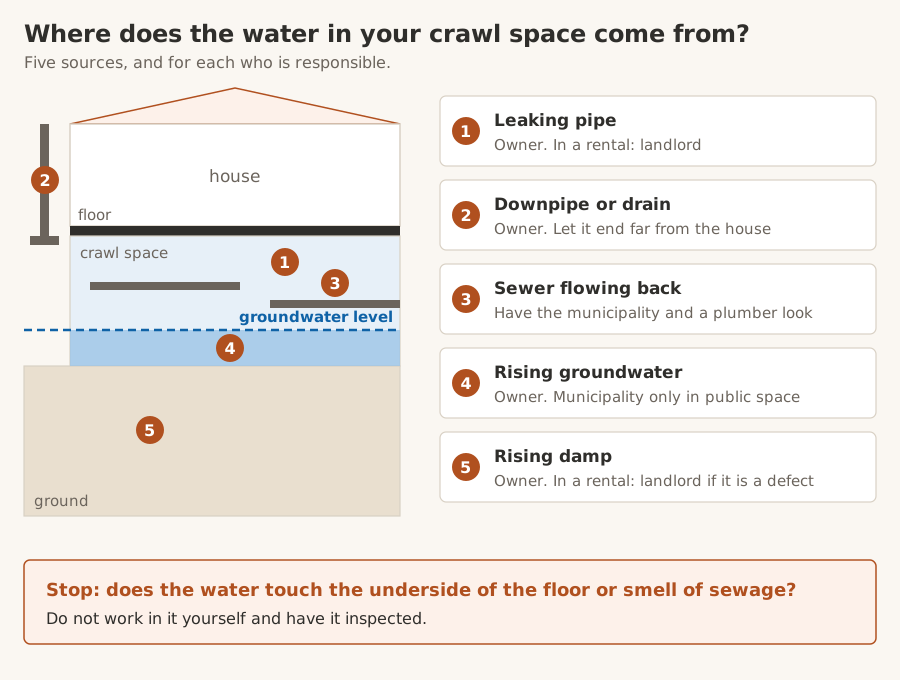
Five sources are the most common. The cause decides who is responsible and what helps, so find it first.
You recognise a leak by a water meter that keeps running while all taps are shut. Groundwater stays after a dry week, rainwater or a badly draining downpipe mostly shows after showers. If it smells of sewage, it is not groundwater.
Want to know how high the groundwater normally stands at your address? The free address check at kruipruimtekaart.nl shows the class based on open data: wet is shallower than 60 cm below ground level, damp 60 to 100 cm, mostly dry 100 to 150 cm and no role deeper than 150 cm.
If the water reaches your plot through a drain or downpipe from the neighbours, that can be unlawful nuisance (article 5:37 Civil Code). Water that runs off naturally from a higher plot you must accept (article 5:38).
| Source | How you recognise it | Who is responsible |
|---|---|---|
| Leaking water or heating pipe | The water meter runs while all taps are shut | Owner. In a rental the landlord |
| Downpipe or drain that ends right next to the house | Water mostly after showers | Owner |
| Sewer flowing back | Sewage smell and dirty water | Have the municipality and a plumber look |
| Rising groundwater | The water stays after a dry week | Owner; the municipality only in public space |
| Rising damp from the ground | Damp patches or mould, sometimes without visible water | Owner, or the landlord if it is a defect |
A first recognition, not a diagnosis. If in doubt, have a certified firm look at it.
Step by step: how to handle it
Take it in this order, then you are in a strong position when you have to report.
- Look without crawling in: open the hatch, use a torch or a camera on a stick. Take photos with a ruler or measuring tape in view and note the date and time.
- Measure the level in centimetres and note the colour and smell. Does the water smell of sewage, is it near pipes or electrics, or does it touch the underside of the floor? Then have a certified firm look at it and do not work in there yourself: that is the quickest and safest way.
- Find the source: shut all taps and see whether the water meter moves. If the water stays after a dry week it is probably groundwater. If it only comes after rain, look at the downpipe and the drain.
- Use the table above to see who is responsible: owner, landlord, owners' association or seller.
- Report it in writing with your photos and level notes. What belongs in it is listed below.
- Pumping out temporarily is fine if it is clear groundwater. Then deal with the source, so it stays dry.
- Have the cause dealt with, such as the leak, the drain, drainage or a tank, and keep a record of what was done.
May you pump out the crawl space yourself?
Yes, with a submersible pump and a hose. That gives you a dry space quickly to look for the source. Pumping does not remove the cause, so deal with the source afterwards.
Make sure the hose carries the water far from the house so that it does not flow back. Where you may discharge depends on where it goes: your municipality regulates the sewer or the street, your water board a ditch or pond. Check both websites or ask before you start pumping. If the water smells of sewage or is near electrics, have a certified firm look at it first.
Reporting: to whom and with what evidence
Always report in writing and keep a copy. In a rental you go to the landlord, in an apartment to the owners' association, after a purchase to the seller. For public space you report to the municipality. Do you have a buildings or contents insurance? Check the policy, then you know what you can claim back.
This is what goes into your report:
- What you see, since when and on which date you discovered it.
- Photos with a ruler or measuring tape in view, with date and time.
- The level in centimetres and when you measured it.
- The water meter reading with all taps shut, if you suspect a leak.
- What you ask of them and by when, for example an inspection or repair within a reasonable period.
Which solutions exist?
What helps depends on the cause. These are the usual solutions; what they cost is further down.
- Repairing the leak or the drain: solves it if the source is a pipe or downpipe.
- Drainage: pipes around or under the house carry the groundwater to a sump pit.
- A sump pit with a submersible pump: collects the water and pumps it away automatically.
- Tanking: the crawl space is made watertight on the inside, like a tub.
- Floor insulation or ground sheet: keeps ground moisture out and insulates the floor.
- Ventilation grilles: let air flow through the space so the floor stays drier.
What does finding out and fixing cost?
Indicative prices from the public price lists of providers, with source. The amount depends on VAT, the type of drainage and how reachable the crawl space is.
First the finding out:
| What | Indicative price | Source |
|---|---|---|
| Inspection by a specialist | € 100 to € 200 incl. VAT | Slimster |
| Inspection with moisture readings and report | € 150 to € 350 | Isolatieproblemen |
| Tracing and sealing a leak | € 150 to € 500 | Isolatieproblemen |
| Repairing a leak | € 200 to € 1,000 incl. VAT | Slimster |
| Report on the groundwater class of your address | € 12.95 | Kruipruimtekaart |
Consulted on 3 November 2026.
And what does fixing it cost?
Whoever tackles the cause is done with it afterwards. The difference between sources lies mostly in VAT, wall or floor drainage and accessibility.
| What | Indicative price | Source |
|---|---|---|
| Pumping out the water | € 250 to € 500 incl. VAT | Slimster |
| Drainage | € 1,500 to € 3,000 excl. VAT; € 1,500 to € 3,500 incl. VAT; € 2,500 to € 5,000 | Murenvochtig; Slimster; Isolatieproblemen |
| Sump pit with submersible pump | € 1,500 to € 4,000 | Isolatieproblemen |
| Tanking | € 50 to € 100 per m² | Murenvochtig |
| Floor insulation | € 15 to € 55 per m² | Murenvochtig; Slimster |
| Ventilation grille | € 150 to € 250 each | Slimster |
Consulted on 3 November 2026. Prices from providers, sometimes excl. and sometimes incl. VAT; it is stated. More on insulation and costs per trade: the insulation price guide.
Do you rent? What you can expect from your landlord
Does the water bother you, for example through damp, mould or a cold floor? Then it can be a defect (article 7:204(2) Civil Code): a state of the home that stops you from enjoying it as you could expect, when you entered the lease, from a well-maintained home.
If it is a defect, the landlord must fix it at your request, unless that is impossible or costs unreasonably much (article 7:206(1)). If nothing happens, give him a reasonable period in writing (article 6:82). If that passes, you may have it fixed yourself and recover the reasonable costs, also by deducting them from the rent (article 7:206(3)). The lease cannot deviate from this to your disadvantage. Put everything in writing before you deduct anything.
You can also ask for a lower rent, in proportion to the loss of enjoyment, from the day you properly reported the defect (article 7:207(1)). A report with a date keeps it simple. Minor repairs, such as keeping ventilation grilles clear, you do yourself (article 7:217), as far as your contract and the Minor Repairs Decree say so.
Just bought? Is it a hidden defect?
If you bought a house and there is water in the crawl space, it may deviate from what you could expect (article 7:17(2) Civil Code). In many purchase deeds, such as the NVM purchase agreement, that standard is replaced by an agreement on normal use as a dwelling, often with an age clause for older houses; so check which standard is in your purchase deed. You cannot rely on it if you knew at signing or could reasonably have known (article 7:17(5)), for example from a report you received before signing.
Report it to the seller shortly after you discover it or should have discovered it: for a house a reasonable time applies (article 7:23(1)). The two-month period only applies to the sale of movable goods. Photos and a date are enough to start. The explanation with examples is in the guide on hidden defects in a bought house.
Apartment: whose is the crawl space?
Whether the crawl space is shared is stated in the deed of division and the accompanying drawing (articles 5:106 and 5:109 Civil Code). The rules of the owners' association govern use, management and maintenance of the shared parts (article 5:112(1)(c)). If it is shared, you put it on the agenda of the meeting and the association arranges the inspection and repair. If it belongs to your apartment, you handle it with the steps above. If the water comes from a shared pipe or sewer, also report it to the owners' association.
When do you handle it yourself?
A thin layer of water after a wet period in an otherwise dry space, without smell, mould or soft joists, mostly calls for measuring and keeping an eye on it. A yearly check fits in a maintenance plan; the maintenance calendar reminds you.
Do you see one of the five signs above, is the level rising, is it near sewage or electrics, or does the job need digging or pumping under the house? Then let a specialist take a look.
Rather have it done?
Looking for someone to trace the cause, seal a leak or repair the drain? On JouwPro you ask up to 15 companies near you for a quote, free of charge. Add what you saw, the level and what the source seems to be.
Frequently asked questions
Is water in the crawl space serious?
Usually it is fine. A thin layer of water after a rainy spell is not harmful in many crawl spaces, as long as the floor and joists stay dry and air can pass. Does the water touch the underside of the floor, do you smell sewage, do joists feel soft or is the level rising? Then have it looked at.
Is water in the crawl space normal?
A wet ground happens, especially where the groundwater is high. What is normal drops when it is dry and does not touch the floor. What matters is that the floor above you stays tight and dry (articles 3.64 and 4.118 of the Buildings Decree).
May I pump out the crawl space myself?
Yes, with a submersible pump, as a temporary measure. Then deal with the source. Have the hose carry the water far from the house. If the water smells of sewage or is near electrics, have a certified firm look at it first. Where you may discharge depends on the municipality and water board.
Why is there water in my crawl space after rain?
Mostly because of a downpipe or drain that ends right next to the house, or because the groundwater rises temporarily. If it is still there after a dry week, it is more likely groundwater or a leak. You see a leak by a water meter running while all taps are shut.
Is water in the crawl space a hidden defect?
It can be. The house must have the properties you could expect on the basis of the sale (article 7:17(2) Civil Code) and you must not have known, or reasonably been able to know, at signing (paragraph 5). Report it shortly after you discover it or should have discovered it (article 7:23(1), reasonable time). Also check which standard is in your purchase deed.
Is the municipality responsible for groundwater in my crawl space?
Usually not for your crawl space. The municipality has a task in public municipal space, where measures are efficient (article 2.16 Environment and Planning Act). On your own plot and in your building you as owner are responsible. If the water comes from the municipal sewer or from municipal works, report it to the municipality. Water Act 3.6, which is often mentioned, lapsed on 1 January 2024.
Who is responsible in a rental or an owners' association?
In a rental the landlord, if the water is a defect that limits your enjoyment of the home (article 7:206 Civil Code). With an owners' association, the division rules say whether the crawl space is shared (article 5:112). If so, the association arranges the repair.
What does it cost to dry out a wet crawl space?
It depends on the cause. Providers mention € 250 to € 500 for pumping out, € 1,500 to € 5,000 for drainage and € 1,500 to € 4,000 for a sump pit. An inspection costs € 100 to € 350 according to them. Indicative prices from public provider lists. On JouwPro you ask up to 15 companies for a quote, free of charge.
Sources
Every claim on this page comes from one of these sources. They were checked on 3 November 2026. Legislation changes, so check the source itself if anything matters to you.
- Environment and Planning Act (Omgevingswet), article 2.16 (tasks of municipalities) and 2.17 to 2.19
- Water Act (Waterwet), article 3.6 (lapsed on 1 January 2024)
- Buildings Decree (Besluit bouwwerken leefomgeving), articles 3.64(2) and 4.118(2) (watertight separation from the crawl space)
- Civil Code Book 7, articles 7:17, 7:23 (sale) and 7:204, 7:206, 7:207, 7:217 (tenancy)
- Civil Code Book 5, article 5:112 (rules of an owners' association)
- IPLO, groundwater nuisance
- Water board Hollands Noorderkwartier, who is responsible for groundwater
- Kruipruimtekaart.nl, groundwater classes per address
- Isolatieproblemen.nl, water in crawl space (price indications)
- Slimster, water in crawl space (price indications)
- Murenvochtig, water in crawl space (price indications)
Tools for your own address
Three things you can check here for free that you will not find like this anywhere else. They run on open data from the Dutch Land Registry, the buildings register and the national energy agency, so the answer applies to your house and not to an average.
This is not legal advice
We set out what the rules say and where they are. Your situation may differ, and in a dispute your own contract, your deed of division or your local council's bylaw takes precedence. If you cannot work it out, Het Juridisch Loket, the Huurcommissie or a lawyer can help.