Leak from the flat above: who is liable for the damage?
Sources checked on 30 August 2026
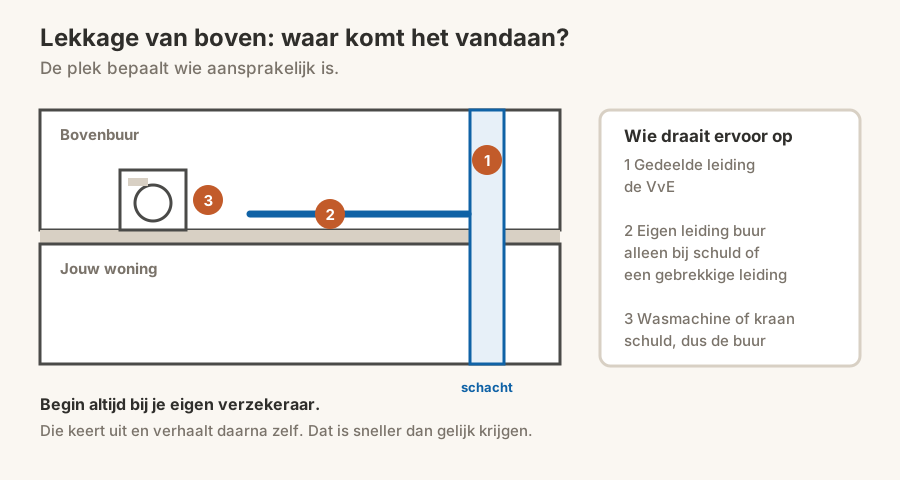
Not automatically your upstairs neighbour. Under Dutch law someone is only liable if they are at fault (article 6:162) or if the pipe was defective and belongs to them (article 6:174). A washing machine hose that fails after ten years is not fault. So report the damage to your own contents insurer first; they pay out and then recover from the neighbour where possible. If the pipe runs through shared parts of the building, the VvE is responsible.
Rather have it done?
Post your job for free. Plumbers near you respond with their own price and you choose. Your money stays safe until you approve the work.
Being liable is not the same as being the cause
This is where most neighbour disputes founder. The fact that the water comes from the flat above does not make that neighbour liable. Dutch law has no strict liability between residents.
There are two routes by which they do have to pay. The first is fault: they left the tap running, they went out with the washing machine on, they drilled into a pipe. That falls under article 6:162, the tort provision.
The second is the defective structure of article 6:174. If the pipe was theirs and did not meet the standards you may expect of it, they are liable even without any blame attaching to them. A pipe that simply grew old usually falls outside this.
Start with your own insurer, not with the neighbour
This feels counterintuitive but it is the fastest route. Your contents insurance covers water damage to your belongings regardless of who caused it. Your buildings insurance covers damage to the property itself if you are the owner.
The insurer pays out and then looks at whether they can recover. That is their job and they are better at it than you, because they have the files and the lawyers.
Meanwhile you do not have to sit with a wet floor for months waiting for someone to admit fault. And you keep the relationship with your neighbour intact, which is worth more in the long run than being proved right.
Consequential damage: the floor, the contents and the rest
The leak itself is one thing, what the water ruins along the way is another. That second part is consequential damage, and it is usually where the argument stalls: repairing the pipe costs a few hundred euro, the laminate floor underneath a few thousand.
The split is less complicated than it looks. Everything that is yours and stands loose in the home falls under your contents insurance: flooring, furniture, appliances. Everything attached to the building falls under buildings insurance, and in an apartment block that is the owners' association collective policy.
Two things decide whether you get paid out, and both are about evidence. Photograph everything before you start drying or clearing up, and have the leak established by someone who writes a report. An insurer who only has your account will settle on your account, and that rarely turns out generous.
- Flooring, furniture and appliances: your contents insurance.
- Plastered ceilings, walls and fitted cupboards: buildings insurance, in a block the association's policy.
- Loss of value on your home: not insured, only recoverable where fault can be shown.
- Alternative accommodation while it dries: some contents policies cover it, check before you book.
- Your excess stays yours, even if the neighbour turns out to be liable.
What to do in the first two hours
The order below matters. Evidence disappears: water dries, stains fade, and an engineer repairing the pipe also removes the proof.
- Shut off the mains if water keeps coming. In a flat this is often in the meter cupboard or by the water meter.
- Switch off the power in the affected room if water is reaching a socket or a ceiling light.
- Photograph everything before you clear up. The ceiling, the floor, your belongings, and where the water is coming from.
- Ring your upstairs neighbour's bell and ask them to turn off the tap or the washing machine. Do this as a report, not as an accusation.
- Report it to your own insurer the same day. Most policies require notification within a short period.
- If you live in a flat, report it to the VvE as well, even if you think shared pipework is not involved.
In a flat: when is it the VvE?
The deed of division decides, and it differs per building. The main rule in most deeds: pipework serving more than one flat is communal, pipework beyond your own stopcock is yours.
A riser or a shaft is therefore almost always the VvE. The connection to your own washing machine almost never is. If it falls in between, read the deed rather than the leaflet.
The VvE holds buildings insurance covering the whole block. When in doubt it is always sensible to report it there too, even if it later turns out the pipe was yours.
- Riser, shaft, roof, facade: communal, so the VvE
- Pipework beyond your own tap or stopcock: private
- Floor coverings and fittings you installed: private
- In doubt: read the deed of division first, argue later
What it costs to find the cause
Tracing a leak is often more expensive than the repair itself, because the pipe is somewhere you cannot see. These are the guide prices we use.
| What | Guide price | Note |
|---|---|---|
| Leak detection | €95 - €150 | often includes the first hour |
| Detection with camera or thermal imaging | €150 - €350 | for pipes in floors or walls |
| Pipe repair, accessible | €90 - €180 | excluding making good the finish |
| Opening and closing floor or wall | €200 - €600 | heavily dependent on the finish |
Guide prices for 2026 including VAT. Call-out fees are often charged separately: €20 to €40 per visit.
When you do not need an expert
Not every damp patch is a leak, and calling someone out for condensation is money wasted.
A damp patch that only appears in winter and moves with cold weather is usually condensation. A patch that grows while nobody is showering and no rain is falling is not.
- Patch unchanged over two dry days: probably old and already repaired
- Only after rain: it is the facade or the roof, not the neighbour
- Only after someone showers above you: it is the sealant or the shower waste
- Visibly growing by the hour: mains off and call immediately
Done reading?
Describe the job in two minutes. Plumbers respond with their price, you compare and choose. Free, with no strings attached.
Post your job for freeFrequently asked questions
My upstairs neighbour will not cooperate. What now?
Report it to your own insurer and to the VvE. The insurer can commission an investigation and has access rights through the VvE that you do not have. A bailiff or a court is only relevant if the damage is large and nobody pays out.
Does my neighbour have to pay my excess?
Only if they are liable. If there is no fault and no defective structure, the excess stays with you. That feels unfair, but it is how the law works.
I rent. Do I report it to the landlord or to the insurer?
Both. The landlord is responsible for repairing the property; your contents insurance covers your belongings. The landlord deals with the building side and the VvE.
How long do I have to report damage?
Most policies say as soon as possible, in practice within a few days. Do not delay: reporting late is one of the few grounds on which an insurer may genuinely refuse.
The leak comes from a pipe in my ceiling. Whose is it?
That is set out in the deed of division. A pipe in the structural floor between two flats is almost always communal, even though it sits in your ceiling.
Can I force my neighbour to replace their washing machine hose?
Not directly. The VvE can set requirements for installations that could cause damage, and after a leak that is a reasonable item to put on the meeting agenda.
The neighbour upstairs will not cooperate. What can I do?
Let your own insurer take it over; they have lawyers and you do not. If you live in an apartment block, report it to the association's board as well, since it can hold an owner to maintaining their own part. If it stays quiet, the last step is the subdistrict court, but up to a few thousand euro in damage that is rarely worth it.
Sources
Every claim on this page comes from one of these sources. They were checked on 30 August 2026. Legislation changes, so check the source itself if anything matters to you.
Tools for your own address
Three things you can check here for free that you will not find like this anywhere else. They run on open data from the Dutch Land Registry, the buildings register and the national energy agency, so the answer applies to your house and not to an average.
This is not legal advice
We set out what the rules say and where they are. Your situation may differ, and in a dispute your own contract, your deed of division or your local council's bylaw takes precedence. If you cannot work it out, Het Juridisch Loket, the Huurcommissie or a lawyer can help.