Is chimney sweeping compulsory and who has to pay for it?
Sources checked on 30 August 2026
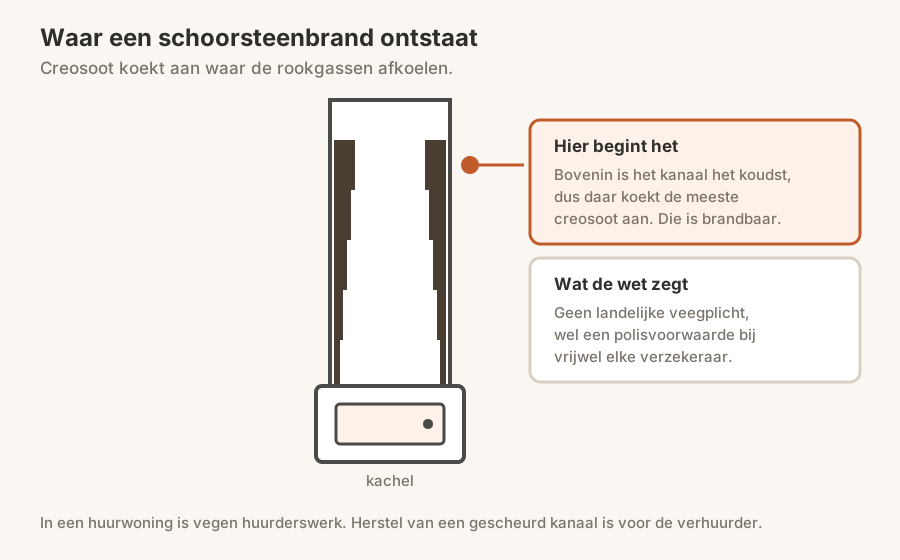
There is no national law making chimney sweeping compulsory. Even so you cannot really avoid it: almost every buildings and contents policy requires an annual sweep for a chimney in use, and after a chimney fire the insurer will ask for the sweep certificate. Some municipalities also impose a sweeping duty in their by-laws. In a rented home, sweeping is the tenant's job under the Besluit kleine herstellingen.
Rather have it done?
Post your job for free. Roofers near you respond with their own price and you choose. Your money stays safe until you approve the work.
No law, but a policy condition
This is the core of the confusion. Search whether sweeping is compulsory and you find both yes and no, because both answers are right in their own way.
Nationally there is no statutory sweeping duty for private households. The Besluit bouwwerken leefomgeving sets requirements for the flue itself, but prescribes no sweeping frequency.
The obligation comes from two other directions. The first is your insurer: nearly every policy states that a flue in use must be swept annually by an approved firm. The second is your municipality; a number of them include a sweeping duty in their by-laws, sometimes with a frequency attached.
The practical effect is the same as a legal duty: skip the sweep, have a fire, and you have a problem with the payout.
What happens if you skip it
In a chimney fire the caked creosote in the flue ignites. That happens at several hundred degrees and flames can reach metres above the chimney. The damage is rarely confined to the flue: the heat travels through the structure and sets alight timbers resting against it.
An insurer may not refuse a payout arbitrarily, but a policy condition you have not met is a valid ground. In practice they will ask for the sweep certificate, which is exactly why you should keep it.
So store the certificate digitally rather than in a drawer. In a fire, a drawer is often precisely what you lose.
The sweeping certificate is the whole point
After a chimney fire an insurer does not ask whether you swept, but whether you can show that you swept. That difference is the entire argument. Without paper it is your word against a claim worth tens of thousands, and the paper that is not there wins.
What counts is an invoice or sweeping certificate from a firm, with the date, the address and what was done. Sweeping yourself with a brush from the DIY store may work perfectly well for safety, but it produces no evidence, and most policies ask explicitly for a recognised firm.
Keep it for at least five years, digitally and somewhere you will find it again. In practice the email with the invoice is enough, as long as you can find it at the moment things go wrong. Add a reminder for the next heating season; that way the sweep itself never quietly lapses either.
- Have it swept before the heating season, so in August or September, while diaries are still empty.
- Ask for an invoice or sweeping certificate showing the date, the address and the work carried out.
- Store it digitally alongside your policy schedule, and set a reminder for next year.
- Read once, in your policy conditions, exactly what it says about maintaining the flue.
- If wood is your main heating, have it swept twice a year and keep both certificates.
In a rental: sweeping is the tenant's job
The Besluit kleine herstellingen explicitly names sweeping chimneys, flues and ventilation ducts as tenant's work. It is one of the few maintenance duties that genuinely sits with the tenant.
That covers the sweeping only. If the flue is damaged, cracked or no longer fit for use, that is a defect and therefore the landlord's.
If you live in a flat with a shared flue, it sits with the VvE and not with you. Check the deed of division if in doubt.
- Sweeping the flue: tenant
- Repairing a crack or a damaged flue: landlord
- Shared flue in a block of flats: VvE
- Never used and never will be: the need falls away, but tell your insurer
How often, and when in the year
The usual standard is once a year with normal use of a wood burner or open fire. If you burn intensively, twice a season is sensible, and with green or wet wood it is necessary.
The best moment is late summer, just before the heating season. In September and October every sweep is fully booked, and by November you will not get one at short notice.
A gas boiler does not need sweeping, but it does need its annual service, during which the flue is checked. That is a different visit and a different trade.
What chimney sweeping costs
Sweeping is one of the cheapest maintenance jobs there is, certainly set against what a chimney fire costs.
| What | Guide price | Note |
|---|---|---|
| Sweeping one flue | €60 - €100 | including sweep certificate |
| Second flue on the same visit | €30 - €50 | discounted because they are already there |
| Camera inspection of the flue | €90 - €175 | when cracks are suspected |
| Relining the flue with a flexible liner | €900 - €2,000 | depends on height and diameter |
| Removing a nest or blockage | €80 - €200 | often only outside the nesting season |
Guide prices for 2026 including VAT. Always ask for a sweep certificate; without that document the visit is worthless for your insurance.
When to stop burning immediately
Some signs mean you let the fire go out and do not wait until a sweep has time. They all point to the same thing: the flue gases are no longer going the right way.
Smoke coming back into the room, a carbon monoxide alarm sounding, or a burning smell in a room with no fire are not inconveniences but warnings.
- Smoke blowing back into the room: stop burning, have the flue checked
- Carbon monoxide alarm sounds: windows open, everyone out, call 112
- Burning smell in another room: call the fire brigade, do not go looking yourself
- Soot particles on the roof or in the garden: a sign of a starting chimney fire
Done reading?
Describe the job in two minutes. Roofers respond with their price, you compare and choose. Free, with no strings attached.
Post your job for freeFrequently asked questions
May I sweep my own chimney?
You may, but it usually does not count for your insurance. Policies nearly always require an approved firm and a sweep certificate. Doing it yourself without documentation has practical value only, not insurance value.
I only light the fire occasionally. Do I still need an annual sweep?
Check your policy, because it rarely makes an exception for light use. If you have stopped burning altogether, tell your insurer; the requirement often falls away then.
My landlord says sweeping is their job. Is that right?
The Besluit kleine herstellingen puts sweeping with the tenant. A landlord may take it on, for example through a service contract, but is not obliged to.
What exactly is creosote?
The tar-like deposit that forms when flue gases cool inside the chimney. It is flammable and it sticks. Burning green or wet wood speeds up its formation considerably, because that produces cooler flue gases.
Does the sweeping requirement apply to a pellet stove?
Yes. Pellets produce less creosote than logs, but still ash and deposits. Manufacturers usually prescribe annual cleaning and insurers treat it as a flue in use.
What does a chimney fire cost if it goes wrong?
It varies widely. Damage confined to the flue often stays under a thousand euros; if the fire spreads to the structure it runs into tens of thousands. That difference is exactly why a sweep of around eighty euros is worth it.
I have lost my sweeping certificate. Can I still put that right?
Ask the firm for a copy; they usually keep invoices for years. If they cannot supply one, have it swept again and keep that certificate, because a recent sweep weighs more than an old one you cannot prove. Report a fire to your insurer immediately either way; withholding it is a bigger problem than a missing invoice.
Sources
Every claim on this page comes from one of these sources. They were checked on 30 August 2026. Legislation changes, so check the source itself if anything matters to you.
Tools for your own address
Three things you can check here for free that you will not find like this anywhere else. They run on open data from the Dutch Land Registry, the buildings register and the national energy agency, so the answer applies to your house and not to an average.
This is not legal advice
We set out what the rules say and where they are. Your situation may differ, and in a dispute your own contract, your deed of division or your local council's bylaw takes precedence. If you cannot work it out, Het Juridisch Loket, the Huurcommissie or a lawyer can help.