How high may a fence be and when do you need a permit?
Sources checked on 30 August 2026
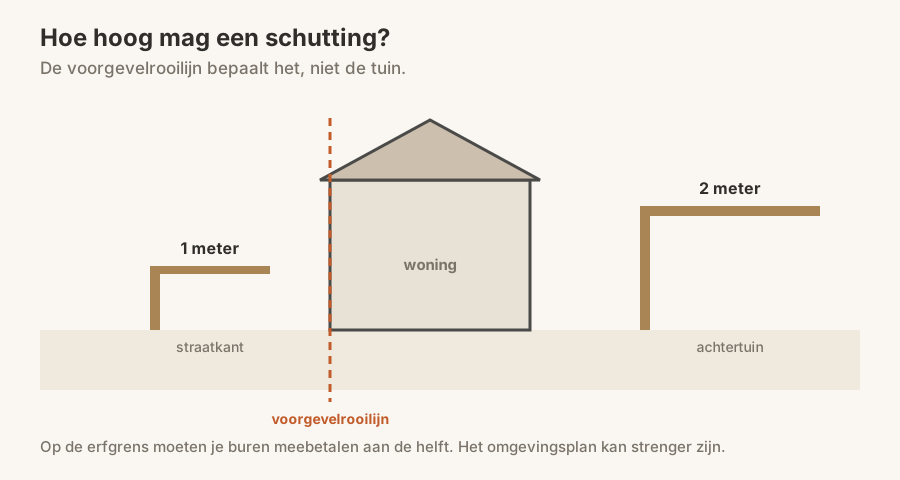
Behind the front building line a fence may be two metres high without an environmental permit. In front of that line, on the street side, one metre is the limit. If the fence stands exactly on the boundary, article 5:49 of the Dutch Civil Code gives you the right to a two-metre partition and your neighbour must contribute half the cost. Your municipality's zoning or environment plan can impose stricter rules, so always check.
Rather have it done?
Post your job for free. Gardeners near you respond with their own price and you choose. Your money stays safe until you approve the work.
Two metres behind, one metre in front
The line that counts is the front building line: the imaginary line along the front of your house. Everything behind it, so your back garden and the part of the side garden behind that line, may be two metres high without a permit.
Everything in front of that line may be one metre. That is why you rarely see a tall fence in a front garden and usually a low hedge instead.
These rules are in the Besluit bouwwerken leefomgeving, which succeeded the old Bor under the Environment Act. The dimensions did not change with the new legislation.
Measure the height from the adjoining ground level, so from the ground as it lies. If you place the fence on a raised bed or a low wall, that counts towards the total.
The local plan can be stricter
Permit-free building does not mean rule-free building. Your municipality may set different dimensions in the environment plan, for example in a protected townscape or an area with a design quality plan.
For a listed building or in a protected townscape the permit-free scope largely disappears, including for a fence.
You can check for free at the Omgevingsloket. Enter your address and the permit check tells you what applies to your plot. That takes five minutes and prevents an enforcement order.
From which point do you measure those two metres?
You measure from ground level right beside the fence, and where two gardens differ in height, that is the higher of the two. If the neighbours' garden sits half a metre higher, your two-metre fence is one and a half on their side and two on yours. The permit-free limit is measured on the high side, so that is where the restriction bites.
A low wall or retaining structure counts. Put a 1.80 fence on a 40 centimetre retaining wall and you have built a 2.20 structure, which needs a permit, even though the panel itself is low enough. This is the mistake most often made in gardens on a slope.
A corner house often has two fronts. A side garden bordering a public road counts as a front, so one metre applies there. If in doubt, use the permit check: it asks about the position rather than about your reading of it.
- Measure from the highest ground level directly beside the fence.
- Count a retaining wall, low wall or raised terrace towards the total height.
- A corner house often has two fronts: a side garden on the road counts as a front.
- A hedge does not fall under these rules, because it is not a structure.
- A fence against a listed building or in a protected townscape is never permit-free.
On the boundary: your neighbour must contribute
Few people know this. Article 5:49 gives you the right to require your neighbour to cooperate in a two-metre partition on the boundary, with the cost shared.
The fence is then joint property, which also means maintenance is shared. You cannot then replace it with something else on your own.
If you do not want those shared costs, or want to decide yourself what the fence looks like, place it entirely on your own land. Then it is yours alone, and you pay for it alone.
Record the agreement, however good the relationship. Neighbours move, and the next owner does not know your verbal arrangement.
- On the boundary: joint ownership, shared cost, shared maintenance
- Entirely on your own land: yours, your cost, your choice
- Always put it in writing, even on good terms
- Unsure where the boundary runs: the Kadaster can mark it out
How to go about it
In this order you avoid the two most expensive outcomes: a fence that has to come down again, and a dispute with your neighbour.
- Run the permit check at the Omgevingsloket using your own address.
- Find out exactly where the boundary runs. If it is not established, the Kadaster can mark it out.
- Discuss it with your neighbour before you order anything, even if you are building on your own land.
- Record what you agree about placement, height, construction and cost.
- Check whether there are cables or pipes where the posts will go. A KLIC notification before digging is free and required.
- Only then start building.
What a fence costs in 2026
The price depends mainly on the material and on whether the ground needs work. Concrete costs more up front and less over twenty years.
| Type | Guide price per metre | Note |
|---|---|---|
| Softwood panels, installed | €90 - €160 | pine or spruce, concrete post and gravel board |
| Hardwood, installed | €160 - €280 | lasts considerably longer |
| Composite, installed | €180 - €320 | maintenance-free |
| Installation only, own materials | €35 - €70 | labour per metre |
| Removing an old fence | €15 - €35 | per metre, including disposal |
Guide prices for 2026 including VAT, for a straight fence on normal ground. Corner posts, gates and work on a slope cost extra.
When you do not need a professional
A short, straight fence on soft ground is one of the few garden jobs that two people can genuinely do in a weekend.
It changes as soon as there is a level difference, hard ground or a long span. A fence that is not plumb blows over, and it often falls the wrong way.
- Straight, under eight metres, soft ground: fine to do yourself
- Level difference or a slope: have it done, the posts need different footings
- Alongside a garage or against a wall: have it done, the fixing is critical
- Paving or services where the posts go: notify before digging
Done reading?
Describe the job in two minutes. Gardeners respond with their price, you compare and choose. Free, with no strings attached.
Post your job for freeFrequently asked questions
May my neighbour paint my fence on their side?
If the fence stands entirely on your land it is yours and your neighbour may not alter it without your permission. If it stands on the boundary and is jointly owned, you both have a say.
What exactly is the front building line?
The imaginary line along the front of your house, extended across the width of your plot. Everything on the street side of it is front garden, everything behind it is rear garden.
May I put a trellis on top of a two-metre fence?
No, the two metres is the total height including anything on top. A trellis or climbing frame counts towards it.
My neighbour refuses to contribute. Can I enforce it?
In principle yes, via article 5:49, but the fence must stand on the boundary and be of a customary type. You cannot demand half the cost of an expensive hardwood fence if a standard panel would do.
Does the two-metre rule apply to a hedge?
No. A hedge is planting, not a structure, so the permit rules do not apply. Neighbour law about distance to the boundary and overhanging branches does.
I rent. May I put up a fence?
That needs the landlord's permission, because you are altering the property. Ask in writing and agree at the same time whether the fence may stay when you leave.
Can I have a three-metre hedge if a fence may only be two?
Yes. A hedge is not a structure, so the permit rules do not apply. Neighbour law still does: a hedge should stand at least half a metre from the boundary, unless the council allows a shorter distance or the neighbours agree. And if it causes demonstrable nuisance, a court can still order it cut back.
Sources
Every claim on this page comes from one of these sources. They were checked on 30 August 2026. Legislation changes, so check the source itself if anything matters to you.
Tools for your own address
Three things you can check here for free that you will not find like this anywhere else. They run on open data from the Dutch Land Registry, the buildings register and the national energy agency, so the answer applies to your house and not to an average.
This is not legal advice
We set out what the rules say and where they are. Your situation may differ, and in a dispute your own contract, your deed of division or your local council's bylaw takes precedence. If you cannot work it out, Het Juridisch Loket, the Huurcommissie or a lawyer can help.