Overhanging branches from next door: what may you remove yourself?
Sources checked on 30 August 2026
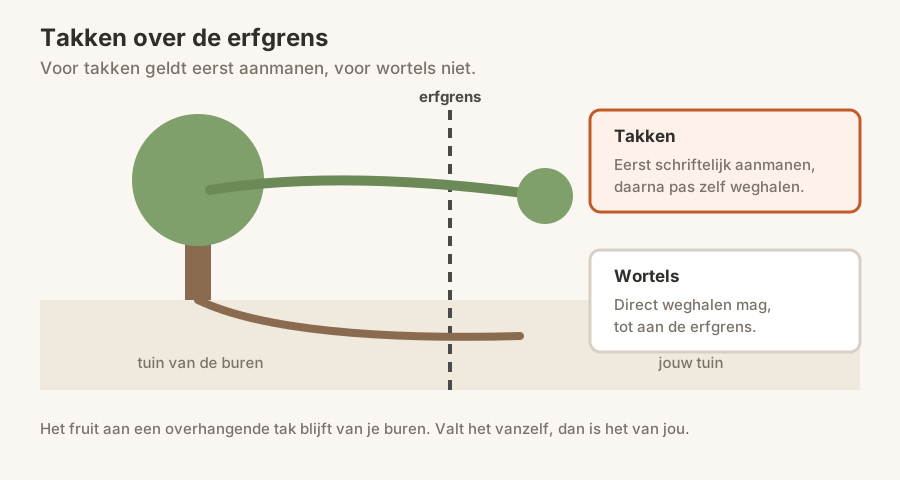
Not immediately. Article 5:44 of the Dutch Civil Code prescribes an order: you first ask your neighbour in writing to remove the branches themselves, and only if they fail to do so within a reasonable period may you do it. That step does not apply to roots, which you may remove straight away up to the boundary. And note: fruit on an overhanging branch remains the neighbour's property.
Rather have it done?
Post your job for free. Gardeners near you respond with their own price and you choose. Your money stays safe until you approve the work.
The law prescribes an order, and you have to follow it
Article 5:44 covers this in two sentences that make all the difference. For branches: you may remove them after formally asking the owner to do it and they fail to comply. For roots no formal request applies; you may remove them straight away.
That difference is not arbitrary. Roots attack your foundations, your paving and your drains, and the damage is invisible until it is large. Branches are visible and the neighbour can remove them without entering your garden.
If you saw off a branch without asking first, you are committing a tort yourself. That sounds heavy for a branch, but on a mature tree the damages can run into thousands and you will be held to it.
How to do it properly, in four steps
The whole matter turns on being able to prove you asked. A conversation over the fence does not exist later on.
- Ask verbally first. In the vast majority of cases that ends the matter and you keep a normal relationship with your neighbours.
- If nothing happens, send a short letter or email. Say which branches, that they hang over your property, and give a reasonable deadline. Four to six weeks is usual outside the nesting season.
- Keep a dated copy. With email that happens automatically; with a letter, photograph the letter and the envelope.
- If the deadline passes without response you may remove the branches up to the boundary. Stay on your side and do not cut beyond the line.
You may prune, but not so far that the tree dies
The right to prune is not a free hand. You may remove what hangs over your side, but you must not damage the tree beyond repair, and you must not use the right to achieve anything other than less overhang. Cut the whole crown away on one side so the tree falls or dies, and that is abuse of the right, leaving you liable for the damage.
In practice: cut up to the boundary and not past it, leave the branch collar intact, and do it in the season the tree can take. For most deciduous trees that is late winter; for a tree that bleeds heavily in spring, such as birch or maple, it is not.
There is one more limit people forget: nests. From March to roughly mid-August there is a real chance of an occupied nest, and that is protected, even in the neighbours' tree. If you see a nest, you wait. That is not advice but a prohibition.
- Cut exactly at the boundary, not past it, and not into the trunk or the branch collar.
- Never take more than about a quarter of a crown in one go: that is the point where a tree gets into trouble.
- Do large branches in late winter, and never in frost.
- Check for nests and, if in doubt, wait until after mid-August.
- The cuttings belong to the tree's owner: put them back or ask whether you may dispose of them.
Watch the nesting season and the felling permit
Roughly between mid-March and mid-July birds are nesting. The Environment Act prohibits deliberately disturbing nests, and that applies in your own garden and to a branch hanging across the boundary. If there is a nest, you wait.
You may also need a felling permit. That is arranged locally and varies widely: some municipalities require a permit above a certain trunk diameter, others keep a list of protected trees. Pruning usually falls outside it, but cutting a tree back hard can be treated as felling.
Check your municipality's by-law before you start. A tree that turns out to have needed a permit is worth a fine, and the tree does not come back.
The fruit stays the neighbour's
This surprises almost everyone. An apple growing on an overhanging branch belongs to the owner of the tree, even where it hangs over your garden. So picking it is not allowed.
If the apple falls of its own accord onto your land, it does become yours. That follows from article 5:36 on fruit falling onto another's property. In practice nobody litigates over this, but it is useful to know which side you are on if the conversation heads that way.
What it costs to have it done
Climbing a tree yourself with a chainsaw is one of the ways people genuinely get hurt. These are the guide prices if you have it done.
| What | Guide price | Note |
|---|---|---|
| Pruning a small tree from the ground | €75 - €150 | per tree, including small clippings |
| Pruning with climbing work | €250 - €600 | landscapers charge per half day here |
| Felling a tree up to 6 metres | €300 - €700 | excluding stump grinding |
| Stump grinding | €100 - €250 | depending on diameter |
| Removal of green waste | €40 - €120 | per cubic metre |
Guide prices for 2026 including VAT. Work on a public road sometimes requires traffic measures, charged separately.
When you are better off doing nothing
There are situations where you are legally in the right and it is still wiser to wait.
Cutting a tree back hard on one side can make it unstable. If it then falls on your shed, the question of who caused that suddenly becomes your problem. On a large tree, always have a landscaper look before you remove a branch that really matters.
- Nest in the branch: wait until after mid-July
- Branch thicker than your wrist on an old tree: landscaper first
- Tree is on the municipal list: call the council first
- Neighbour is willing but needs time: give it, and put it in writing
Done reading?
Describe the job in two minutes. Gardeners respond with their price, you compare and choose. Free, with no strings attached.
Post your job for freeFrequently asked questions
How long is a reasonable deadline for the request?
The law names no period. Four to six weeks is usual and defensible, outside the nesting season. Where there is immediate danger, such as a branch threatening your roof, that period may be shorter.
Can I throw the cut branches back over the fence?
No. Once cut, the branches become your property and therefore your waste. Throwing them over the fence is dumping waste on someone else's land.
My neighbour planted the tree right on the boundary. Is that allowed?
Article 5:42 names two metres for trees and half a metre for shrubs, measured from the boundary. Municipalities may set different distances in a by-law and often do, so check. The right to demand removal also lapses after twenty years.
Roots from next door are lifting my paving. What may I do?
You may remove roots up to the boundary straight away, without a formal request. Be careful though: cutting thick roots can destabilise the tree, and then liability shifts.
Who pays for pruning if the neighbour does it themselves?
The owner of the tree. If they do not and you do it yourself after a formal request, you can in principle recover the reasonable costs, but that requires you to be able to prove the request.
Does this also apply to a hedge?
Yes, the same rules. A hedge growing across the boundary counts as overhanging planting, so again: ask first for branches, remove roots straight away.
The neighbours will not prune and do not respond. What now?
Then you may prune yourself, provided you asked in writing and gave a reasonable deadline. For a large tree six weeks is usually considered reasonable, partly because the pruning season counts. Keep the letter and proof of delivery: without that evidence of notice you are in a weak position afterwards, even when you are right.
Sources
Every claim on this page comes from one of these sources. They were checked on 30 August 2026. Legislation changes, so check the source itself if anything matters to you.
Tools for your own address
Three things you can check here for free that you will not find like this anywhere else. They run on open data from the Dutch Land Registry, the buildings register and the national energy agency, so the answer applies to your house and not to an average.
This is not legal advice
We set out what the rules say and where they are. Your situation may differ, and in a dispute your own contract, your deed of division or your local council's bylaw takes precedence. If you cannot work it out, Het Juridisch Loket, the Huurcommissie or a lawyer can help.